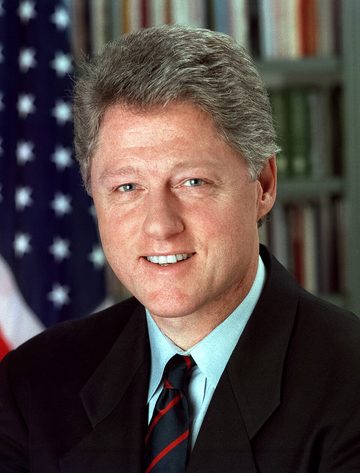
Official portrait
President #42
Bill Clinton
1946–
Leadership Style
Clinton governed as a high-energy political polymath — a Rhodes Scholar with a small-town Arkansas politician's tactile grasp of voters. He absorbed policy detail at extraordinary speed, ran cabinet meetings as graduate seminars, and could pivot ideologically without apparent self-consciousness ('triangulation,' Dick Morris called it). His first two years overreached — health care reform collapsed, the 1994 midterms produced the first Republican House majority in forty years — and the rest of his presidency was a master class in working with a hostile Congress. He felt every voter's pain, sometimes literally, and his personal magnetism could mask serious policy substance. His self-discipline was famously incomplete in ways that nearly destroyed him.
Greatest Accomplishments
Clinton presided over the longest peacetime expansion in U.S. history (March 1991 to March 2001 — he inherited it from Bush but extended it for 120 months). He balanced the federal budget — the first surplus since 1969 (FY 1998) and three more after, the last surpluses the U.S. has run. He signed NAFTA (December 1993) and brought China into the WTO (December 2000), defining the globalized trade order of the next twenty years. He signed welfare reform (PRWORA, 1996), which moved millions from cash assistance to work and which the left has alternately credited and blamed for two decades. He intervened in Bosnia (Dayton Accords, 1995) and Kosovo (1999), stopping ethnic cleansing in both. He pursued the Israeli-Palestinian peace process to Camp David II (2000) — which failed but came closer than anything since.
Greatest Failures
The Monica Lewinsky scandal and the impeachment that followed defined his second term's public memory. He lied under oath in his January 1998 deposition in the Paula Jones lawsuit ('I did not have sexual relations with that woman, Miss Lewinsky'), was impeached by the House in December 1998 on perjury and obstruction of justice charges, and was acquitted by the Senate in February 1999 (55–45 on perjury, 50–50 on obstruction, well short of the two-thirds needed for removal). He humiliated his family, his party, and the office. He left the country exhausted by a year of scandal coverage that displaced substantive governance. The reputational rehabilitation that followed (high approval ratings, post-presidency philanthropy) is real but does not erase the harm.
Greatest Challenge
After the 1994 midterms — when Newt Gingrich's Contract with America delivered Republican control of both chambers for the first time since 1954 — Clinton faced the hardest legislative environment of any postwar Democratic president. He chose accommodation over confrontation, triangulating between his own party's left and the new Republican majority. The 1995 government shutdown (December 1995–January 1996) was the first major test, and Clinton won it by patiently waiting Gingrich out. He had to navigate Bosnia, Kosovo, Rwanda (where his administration failed to intervene during the 1994 genocide — a failure he has publicly acknowledged), the rise of al-Qaeda (the 1993 World Trade Center bombing, 1998 East African embassy bombings, 2000 USS Cole), and the dot-com boom and bust all while his personal conduct created openings his political enemies exploited.
Quotes & Slogans
Campaign 1992: 'It's the economy, stupid' (internal campaign sign by James Carville). Inaugural (1993): 'There is nothing wrong with America that cannot be cured by what is right with America.' 1996 State of the Union: 'The era of big government is over.' Apology (August 17, 1998): 'I misled people, including even my wife. I deeply regret that.' On himself: 'I feel your pain.' On the 1990s: 'It depends on what the meaning of the word is is' — perjury defense that became cultural shorthand. On work: 'There is no problem so big that it cannot be solved by hard work and intelligence applied with persistence.'
Economic Data
The Clinton economy was the strongest sustained expansion since the 1960s. GDP grew 3.8% annually on average. Unemployment fell from 7.5% to 4.0% — the lowest in thirty years. Inflation averaged 2.6%. Twenty-three million jobs were created. The Dow tripled from 3,300 to over 10,500. The S&P 500 returned 17% annually. The federal budget moved from $290 billion deficit in 1992 to $236 billion surplus in 2000. Median household income rose 14% in real terms — the only postwar period where working-class incomes rose substantially. The top marginal tax rate increased from 31% to 39.6% (OBRA 1993, which passed without a single Republican vote and contributed to deficit reduction). The repeal of Glass-Steagall (1999) sowed seeds for 2008.
Quality of Life
The 1990s felt, in retrospect, like a holiday from history — the Cold War over, terrorism still a distant threat, the economy roaring, the internet emerging without yet having transformed everything. Americans gained the World Wide Web (Mosaic browser 1993, Netscape 1994), email as default communication, AOL CDs in every mailbox, the dot-com boom and bust. Cell phones went from luxury to ubiquity. Friends, Seinfeld, and The Sopranos defined television. Life expectancy reached 76.8. Crime fell sharply — violent crime dropped 33% during the decade — for reasons economists still debate. Same-sex marriage was not yet a possibility (DOMA, which he signed in 1996, defined marriage federally as between a man and a woman; he has since said he was wrong to sign it). The country left the decade more prosperous, more connected, and more politically polarized than it had entered.