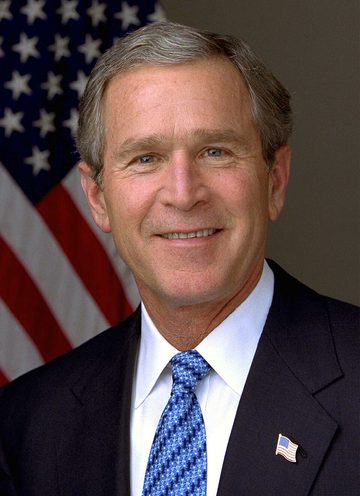
Official portrait
President #43
George W. Bush
1946–
Leadership Style
Bush 43 governed as a decisive, faith-grounded executive — Yale and Harvard MBA, former Texas governor, recovering alcoholic whose 1986 conversion experience shaped his presidency. He preferred clear principles to nuance, gut decisions to extended deliberation, and loyalty in his inner circle. He delegated heavily — Vice President Dick Cheney's influence on foreign and security policy was unprecedented — and trusted his instincts in moments his critics considered the wrong time to. He was warmer in person than on camera, disciplined about his schedule (in bed by 10, up by 5, daily exercise), and dismissive of polling. After 9/11 he became a wartime president and saw most of his subsequent decisions through that frame. His approval rating ranged from 90% (post-9/11) to 25% (final year) — the largest swing in polling history.
Greatest Accomplishments
Bush's post-9/11 leadership in the immediate aftermath — the bullhorn moment at Ground Zero on September 14, 2001, the joint session address on September 20 ('whether we bring our enemies to justice, or bring justice to our enemies, justice will be done'), the rapid removal of the Taliban from power in Afghanistan by December 2001 — held a traumatized country together. PEPFAR (President's Emergency Plan for AIDS Relief, 2003) committed $15 billion (later expanded) to fighting HIV/AIDS in Africa and has saved an estimated 25 million lives — the largest public health intervention in history, and the most underappreciated American foreign policy accomplishment of the twenty-first century. No Child Left Behind (2002) imposed federal accountability standards on K–12 education. The Medicare Modernization Act (2003) added prescription drug coverage. His response to the 2008 financial crisis — TARP, the bank capitalization, the auto bridge loans — was the unpopular emergency action that prevented a depression.
Greatest Failures
The 2003 invasion of Iraq is the defining policy failure of his presidency. The intelligence asserting Saddam Hussein possessed weapons of mass destruction was wrong (the Senate Intelligence Committee report and the Duelfer Report both established this). The invasion succeeded militarily within weeks; the occupation collapsed into insurgency, sectarian civil war, and the eventual rise of ISIS. Roughly 4,500 American service members died, tens of thousands were wounded, and Iraqi civilian deaths are estimated between 150,000 and 600,000+. The cost reached $2 trillion. Hurricane Katrina (August 2005) and the federal response — the FEMA failure, 'Brownie, you're doing a heck of a job,' images of New Orleans residents trapped on rooftops — broke public trust in his administration's competence. The 2008 financial crisis happened on his watch, regardless of how he managed it.
Greatest Challenge
He was eight months into his presidency on September 11, 2001 — the worst attack on American soil in history, 2,977 dead, the World Trade Center towers fallen, the Pentagon hit, Flight 93 crashed in Pennsylvania. The entire structure of American foreign and security policy had to be rebuilt in months: the Department of Homeland Security, the USA PATRIOT Act, the Authorization for Use of Military Force, the wars in Afghanistan and Iraq, Guantanamo, the enhanced interrogation program (which he authorized and which subsequent investigation established constituted torture). The 2008 financial crisis hit in September of his final year, with Lehman Brothers' collapse, the AIG bailout, and the largest market drop since 1929. He spent the last hundred days of his presidency preventing a depression he handed to his successor.
Quotes & Slogans
At Ground Zero (September 14, 2001): 'I can hear you. The rest of the world hears you. And the people who knocked these buildings down will hear all of us soon.' To Congress (September 20, 2001): 'Every nation, in every region, now has a decision to make. Either you are with us, or you are with the terrorists.' On Iraq: 'Mission Accomplished' (banner on USS Abraham Lincoln, May 1, 2003 — became the iconic image of premature triumphalism). Campaign 2000: 'Compassionate conservatism.' On nuance: 'I'm a uniter, not a divider.' On himself: 'I'm the decider, and I decide what is best.' Final press conference (January 12, 2009): 'I disagree with this assessment that, you know, that people view America in a dim light.' Post-presidency he has been notably quiet about his successors.
Economic Data
Bush inherited the dot-com bust and ended with the worst financial crisis since 1929. GDP growth averaged 1.7% — the weakest of any modern two-term president. He inherited a $236 billion surplus and left a $1.4 trillion deficit. Two major tax cuts (2001 and 2003) reduced top marginal rates from 39.6% to 35%, dropped capital gains and dividend rates, and added an estimated $1.5–1.7 trillion to the debt over a decade (CBO estimates). Unemployment ranged from 4.2% to 7.8%, ending at 7.8% in the financial crisis. The Dow fell 25% during his term net — from 10,587 to 7,949. The 2008 crisis erased roughly $11 trillion in household wealth. TARP (October 2008) committed $700 billion to stabilize the financial system, most of which was eventually repaid with interest.
Quality of Life
The Bush years reshaped American daily life through the security state and the smartphone. Air travel became permanently more invasive. TSA was created (November 2001). The iPhone launched in June 2007. Facebook went live in 2004; YouTube in 2005; Twitter in 2006. The housing bubble inflated and then burst — 10 million Americans lost homes to foreclosure over the next several years. Hurricane Katrina killed 1,392 and displaced a million people. The Iraq War cast a generation-long shadow over American foreign policy consensus. Life expectancy rose to 78.0. The country was demographically more diverse (the 2000 Census reflected the post-1965 immigration wave), more digitally connected, and politically more polarized than it had been in 2001 — the partisan gap that defines our current era widened sharply under Bush.