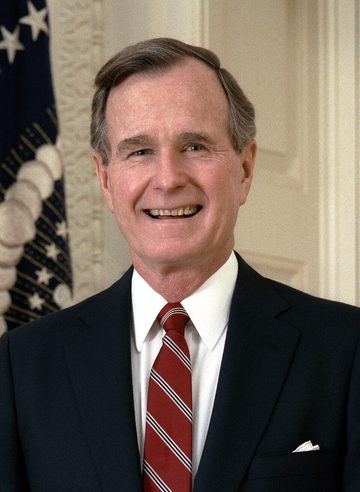
Official portrait
President #41
George H. W. Bush
1924–2018
Leadership Style
Bush governed as a New England-bred Texas oilman with the deepest foreign policy résumé of any modern president: WWII naval aviator (shot down over the Pacific at 20), congressman, U.N. ambassador, envoy to China, CIA director, Vice President for eight years. He managed by personal relationship — his Rolodex of foreign leaders was unmatched, and his diplomacy was conducted through phone calls he often made himself. He distrusted ideology and preferred competence. He was uncomfortable on television, awkward in scripted moments, and at his best in crisis when his prudence and experience compounded. He had what his speechwriter Peggy Noonan called 'the vision thing' problem — he could manage the world but struggled to articulate where it was going, which became politically fatal in 1992.
Greatest Accomplishments
Bush managed the peaceful end of the Cold War — arguably the largest geopolitical transition of the twentieth century — without triumphalism that would have humiliated Moscow into resistance. The Berlin Wall fell on November 9, 1989, ten months into his term; he deliberately declined to celebrate publicly to avoid provoking Soviet hardliners. He negotiated German reunification within NATO (October 1990) — a result Soviet leaders had vowed never to accept. He held together a 35-nation coalition for the Gulf War (Operation Desert Storm, January–February 1991), expelled Iraq from Kuwait in 100 hours of ground combat with 148 American combat deaths, and then declined to march on Baghdad — restraint his son would not match. He signed the Americans with Disabilities Act (July 1990), the Clean Air Act amendments (1990), and START I (July 1991, with Gorbachev).
Greatest Failures
At the 1988 Republican convention, Bush had pledged: 'Read my lips: no new taxes.' In the 1990 budget agreement with Democrats, facing a deficit explosion inherited from Reagan, he raised taxes. The decision was substantively defensible — the deal also constrained spending and contributed to the deficit reduction that produced the 1990s surplus — but it broke the central promise of his campaign. The right of his party never forgave him. Pat Buchanan challenged him in the 1992 primaries and won 38% in New Hampshire. Ross Perot's third-party candidacy captured 19% of the general election vote, drawing disproportionately from former Bush voters. Bush won 37.4% in the general — one of the worst showings for an incumbent in the twentieth century.
Greatest Challenge
He had to navigate the most uncertain strategic transition of the postwar era without a doctrine. The Soviet Union dissolved on December 25, 1991. Fifteen new states emerged. Yugoslavia began coming apart in 1991. China's Tiananmen Square massacre (June 1989) tested his commitment to the U.S.-China relationship he had personally built. Saddam Hussein invaded Kuwait (August 1990). The savings-and-loan crisis required a $124 billion taxpayer bailout (FIRREA 1989). The 1990–91 recession, though shallow by historical standards, lingered politically through the 1992 campaign and made his foreign policy successes feel irrelevant to voters worried about jobs. He had to manage the entire post-Cold-War world simultaneously with a domestic economy that felt stuck.
Quotes & Slogans
1988 convention: 'Read my lips: no new taxes.' Inaugural (1989): 'A new breeze is blowing, and a world refreshed by freedom seems reborn.' On the 'vision thing' — his own self-aware liability. On the Gulf War: 'This will not stand, this aggression against Kuwait.' On collapse of the USSR: 'A world once divided into two armed camps now recognizes one sole and preeminent power, the United States of America' (January 1992 State of the Union). Campaign 1988: 'Kinder, gentler nation' and 'A thousand points of light.' His handwritten note to Bill Clinton on the Oval Office desk (January 20, 1993): 'Your success now is our country's success. I am rooting hard for you.'
Economic Data
Bush inherited Reagan's expansion in its eighth year and the deficit it had produced. The 1990–91 recession was relatively mild — GDP contracted 1.4% peak-to-trough, unemployment rose from 5.3% to 7.8% by mid-1992 — but the recovery was sluggish and 'jobless,' which became the defining political fact of 1992. Inflation stayed around 3–4%. The 1990 budget deal raised the top marginal rate from 28% to 31%, capped some deductions, and instituted PAYGO rules that disciplined spending for the next decade. The Dow rose from 2,168 at inauguration to 3,309 at exit — a 53% gain that voters did not feel because median wages were stagnant. He left an economy that was structurally recovering but politically poisoned.
Quality of Life
The early 1990s were a moment of strategic optimism and domestic anxiety. The Cold War ended without a shot fired between superpowers. The Hubble Space Telescope launched (1990). The World Wide Web was invented at CERN (1989) and the first website went online during his term (1991). Grunge music, Nirvana, and Pearl Jam captured a Generation X malaise. The Los Angeles riots (April 1992, following the Rodney King verdict) showed urban racial tensions had not healed. Life expectancy reached 75.4. The crack epidemic peaked. The first Gulf War became the first 'cable news war' — CNN's Baghdad coverage created modern wartime television.