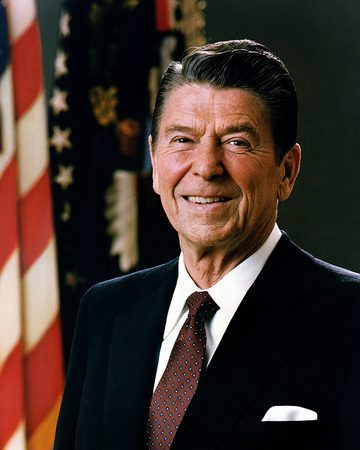
Official portrait
President #40
Ronald Reagan
1911–2004
Leadership Style
Reagan led through clarity of conviction, delegated execution, and televised performance. A former actor, sportscaster, and General Electric corporate spokesman, he understood the modern presidency as primarily a communicative office. He set a handful of priorities — tax cuts, defense buildup, confronting the Soviets, deregulation — and let his cabinet implement them. He was famously detached from operational detail (the diary entries and cabinet records reveal a less hands-on president than his admirers admit and a more strategically intentional one than his critics conceded). He projected optimism in a way no postwar president had since FDR. He believed America was right, the Soviet Union was wrong, and history was going to vindicate the first over the second — and he turned out to be correct.
Greatest Accomplishments
Reagan accelerated the end of the Cold War. He confronted the Soviet Union with sustained pressure — a defense buildup that drove Moscow toward economic exhaustion, the Strategic Defense Initiative ('Star Wars') that frightened Soviet planners even though it never deployed, the 'Evil Empire' rhetoric that put moral weight behind the contest — and then, when Mikhail Gorbachev emerged in 1985, he pivoted to engagement. Four summits (Geneva 1985, Reykjavik 1986, Washington 1987, Moscow 1988) and the INF Treaty (December 1987, eliminating an entire class of intermediate-range nuclear missiles) reshaped the strategic balance. The Berlin Wall fell ten months after he left office. Domestically, the Economic Recovery Tax Act of 1981 and the Tax Reform Act of 1986 cut top marginal rates from 70% to 28% and broadened the base — the most significant tax restructuring since 1913.
Greatest Failures
The Iran-Contra Affair (revealed November 1986) was the constitutional low point of his presidency. The administration secretly sold arms to Iran — an embargoed state and a sponsor of terrorism — to fund the Contras in Nicaragua after Congress had explicitly prohibited such funding via the Boland Amendments. The Tower Commission found Reagan had not known the operational details but had created a White House where such an operation was possible. Eleven officials were convicted (most later pardoned by George H. W. Bush). The federal deficit tripled under his administration, from $79 billion in 1981 to $221 billion in 1986; the national debt nearly tripled, from $994 billion to $2.85 trillion. His indifference to the early AIDS epidemic — he did not publicly mention the disease until 1985, four years and 12,000 deaths in — is a serious moral failure that historians have increasingly emphasized.
Greatest Challenge
He inherited stagflation, 21% prime rates, a hostage crisis just resolved, and an American public that had lost faith in the presidency, the economy, and the country's place in the world. Within ten weeks of taking office (March 30, 1981), he was shot by John Hinckley Jr. outside the Washington Hilton and nearly died — the bullet stopped an inch from his heart. His recovery, conducted with public good humor ('Honey, I forgot to duck'), reset his political standing. The 1981–82 recession was the worst since the 1930s — unemployment hit 10.8% in November 1982 — and his approval cratered to 35%. The recovery that followed, accelerated by Volcker's eventual rate cuts and Reagan's tax cuts, vindicated him politically and produced the 49-state landslide of 1984.
Quotes & Slogans
Campaign 1980: 'Are you better off than you were four years ago?' Campaign 1984: 'It's morning again in America.' Brandenburg Gate (June 12, 1987): 'Mr. Gorbachev, tear down this wall!' First inaugural (1981): 'Government is not the solution to our problem; government is the problem.' On the assassination attempt: 'Honey, I forgot to duck.' Challenger memorial (January 28, 1986): 'They slipped the surly bonds of Earth to touch the face of God.' Farewell address (1989): 'I've spoken of the shining city all my political life... a tall, proud city built on rocks stronger than oceans.' On government: 'The nine most terrifying words in the English language are: I'm from the government, and I'm here to help.'
Economic Data
Reagan presided over the second-longest peacetime expansion in U.S. history (92 months from November 1982 to July 1990, continuing into Bush 41). GDP averaged 3.5% annual growth. Unemployment fell from 10.8% in 1982 to 5.3% by 1989. Inflation collapsed from 13.5% (1980) to 4.1% (1988). The Dow tripled from 950 to over 2,800. Twenty million jobs were created. But the federal debt nearly tripled (from $994 billion to $2.85 trillion), the trade deficit ballooned, and income inequality began the long widening that has continued. Top marginal income tax rate fell from 70% to 28%. The 1986 Tax Reform Act, passed with Democratic cooperation, broadened the base and closed loopholes — a model of bipartisan structural reform.
Quality of Life
Reagan-era America experienced both renewed confidence and widening inequality. The personal computer (IBM PC 1981, Macintosh 1984) entered American homes. MTV launched (August 1981). The Cosby Show and the Reagan recovery converged in a televised optimism. Cable television, the VCR, and the compact disc transformed media. The 1984 Los Angeles Olympics (boycotted by the Soviets but a domestic triumph) became a patriotic moment. Crack cocaine devastated inner cities starting in 1984. AIDS killed 89,000 Americans by his exit, and the federal response was scandalously slow. Homelessness became visible as deinstitutionalization combined with rent inflation. Life expectancy rose to 74.9. Real median household income rose roughly 11%.