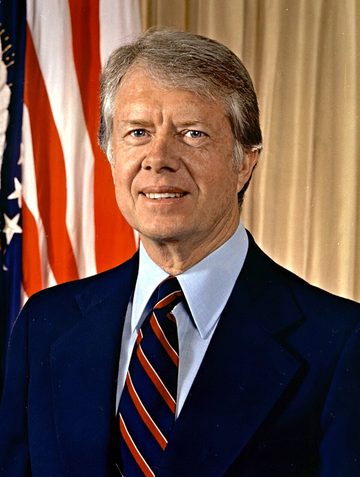
Official portrait
President #39
Jimmy Carter
1924–2024
Leadership Style
Carter governed as an engineer and a moralist — a Naval Academy graduate, nuclear submarine officer, peanut farmer, and Sunday school teacher who believed in detail and conviction in roughly equal measure. He read briefing books cover to cover, sometimes managed the White House tennis court schedule personally, and was famously immune to the social rituals of Washington. He campaigned as a Washington outsider after Watergate and governed as one — which meant he never built the congressional relationships even with his own party that a president needs to move legislation. He told Americans hard truths at a moment they wanted reassurance. He was the most personally decent president of the postwar era and one of the least politically effective.
Greatest Accomplishments
The Camp David Accords of September 1978 — thirteen days of Carter personally mediating between Egyptian President Anwar Sadat and Israeli Prime Minister Menachem Begin at the presidential retreat — produced the framework that became the Egypt-Israel peace treaty of March 1979. It was the first peace agreement between Israel and an Arab state and has held for forty-seven years. He also negotiated the Panama Canal treaties (1977, returning canal sovereignty to Panama in 1999), normalized relations with China (January 1979), signed SALT II (June 1979, though never ratified by the Senate), created the Departments of Energy and Education, deregulated airlines, trucking, and rail, and pardoned Vietnam draft evaders on his second day in office.
Greatest Failures
The Iran hostage crisis defined and destroyed his presidency. After the Shah was overthrown in February 1979 and admitted to the U.S. for medical treatment in October, Iranian students seized the U.S. embassy in Tehran on November 4, 1979, taking 52 Americans hostage for 444 days. Operation Eagle Claw, the April 1980 military rescue attempt, ended in disaster in the Iranian desert — eight servicemen killed, helicopters crashed, no hostages reached. The hostages were released on January 20, 1981, the moment Reagan took the oath — a final humiliation. The July 1979 'malaise speech' (he never used the word) diagnosed American spiritual exhaustion accurately but landed as defeatism. Stagflation, gas lines, and 21% prime interest rates by 1980 sealed his electoral fate.
Greatest Challenge
He inherited an energy crisis that he correctly identified as structural — American dependence on imported oil at the mercy of OPEC and Middle Eastern instability — but for which there was no politically palatable solution. The 1979 Iranian Revolution triggered a second oil shock. Inflation hit 13.5% in 1980. Paul Volcker, whom Carter appointed Fed chairman in August 1979, broke inflation by raising rates to 20% — which broke the economy in the short term too. The Soviets invaded Afghanistan in December 1979, ending détente. Carter was simultaneously fighting inflation, energy shortages, hostages, Soviet expansion, and a primary challenge from Ted Kennedy. Few presidents have faced more crises simultaneously with fewer political resources.
Quotes & Slogans
Campaign: 'A Leader, for a Change.' Inaugural (1977): 'I have no new dream to set forth today, but rather urge a fresh faith in the old dream.' 'Crisis of Confidence' speech (July 15, 1979): 'The threat is nearly invisible in ordinary ways. It is a crisis of confidence. It is a crisis that strikes at the very heart and soul and spirit of our national will.' On the Soviets in Afghanistan: 'My opinion of the Russians has changed most drastically in the last week.' On himself: 'I will never lie to you' — a campaign promise he kept, which was both his moral signature and his political weakness.
Economic Data
Carter's economy was the worst since the Great Depression and remained so until 2008. Inflation rose from 6.5% in 1977 to 13.5% in 1980. Prime interest rates hit 21.5% in December 1980. Unemployment averaged 6.5–7.5%. The Misery Index (inflation plus unemployment) reached 21.98 in June 1980 — the highest since World War II. Gas prices doubled. Real median household income fell. The Dow ended his term roughly flat in nominal terms — meaning down sharply in real terms. He appointed Volcker, whose monetary tightening eventually broke inflation but at the cost of the 1981–82 recession that Reagan inherited and survived politically. His deregulation of transportation industries delivered long-term gains his successor reaped.
Quality of Life
The late 1970s were a low point in American self-confidence. Gas lines wrapped around blocks. The Three Mile Island nuclear accident (March 1979) traumatized public faith in technology. Stagflation hit working families hardest — savings eroded, mortgage rates put homeownership out of reach. The Sony Walkman launched (1979). The first commercial cellular call was demonstrated. Skylab fell from orbit (July 1979). Life expectancy reached 73.7. Cultural malaise was the literal subject of Carter's most famous speech. The hostage crisis played out nightly on television — Ted Koppel's 'America Held Hostage' became Nightline. Yet Carter's post-presidency, working for Habitat for Humanity and through the Carter Center, rehabilitated his reputation more thoroughly than any predecessor's.