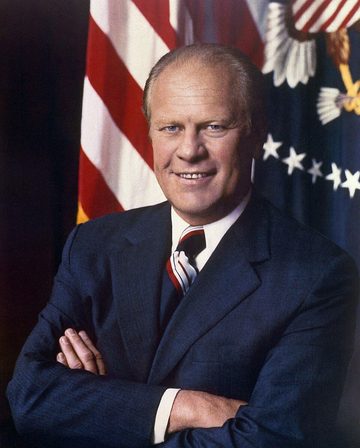
Official portrait
President #38
Gerald Ford
1913–2006
Leadership Style
Ford was the most ordinary person to occupy the modern presidency, and the country needed exactly that. A twenty-five-year congressman from Michigan, former House Minority Leader, decent, unpretentious, slow to anger and slower to lie, he was the constitutional substitute the Twenty-fifth Amendment was designed to produce. He governed by consultation, kept an open Oval Office door, and made decisions without theatrical agonizing. He had no national constituency, no electoral mandate (he is the only person to serve as both Vice President and President without being elected to either), and he treated the office as stewardship rather than personal achievement. His Eagle Scout earnestness was either reassuring or insufficient depending on the observer's mood.
Greatest Accomplishments
Ford restored basic functional integrity to a presidency that had been an organized criminal enterprise. He filled the executive branch with people who actually believed in the Constitution. He signed the Helsinki Accords (August 1975), which committed Eastern Bloc governments to human rights principles their dissidents — Sakharov, Havel, the Soviet refuseniks — would use against them for the next fifteen years; historians now credit Helsinki as a quiet but real Cold War turning point. He kept the country out of new wars during the chaotic post-Vietnam moment. He vetoed 66 bills, more per month than any president since Cleveland, holding the line on inflationary spending. He picked John Paul Stevens for the Supreme Court — a quietly excellent choice who served 35 years.
Greatest Failures
On September 8, 1974, one month into office, Ford issued a 'full, free, and absolute pardon' to Richard Nixon for all federal crimes he 'committed or may have committed' as president. His approval rating dropped 22 points overnight, from 71% to 49%. His press secretary resigned. Whether the pardon was statesmanship (sparing the country a years-long Nixon trial that would have paralyzed national attention) or corruption (rumors of a deal that Ford denied to his grave and that no evidence ever supported) became the definitional question of his presidency. He testified voluntarily before a House subcommittee in October 1974 — the first sitting president to testify before Congress since Lincoln — and insisted there was no deal. The pardon almost certainly cost him the 1976 election.
Greatest Challenge
He inherited a presidency at the absolute floor of public trust, an economy in stagflation, Saigon falling on April 30, 1975 (the iconic helicopter evacuation of the U.S. embassy happened on his watch), the Mayaguez incident in May 1975, and a country tired of crisis. He faced two assassination attempts within seventeen days in September 1975 (Squeaky Fromme in Sacramento, Sara Jane Moore in San Francisco). He had to negotiate with a Democratic Congress that had won 49 House seats in the post-Watergate 1974 midterms and was determined to reassert legislative power — the War Powers Resolution had passed over Nixon's veto in 1973, the Budget and Impoundment Control Act in 1974, and Ford could not get most of his agenda through.
Quotes & Slogans
On taking the oath: 'My fellow Americans, our long national nightmare is over.' Pardon address (September 8, 1974): 'I have searched my conscience and I am certain it is right.' His 'WIN' campaign — Whip Inflation Now, complete with red lapel buttons — became a national punchline. On himself: 'I'm a Ford, not a Lincoln.' On the presidency: 'Truth is the glue that holds government together.' On his pardon decades later, after Senator Edward Kennedy gave him the Profile in Courage Award in 2001: history had largely come around to viewing the pardon as the right call.
Economic Data
Ford inherited 11% inflation and 9% unemployment — stagflation that conventional economics could not explain. He prioritized inflation first, took the recession that came with that choice, and inflation fell from 12.3% in 1974 to 4.9% by 1976. Unemployment peaked at 9.0% in May 1975, then declined. GDP contracted 0.5% in 1974, then grew 5.4% in 1976. The Dow recovered from the Watergate-era lows. He pushed deregulation that bore fruit under Carter — the Airline Deregulation Act was being designed during his term. His vetoes of Democratic spending bills held federal expenditure growth roughly in check. He left office with the economy clearly recovering, which his successor inherited and his successor's successor took credit for.
Quality of Life
The Bicentennial in July 1976 was the cultural highlight of his presidency — tall ships in New York Harbor, fireworks over the Capitol, a national exhale after Vietnam and Watergate. Disco was at its peak. Star Wars premiered five months after he left office. Apple Computer was founded (April 1976) in a Silicon Valley garage on his watch. The CB radio fad swept the country. Life expectancy reached 72.6. The first generation of Americans to grow up entirely under civil rights law was entering high school. Faith in institutions remained at historic lows but had stopped falling — Ford's quiet decency was part of why.