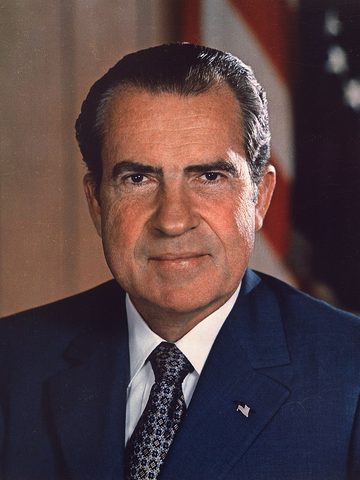
Official portrait
President #37
Richard Nixon
1913–1994
Leadership Style
Nixon was the most strategically gifted and psychologically tortured president of the modern era. He thought in geopolitical chess moves three moves ahead — his opening to China, the détente architecture with Moscow, the use of one against the other was conceptual brilliance. But he governed from a place of grievance, kept enemies lists, recorded conversations in the Oval Office because he distrusted those around him, and built an apparatus of secrecy and surveillance that ultimately consumed him. He delegated domestic policy to subordinates while he focused on foreign affairs with Henry Kissinger. He was paranoid in ways that turned out to be partly justified and disastrously self-destructive. No president was more capable in office; none destroyed his own presidency more thoroughly.
Greatest Accomplishments
The opening to China in February 1972 — preceded by Kissinger's secret July 1971 trip to Beijing — fundamentally rebalanced the Cold War. By playing Moscow and Beijing against each other, Nixon created leverage no successor has had since. SALT I (May 1972) was the first nuclear arms limitation treaty between the superpowers. He ended the military draft in 1973, established the Environmental Protection Agency (December 1970), signed the Clean Air Act (1970), Clean Water Act (1972), and the Endangered Species Act (1973). He proposed a guaranteed minimum income (Family Assistance Plan) that died in Congress but anticipated later thinking. He desegregated Southern schools more effectively than Kennedy or Johnson — by 1974, the percentage of Black students attending majority-white schools in the South rose from 18% to 90%.
Greatest Failures
Watergate. The June 17, 1972 break-in at the Democratic National Committee headquarters at the Watergate complex was bungled, but the cover-up that followed — the hush money, the obstruction of the FBI, the firing of special prosecutor Archibald Cox in the Saturday Night Massacre, the eighteen-and-a-half-minute gap in the tapes — became the constitutional crisis of the postwar era. The Supreme Court ruled unanimously (United States v. Nixon, July 24, 1974) that he had to surrender the tapes. The 'smoking gun' tape of June 23, 1972 proved he had ordered the FBI investigation obstructed six days after the break-in. Facing certain impeachment and removal, he resigned on August 9, 1974 — the only American president ever to do so.
Greatest Challenge
He inherited a country at war with itself: 500,000 troops in Vietnam, Kent State and Jackson State shootings in 1970, the Pentagon Papers leak in 1971, urban riots, campus revolts, and the cultural rupture of the 1960s still unhealed. He had to extract the United States from Vietnam without admitting defeat — the Paris Peace Accords were signed in January 1973, after the secret bombing of Cambodia and the 1972 Christmas bombings of Hanoi he believed were necessary leverage. He faced the 1973 OPEC oil embargo, the resulting energy crisis, stagflation, the Yom Kippur War, and Vice President Spiro Agnew's resignation in October 1973 over corruption charges unrelated to Watergate — all while his own presidency was unraveling.
Quotes & Slogans
'I am not a crook' (November 1973, said in response to questions about his taxes and Watergate — became one of the most ironic statements in American political history). On leaving: 'I have never been a quitter. To leave office before my term is completed is abhorrent to every instinct in my body. But as President, I must put the interest of America first.' Final farewell to staff (August 9, 1974): 'Always remember, others may hate you, but those who hate you don't win unless you hate them, and then you destroy yourself.' Campaign 1968: 'Nixon's the One.' On governance: 'I gave them a sword. And they stuck it in. And they twisted it with relish.'
Economic Data
Nixon presided over the end of the postwar economic order. On August 15, 1971, he closed the gold window, ended Bretton Woods, and imposed 90-day wage-and-price controls — a unilateral restructuring of the global monetary system. The 1973 OPEC oil embargo quadrupled crude prices, triggered gas lines, and ushered in stagflation: GDP contracted, unemployment rose, and inflation hit 11% by 1974. The S&P 500 fell roughly 40% from January 1973 to December 1974 — among the worst bear markets of the postwar era. Top marginal income tax rate stayed at 70%. The wage-price controls failed and were lifted. He left an economy in worse shape than he found it, though much of the damage was external.
Quality of Life
The cultural ground continued shifting. Roe v. Wade (January 1973) legalized abortion nationwide. Title IX (1972) opened federally funded education to women on equal terms. The Vietnam War's end (1973) drained the moral fever of the era. Apollo 11 had landed in 1969, six months into his term, fulfilling Kennedy's pledge — Nixon spoke to the astronauts from the Oval Office. Disco emerged. The Watergate hearings (summer 1973) drew 71% of Americans to their televisions and rewrote the relationship between citizens and Washington. Trust in government collapsed: from 73% in 1964 to under 40% by Nixon's exit, where it has roughly remained. Life expectancy rose to 71.5.