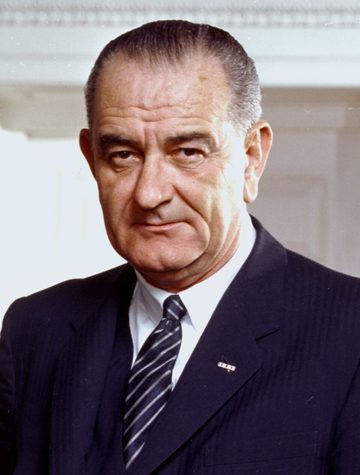
Official portrait
President #36
Lyndon B. Johnson
1908–1973
Leadership Style
Johnson was the most legislatively skilled president of the twentieth century — and arguably of any century. As Senate Majority Leader he had mastered the 'Johnson Treatment': the close-talking, lapel-grabbing, vote-trading, favor-banking exercise of pressure that few could resist. In the White House he applied it relentlessly. He worked 16-hour days, called senators at 3 a.m., remembered every favor owed and owed, and used Kennedy's martyrdom to push through legislation Kennedy himself had not been able to move. He could be magnanimous and cruel within the same conversation, profane and sentimental, brilliant and self-pitying. His instinct for power was sharper than any contemporary's; his blind spot — Vietnam — was the same instinct turned inside out.
Greatest Accomplishments
In two extraordinary years, Johnson passed the Civil Rights Act of 1964 (banning discrimination in employment, public accommodations, federally funded programs), the Voting Rights Act of 1965 (federal supervision of voter registration in Jim Crow states), the Immigration and Nationality Act of 1965 (ending national-origin quotas and reshaping American demographics), and the Social Security Amendments of 1965 (creating Medicare and Medicaid — health insurance for the elderly and the poor, the largest expansion of the welfare state since the New Deal). Add the Elementary and Secondary Education Act, Head Start, the Higher Education Act, the Fair Housing Act of 1968, the creation of HUD, the Department of Transportation, NPR, PBS, and the National Endowments for Arts and Humanities. The American social contract was rewritten in five years.
Greatest Failures
Vietnam destroyed his presidency and his historical reputation. After the Gulf of Tonkin Resolution (August 1964), passed on intelligence that was at best ambiguous and at worst manufactured, Johnson escalated U.S. troop levels from 16,000 to 536,000 by 1968. The Tet Offensive in January–February 1968 — though a military defeat for the North — shattered the credibility of administration claims that the war was being won. 58,220 Americans ultimately died. Johnson, exhausted and politically broken, announced on March 31, 1968 that he would not seek reelection. He privately knew earlier than he admitted publicly that the war could not be won at acceptable cost, and he escalated anyway.
Greatest Challenge
He took the oath of office on Air Force One in Dallas next to Kennedy's blood-stained widow. He had to reassure a traumatized nation, hold a fractious Democratic coalition together, pass Kennedy's stalled agenda as a memorial, define his own presidency, and simultaneously inherit an escalating war he did not start in a country he could not find on a map without help. The civil rights movement, the urban riots (Watts 1965, Newark and Detroit 1967), the assassinations of Martin Luther King and Robert Kennedy in 1968, the campus uprisings, and the Chicago convention all played out against the backdrop of Vietnam. No president since Lincoln faced a more turbulent domestic landscape.
Quotes & Slogans
On signing the Civil Rights Act: 'We have lost the South for a generation' (reportedly to aide Bill Moyers). Voting Rights Act speech (March 1965): 'We shall overcome.' Campaign 1964 against Goldwater: 'All the Way with LBJ' and the 'Daisy' ad — the most famous political ad ever made. On Vietnam: 'I am not going to be the President who saw Southeast Asia go the way China went.' On the presidency itself: 'The presidency has made every man who occupied it, no matter how small, bigger than he was; and no matter how big, not big enough for its demands.' March 31, 1968: 'I shall not seek, and I will not accept, the nomination of my party for another term as your President.'
Economic Data
GDP grew at an average 4.8% during his tenure — the strongest sustained expansion of the postwar era. Unemployment fell from 5.7% to 3.4%, the lowest since the Korean War. Inflation, however, accelerated from 1.3% in 1964 to 4.7% by 1968 as guns-and-butter spending — Vietnam plus the Great Society — overheated the economy. The Revenue and Expenditure Control Act of 1968 added a 10% surcharge, an admission that the bill was coming due. Poverty rate fell from 19% in 1964 to 12.8% by 1968 — the steepest decline in American history, driven by Great Society programs. Medicare and Medicaid covered roughly 39 million Americans by his exit. The Dow ended his term modestly higher.
Quality of Life
Johnson's Great Society materially improved millions of American lives — elderly Americans gained health coverage for the first time, school funding flowed into impoverished districts, and federal civil rights enforcement actually changed the legal status of Black Americans for the first time in a century. Life expectancy rose to 70.2. Television color sets became standard. The Beatles, Motown, and Woodstock (1969) defined a generational rupture. But cities burned: 1967 saw 159 race riots; 1968 saw 125 more after King's assassination. Trust in government, which peaked above 70% in the early 1960s, began its long decline that has not stopped. The America Johnson left was richer, more equal in law, and more unsettled in spirit than the one he inherited.