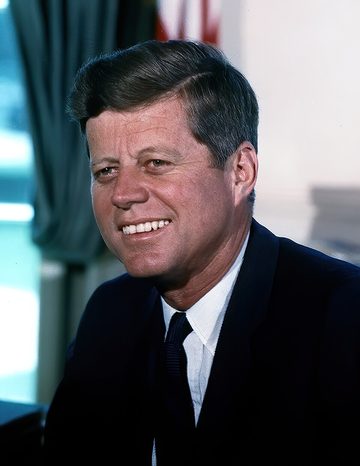
Official portrait
President #35
John F. Kennedy
1917–1963
Leadership Style
Kennedy brought television-age charisma, intellectual restlessness, and a deliberate generational break from Eisenhower's caution. He ran a White House of competing factions — the 'best and brightest' of academia and business — and preferred to hear arguments out before deciding, often keeping his own counsel until the last moment. After the Bay of Pigs taught him not to defer to expert consensus, he restructured decision-making to surface dissent. He was glamorous in public and pragmatic in private, capable of rhetorical lift ('Ask not what your country can do for you') matched to a cold reading of power. His youth (the youngest elected president) signaled energy; his health (Addison's disease, chronic back pain, daily injections) was concealed from the public.
Greatest Accomplishments
During thirteen days in October 1962, Kennedy navigated the Cuban Missile Crisis — the closest the world has come to nuclear war — without flinching and without escalating. He rejected the Joint Chiefs' near-unanimous push for an air strike on Cuba, chose a naval quarantine instead, opened a back-channel through his brother Robert and Soviet Ambassador Dobrynin, and quietly traded removal of obsolete Jupiter missiles from Turkey for Khrushchev's withdrawal of missiles from Cuba. He established the Peace Corps by executive order in March 1961, sending tens of thousands of young Americans abroad. In a speech at Rice University in September 1962, he committed the nation to the Moon — 'we choose to go to the Moon in this decade, not because it is easy, but because it is hard' — a goal Apollo 11 fulfilled in 1969.
Greatest Failures
The Bay of Pigs invasion (April 17–19, 1961) was a debacle inherited from Eisenhower-era CIA planning, but Kennedy owned the execution. The plan to land 1,400 Cuban exiles to overthrow Castro collapsed within three days; he refused the air cover the planners had assumed, the brigade was captured or killed on the beach, and the entire operation publicly humiliated his three-month-old administration. He took full responsibility, telling reporters 'victory has a hundred fathers, but defeat is an orphan.' The failure pushed Castro firmly into Soviet arms and set in motion the missile crisis eighteen months later. His escalation of advisers in Vietnam from 900 to 16,000 also planted seeds his successor would water.
Greatest Challenge
Kennedy presided over the most dangerous moment in the nuclear age. The Berlin Wall went up in August 1961. The Soviets resumed atmospheric nuclear testing. Khrushchev placed medium-range nuclear missiles in Cuba in October 1962, capable of hitting Washington with five minutes' warning. The civil rights movement reached its crucible — Freedom Riders, Birmingham, the March on Washington in August 1963 — and Kennedy, initially cautious, finally introduced the legislation that became the 1964 Civil Rights Act. He was navigating all of this when he was assassinated in Dallas on November 22, 1963, leaving the country in a state of shock the public mythology of his presidency never fully relinquished.
Quotes & Slogans
Inaugural (1961): 'Ask not what your country can do for you — ask what you can do for your country.' Berlin (1963): 'Ich bin ein Berliner.' Rice (1962): 'We choose to go to the Moon in this decade and do the other things, not because they are easy, but because they are hard.' On civil rights (June 1963): 'We are confronted primarily with a moral issue. It is as old as the Scriptures and as clear as the American Constitution.' Campaign slogan: 'A Time for Greatness.' His American University speech (June 1963) reframed the Cold War: 'For, in the final analysis, our most basic common link is that we all inhabit this small planet.'
Economic Data
Kennedy inherited a recession and pushed the Revenue Act tax cuts (top marginal rate from 91% to 70%) that passed posthumously in 1964 and helped fuel the 1960s boom. GDP growth averaged 5.5% during his abbreviated term. Unemployment fell from 6.7% to 5.5%. Inflation stayed under 1.3% annually. The steel-price confrontation of April 1962 — when he publicly forced U.S. Steel to roll back price increases — briefly spooked Wall Street but established him as willing to confront concentrated economic power. He pushed the Trade Expansion Act of 1962, the foundation of the Kennedy Round of GATT tariff reductions that integrated the postwar Western economy. The Dow ended his tenure roughly where it began.
Quality of Life
The early 1960s sat at the edge of cultural upheaval. The pill became widely available (1960), reshaping family formation. Television news matured — Kennedy's televised press conferences and the assassination coverage created the modern visual presidency. Median family income rose from $5,600 to $6,200. The civil rights movement reached every living room. The Beatles arrived in February 1964, three months after his death. Life expectancy reached 70. Polio was nearly eradicated in the U.S. Beneath the optimism: 23 million Americans lived below the poverty line (Michael Harrington's The Other America was published in 1962 and influenced Kennedy), Jim Crow remained intact, and the Vietnam buildup that would define the rest of the decade was already underway.