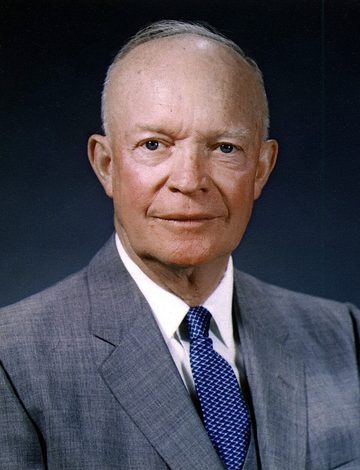
Official portrait
President #34
Dwight D. Eisenhower
1890–1969
Leadership Style
Eisenhower governed the way he had commanded Allied forces in Europe: through delegation, staff structure, and what he called 'the hidden hand.' He preferred to let cabinet secretaries take public positions while he worked behind the scenes, often appearing less engaged than he was — a deliberate strategy historian Fred Greenstein later documented from his papers. He was a consensus-builder who understood that visible partisanship cost authority. Genial in public, he was steel underneath: he had managed Patton, Montgomery, and de Gaulle, so domestic politicians did not intimidate him. He valued stability over ideology, distrusted both the far right and the far left of his own party, and ran the most institutionally orderly White House of the modern era.
Greatest Accomplishments
The Federal-Aid Highway Act of 1956 authorized 41,000 miles of Interstate Highway System — the largest public works project in human history at the time, funded by a dedicated gas tax trust fund. It reshaped American commerce, settlement patterns, and national defense logistics for the next seventy years. He ended the Korean War within six months of taking office, holding the line at the 38th parallel where it remains today. In September 1957 he federalized the Arkansas National Guard and sent the 101st Airborne to Little Rock Central High School to enforce school integration — the first time since Reconstruction federal troops protected Black Americans' constitutional rights. He signed the Civil Rights Acts of 1957 and 1960, modest but the first since Reconstruction.
Greatest Failures
The U-2 incident in May 1960 — when Francis Gary Powers was shot down over the Soviet Union and Eisenhower was caught publicly lying about the mission — collapsed the Paris summit and ended any hope of détente before he left office. On civil rights, he was personally uncomfortable with Brown v. Board (he privately called the Warren appointment 'the biggest damn-fool mistake I ever made'), and he refused to use the presidential bully pulpit to advance integration, leaving the legislative push to his successors. His farewell warning about the 'military-industrial complex' was prescient but came from a president who had presided over its construction.
Greatest Challenge
The Cold War turned hot-adjacent on his watch. The Soviets tested a hydrogen bomb in 1953, launched Sputnik in October 1957 (triggering American panic about a 'missile gap' that turned out to be fictional), and crushed the Hungarian uprising in 1956 while Eisenhower judged he could not intervene without nuclear war. The Suez Crisis the same year forced him to publicly humiliate Britain, France, and Israel to preserve American credibility in the developing world. He oversaw the CIA coups in Iran (1953) and Guatemala (1954) that bought short-term stability at long-term cost. Through all of it, he kept the country out of major war and the defense budget below 10% of GDP — restraint his successors did not match.
Quotes & Slogans
Campaign: 'I Like Ike.' Farewell address (1961): 'In the councils of government, we must guard against the acquisition of unwarranted influence, whether sought or unsought, by the military-industrial complex.' On war: 'Every gun that is made, every warship launched, every rocket fired signifies, in the final sense, a theft from those who hunger and are not fed.' On leadership: 'Leadership is the art of getting someone else to do something you want done because he wants to do it.' On planning: 'Plans are worthless, but planning is everything.'
Economic Data
The Eisenhower years were the closest thing to American economic equilibrium of the twentieth century. GDP grew at an average of 2.5% annually, inflation averaged 1.4%, and unemployment averaged 4.9%. The top marginal income tax rate remained at 91% — Eisenhower resisted Republican pressure to cut it, prioritizing debt reduction. The federal budget ran small surpluses three of his eight years. Three recessions (1953–54, 1957–58, 1960–61) were each shallow and short. The Dow Jones doubled from 280 to 615. Real median family income rose roughly 30%. He left office with the national debt roughly flat in nominal terms — a fiscal achievement no president has matched since.
Quality of Life
The 1950s became American shorthand for prosperity for a reason. Homeownership crossed 60% for the first time. Two-car households became common. Television penetration reached 90% of homes. Disneyland opened (1955), McDonald's franchised (1955), the polio vaccine was distributed (1955), and the birth control pill received FDA approval in 1960. Life expectancy rose to 69.7. The first commercial jet service (Boeing 707) began in 1958, shrinking the country. Beneath the prosperity: legally enforced segregation continued in the South, women were largely excluded from professional life, and the gay community lived under criminal statutes. The decade's surface calm masked pressures that would erupt in the 1960s.