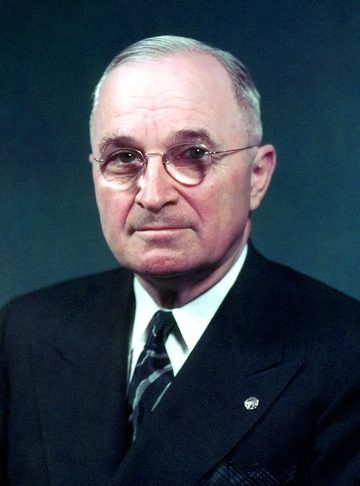
Official portrait
President #33
Harry S. Truman
1884–1972
Leadership Style
Truman led with plainspoken Missouri directness, famously declaring 'The buck stops here.' A former haberdasher and senator with no college degree, he made decisions quickly and lived with them — sometimes painfully so. His style fused humility about his sudden elevation with iron resolve once a choice was made. He surrounded himself with capable advisers (Marshall, Acheson) but never deferred his judgment to them. Where FDR was patrician and oblique, Truman was blunt, profane in private, and morally certain in public. He treated the presidency as a job to be done honestly, not a role to be performed, and he absorbed criticism without flinching when he believed he was right.
Greatest Accomplishments
Truman architected the postwar order that defined the next seventy-five years. The Marshall Plan (1948) poured $13 billion into rebuilding Western Europe, denying the Soviets a vacuum to exploit and creating the trading partners America would prosper alongside. He chartered NATO in 1949, the first peacetime military alliance in U.S. history, binding the West together against Soviet expansion. Executive Order 9981 (1948) desegregated the armed forces by presidential fiat — years before Brown v. Board, decades before the Civil Rights Act. He recognized Israel within eleven minutes of its declaration. The Truman Doctrine framed containment as American doctrine. He built the architecture — UN headquarters, IMF, World Bank, CIA, Department of Defense — that the United States operated through for generations.
Greatest Failures
The firing of General Douglas MacArthur in April 1951 was constitutionally correct — civilian control of the military is non-negotiable, and MacArthur was openly defying his commander-in-chief over Korea strategy. But Truman handled the firing clumsily, leaking it before notifying MacArthur, and his approval rating collapsed to 22 percent, the lowest in polling history at that time. The Korean War itself ground into a stalemate at the 38th parallel, with 36,000 Americans dead and no clear victory. He left office deeply unpopular, his reputation only rehabilitated by historians decades later.
Greatest Challenge
He inherited the presidency on April 12, 1945, with no briefing on the Manhattan Project, no warning, and FDR's wartime architecture entirely in other men's heads. Within months he authorized atomic bombs on Hiroshima and Nagasaki — a decision he defended for the rest of his life without visible doubt — wound down a global war, demobilized 12 million troops, faced down Stalin at Potsdam, and began constructing a Cold War strategy that did not yet have a name. The Berlin Airlift (1948–49), the loss of China to Mao, the Soviet atomic bomb test, the Korean invasion in June 1950 — each crisis would have defined a normal presidency. He faced them sequentially, often alone.
Quotes & Slogans
'The buck stops here' (Oval Office desk sign). 'If you can't stand the heat, get out of the kitchen.' 1948 campaign: 'Give 'em hell, Harry!' — to which he replied he just told the truth and they thought it was hell. On the atomic bomb: 'I never lost any sleep over my decision.' On succeeding FDR: 'I felt like the moon, the stars, and all the planets had fallen on me.' The famous 'Dewey Defeats Truman' Chicago Tribune headline he held up grinning after the 1948 upset became American political iconography.
Economic Data
Truman managed the largest economic transition in U.S. history — from wartime command economy to peacetime consumption. GDP contracted sharply in 1946 as war production wound down but resumed growth by 1948. Inflation spiked to 14.4% in 1947 as price controls lifted. Unemployment stayed remarkably low (under 4% most years) as 12 million veterans were absorbed into the workforce, aided by the GI Bill (signed by FDR, implemented by Truman) which sent 7.8 million veterans to college or trade school. The Employment Act of 1946 made full employment a federal responsibility. The Dow roughly doubled during his tenure.
Quality of Life
The American middle class was born under Truman. Suburbanization exploded — Levittown opened in 1947, the FHA and VA loans put homeownership within reach of working families for the first time. Television sets in U.S. homes went from under 10,000 in 1945 to over 20 million by 1953. The interstate trucking economy began organizing around new highways. Life expectancy rose from 65.9 to 68.8. Polio remained terrifying (Salk's vaccine arrived in 1955, just after Truman). Racial segregation remained the legal norm in the South, but Truman's civil rights commission and military integration order planted the seeds of what came next.