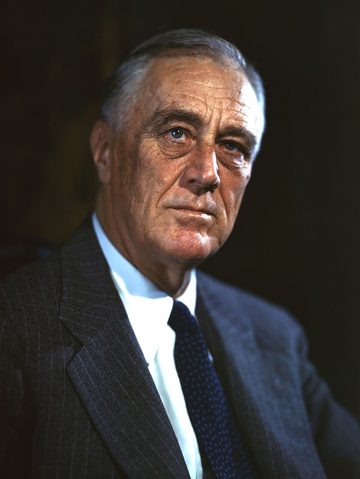
Official portrait
President #32
Franklin D. Roosevelt
1882–1945
Leadership Style
FDR was the master politician of the twentieth century—patrician charm, ruthless pragmatism, experimental willingness, and a communicator's instinct for the medium of his moment. Paralyzed from the waist down by polio (1921), he never let the public see him struggle and built a press corps complicity around the concealment. He governed through what he called "bold, persistent experimentation"—if one program failed, try another. His fireside chats (30 between 1933 and 1944) used radio to speak directly to Americans in their homes. He surrounded himself with the "Brain Trust"—Berle, Tugwell, Moley—and pitted advisers against each other to surface options. He kept his own counsel, lied when he found it useful, and held the nation through twelve years of crisis with a confidence that exceeded what the facts warranted but proved self-fulfilling.
Greatest Accomplishments
The New Deal and the victory in WWII—two achievements either of which would secure his place. The New Deal (1933-1939) transformed American government: the Emergency Banking Act (March 1933) and bank holiday saved the banking system; the FDIC (1933) ended bank-run panics; the SEC (1934) regulated securities; the Civilian Conservation Corps and Works Progress Administration put millions to work; the Tennessee Valley Authority brought electrification and flood control; the Wagner Act (1935) protected unionization; the Social Security Act (1935) created old-age insurance and unemployment compensation—the foundation of the modern American welfare state; the Fair Labor Standards Act (1938) established the minimum wage and 40-hour week. In WWII (1941-1945), Roosevelt built the Grand Alliance with Churchill and Stalin, mobilized the most productive war economy in history, and led the country to victory over the Axis.
Greatest Failures
Executive Order 9066 (February 19, 1942) authorized the forced relocation and internment of approximately 120,000 people of Japanese ancestry—two-thirds of them U.S. citizens—into concentration camps across the West. They lost homes, businesses, and farms; spent up to three years in barracks behind barbed wire; were interrogated for loyalty; and many young men were drafted from the camps to fight (the 442nd Regimental Combat Team became the most decorated unit of its size in U.S. military history). The internment was a racially motivated mass civil rights violation that the government formally apologized for in 1988 (Civil Liberties Act, $20,000 reparations to survivors). His court-packing plan (1937) to add up to six justices was a major political failure that energized opposition and lost him control of his own party for the rest of his presidency. His refusal to push anti-lynching legislation, fearing the loss of Southern Democratic support, deserves honest acknowledgment.
Greatest Challenge
The Great Depression and the Second World War, sequentially and overlapping—arguably the two greatest crises of the American twentieth century. He inherited 25% unemployment, a collapsed banking system, deflation, and a population near despair. By 1937 unemployment had fallen to 14% before a renewed recession sent it back up. WWII finally ended the Depression through massive military spending and full mobilization. Then he had to win a global war fought on three continents and two oceans against industrial powers (Germany, Japan, Italy) led by sophisticated state machines. He coordinated with Churchill and Stalin, oversaw the development of the atomic bomb (Manhattan Project, authorized 1942), planned the postwar order at Tehran (1943) and Yalta (1945), and died on April 12, 1945—four weeks before V-E Day, four months before V-J Day.
Quotes & Slogans
"The only thing we have to fear is fear itself." (First Inaugural, March 4, 1933). "A date which will live in infamy." (war message after Pearl Harbor, December 8, 1941). "We have nothing to fear but fear itself." "The test of our progress is not whether we add more to the abundance of those who have much; it is whether we provide enough for those who have too little." His campaigns ran on "A New Deal for the American People" (1932), "Re-elect Roosevelt" (1936, won 46 of 48 states), "Don't Switch Horses in Midstream" (1940, breaking the two-term tradition), and "Bring Them Home" (1944). He won four presidential elections—a feat the Twenty-Second Amendment (ratified 1951) made permanently impossible.
Economic Data
GDP recovered from $58 billion (1932) to $228 billion (1945). Unemployment fell from 25% (1933) to 14% (1937), rose to 19% (1938 recession), and reached 1.2% by 1944 under war mobilization. Federal spending: $4.6 billion (1933), $9.4 billion (1939), $92.7 billion (1945). Federal debt rose from $22 billion (1933) to $260 billion (1945)—about 120% of GDP. The Social Security Act (1935) created a payroll-funded pension and unemployment insurance system. The Wagner Act (1935) protected unionization; union membership grew from 3 million (1933) to 14 million (1945). Top marginal income tax rate rose to 94% in 1944. The Bretton Woods agreement (1944) established the postwar international monetary system. War production produced 300,000 aircraft, 89,000 tanks, 6,500 naval vessels.
Quality of Life
FDR's twelve years remade American daily life. Bank deposits became safe; old age became insurable; unions became legal; the federal minimum wage and 40-hour week became standard. Electricity reached rural America through the REA. Public works built schools, post offices, dams, parks, and roads still in use. Yet inequities persisted and worsened in places: Black Americans, though gaining some New Deal benefits, were excluded from many programs (farm and domestic labor exclusions in Social Security; segregated CCC camps); the FHA pioneered redlining. Japanese Americans were imprisoned. Mexican Americans were deported. After Pearl Harbor, the country mobilized totally—rationing, war bonds, women entering industrial workforce ("Rosie the Riveter"). 16 million Americans served in the military; 405,000 died. The GI Bill (1944) opened higher education and homeownership to a generation.