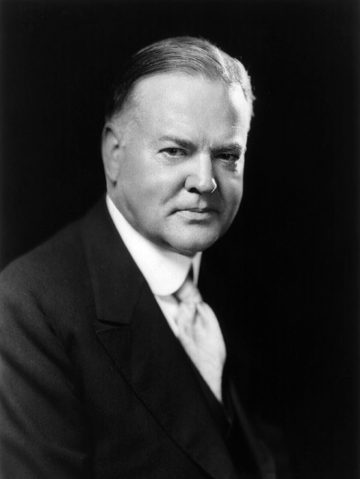
Official portrait
President #31
Herbert Hoover
1874–1964
Leadership Style
Hoover was the most accomplished pre-presidential figure since John Quincy Adams—a self-made mining engineer who became a multimillionaire by his forties, then renounced business to direct relief feeding millions in WWI Belgium and post-Armistice Europe (probably saving more lives than any private American of his era), then served as the dominant Secretary of Commerce under Harding and Coolidge. He brought to the presidency an engineer's faith in data, expertise, and voluntary cooperation. He governed by convening conferences, persuading business leaders, and trying to coordinate private response. He was personally hardworking, austere, and shy—uncomfortable with retail politics. His leadership style was technocratic in an era that needed empathic communication, and conservative in fiscal philosophy when the moment demanded experimental boldness.
Greatest Accomplishments
Hoover took more direct federal action against economic depression than any previous president. The Reconstruction Finance Corporation (1932) was the largest federal lending program in peacetime history, eventually lending billions to banks, railroads, and industry. The Federal Home Loan Bank Act (1932) created the Federal Home Loan Bank System. The Emergency Relief and Construction Act (1932) funded public works. He doubled federal public-works spending. He signed the Norris-LaGuardia Anti-Injunction Act (1932), restricting court injunctions against strikes. The Hoover Dam (then Boulder Dam) was authorized in 1928 and built during his term—a monument to federal capacity. He pushed for tax reform and prison reform. The infrastructure of New Deal lending and intervention substantially originated in Hoover-era institutions; FDR expanded what Hoover had built.
Greatest Failures
The Great Depression on his watch and his perceived—and partly real—inadequacy of response. The October 1929 crash erased $30 billion of stock value. Unemployment rose from 3.2% (1929) to 23.6% (1932). Industrial production fell by nearly half. Roughly 9,000 banks failed between 1930 and 1933, wiping out depositor savings. The Smoot-Hawley Tariff (June 1930), which Hoover signed despite a petition from 1,000 economists begging him not to, triggered retaliatory tariffs that collapsed global trade by roughly two-thirds. The Bonus Army of WWI veterans camped in Washington in summer 1932 demanding early bonus payment; Hoover ordered General MacArthur to clear the camp, and MacArthur exceeded orders, burning the shanties and using cavalry, tear gas, and tanks against unarmed veterans. The images destroyed Hoover politically.
Greatest Challenge
The Crash of 1929 and the Depression that followed—the worst economic catastrophe in American history. Within a year of his inauguration, the foundations of the 1920s prosperity collapsed: banks, employment, prices, trade, confidence. Hoover faced the worst hand any president had been dealt outside Lincoln. His philosophy resisted direct federal relief (he believed it would corrode self-reliance); his actions exceeded his philosophy but lagged the catastrophe. He tried voluntary wage maintenance, public works expansion, lending to banks—but refused direct cash relief to individuals until the very end. He balanced his last budget on the way out, raising taxes in 1932 to fight the deficit, which deepened the contraction. He lost 1932 to FDR by 472 to 59 electoral votes, the worst defeat of an incumbent since 1840.
Quotes & Slogans
"Prosperity is just around the corner." (often quoted against him, though the exact phrasing varies). "Older men declare war. But it is youth that must fight and die." "The American system of rugged individualism." His 1928 campaign ran on "A chicken in every pot and a car in every garage" (Republican Party slogan, not Hoover's own words) against Al Smith, winning 444 electoral votes including five Southern states for the first time since Reconstruction. The 1932 campaign was a salvage operation against FDR; Hoover toured but was greeted by jeering crowds. Shantytowns of the dispossessed were called "Hoovervilles"; newspapers used as blankets were "Hoover blankets."
Economic Data
The 1929 crash wiped out $30 billion (about $500 billion in 2025 dollars) in stock value within weeks. GDP fell from $103 billion (1929) to $58 billion (1932)—a 44% nominal decline. Unemployment: 3.2% (1929), 8.7% (1930), 15.9% (1931), 23.6% (1932), peaking at about 25% in early 1933. Industrial production fell 46% peak to trough. Roughly 9,000 banks failed 1930-1933, wiping out roughly $7 billion in deposits. The Smoot-Hawley Tariff (1930) raised average rates to about 59%; world trade collapsed about 66%. The Revenue Act of 1932 raised the top income tax rate from 25% to 63%—the largest peacetime tax increase to that date. The RFC lent $1.5 billion in its first year.
Quality of Life
Daily life collapsed for tens of millions. Soup lines stretched for blocks; Hoovervilles—shantytowns of cardboard and corrugated tin—sprang up in every major city. The 1932 Bonus Army march and its violent dispersal symbolized federal failure. Dust storms began stripping the southern plains by 1932, displacing hundreds of thousands of Okies. Suicide rates rose; birth rates fell; marriages were postponed. Hospitals and schools cut services as tax revenues collapsed. For Black Americans, already poorer, the Depression was catastrophic—"last hired, first fired." Mexican Americans faced mass deportation (often called "repatriation"). Yet cultural life persisted: radio reached most homes, talking pictures conquered cinema, and the Empire State Building opened in 1931. Life expectancy actually rose slightly as automobile fatalities and infectious disease declined.