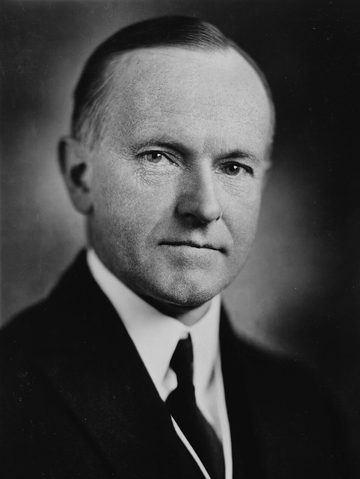
Official portrait
President #30
Calvin Coolidge
1872–1933
Leadership Style
Coolidge was "Silent Cal"—taciturn, frugal, and deliberately minimalist. He took the presidential oath from his father, a notary public, by kerosene lamp in a Vermont farmhouse at 2:47 AM on August 3, 1923, when news of Harding's death reached him. He believed the presidency required restraint, not activism; he took daily naps, gave brief press conferences (the first to hold regular ones), and limited White House social functions. His leadership style was constitutional minimalism: government should govern least where private enterprise could govern itself. He restored ethical seriousness after the Harding scandals (he kept Daugherty briefly then dismissed him, supported the Teapot Dome prosecutions) while shrinking the federal footprint. His silence was a form of governance; what he didn't do mattered as much as what he did.
Greatest Accomplishments
Coolidge stabilized the country after Harding's death and presided over the most prosperous period of the 1920s. He won 1924 election in his own right with 382 electoral votes against Democrat John Davis and Progressive Robert La Follette. He continued the Mellon tax cuts, reducing the top rate from 46% to 25% (Revenue Act of 1926), and cut federal spending to about $3 billion annually. The federal debt fell from $22 billion (1923) to $17 billion (1929). He signed the Kellogg-Briand Pact (1928), the international agreement outlawing war as instrument of national policy—legally important even though it had no enforcement mechanism. He granted Native Americans U.S. citizenship via the Indian Citizenship Act (1924). He created the Federal Radio Commission (1927), forerunner of the FCC. He restored the dignity and ethical baseline of the office.
Greatest Failures
Coolidge's laissez-faire approach to the speculative excesses of the late 1920s contributed to the conditions that produced the 1929 crash. Stock prices roughly doubled between 1925 and 1929; margin lending exploded; the Federal Reserve under his appointees pursued accommodative policy that fueled the bubble. Coolidge himself made publicly optimistic statements about the market into 1928. Critics argue—reasonably—that more aggressive regulatory or monetary action could have constrained the buildup. Coolidge also vetoed the McNary-Haugen Farm Relief Bill twice (1927, 1928), leaving the agricultural depression of the 1920s unaddressed. He extended high tariffs that crushed European recovery and aggravated trade imbalances. His refusal to use federal power left the architecture of disaster in place for his successor.
Greatest Challenge
Following Harding amid the unfolding Teapot Dome scandals and rebuilding public trust in Republican governance without alienating the conservative core. Coolidge could not be seen to whitewash the scandals nor to repudiate Harding outright. He kept Daugherty briefly to maintain appearance of continuity, then dismissed him; supported the prosecutions while distancing the administration from their original conduct; and won 1924 election convincingly. The deeper challenge was governing during a period of profound social transformation—immigration restriction reshaping the demographic future, Jim Crow consolidating in the South and now spreading through Klan revival in the North, women entering the electorate, modernist culture clashing with rural fundamentalism (Scopes Trial, 1925)—with a philosophy that resisted federal action on any of these.
Quotes & Slogans
"The chief business of the American people is business." (1925 speech to American Society of Newspaper Editors). "I have noticed that nothing I never said ever did me any harm." "It is a great advantage to a president, and a major source of safety to the country, for him to know that he is not a great man." "Perhaps one of the most important accomplishments of my administration has been minding my own business." His 1924 campaign ran on "Keep Cool with Coolidge" against Democrats divided over the Klan and Prohibition. His famous "I do not choose to run for President in nineteen twenty-eight" announcement (August 1927) was so terse that historians still debate its exact meaning.
Economic Data
The Revenue Act of 1926 cut the top income tax rate to 25%. Federal spending held at about $3 billion annually—almost exactly the prewar level. Federal debt fell from $22 billion (1923) to $17 billion (1929). The Mellon program reduced surtaxes broadly. GDP grew about 4-5% annually from 1923-1929. Stock prices roughly doubled in the same period. Margin debt rose from about $1 billion (1921) to about $9 billion (October 1929). The Federal Reserve cut its discount rate from 4% (1924) to 3.5% (1927), then raised to 5% (1928) and 6% (August 1929)—too late to deflate the bubble without bursting it. Tariffs remained high under Fordney-McCumber. Automobile production reached 4.6 million units in 1929.
Quality of Life
The Coolidge years were the height of the Roaring Twenties for the urban middle class. Electrification spread to about 70% of urban households. Automobiles, radios, refrigerators, washing machines entered homes en masse. Jazz, flapper culture, and Hollywood reshaped American social life. Yet the prosperity was uneven: farmers suffered chronic depression as wartime demand vanished; Black Southerners migrated north into segregated industrial cities; the 1924 Immigration Act slashed legal arrivals from Southern and Eastern Europe; the Klan's resurgence brought lynchings and intimidation. The Scopes Monkey Trial (1925) dramatized the cultural rift between modernists and fundamentalists. Life expectancy rose to about 58. The veneer of universal prosperity obscured agricultural collapse and bank fragility that would matter terribly in 1930.