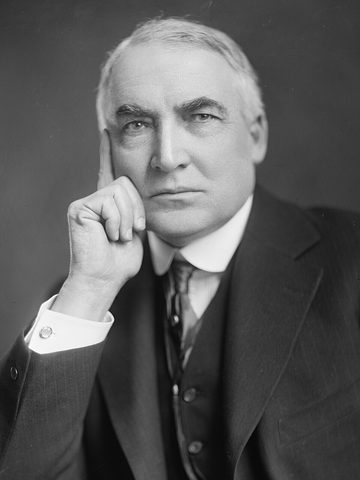
Official portrait
President #29
Warren G. Harding
1865–1923
Leadership Style
Harding was the first president elected after women's suffrage and the first to ride to office in an automobile. A genial Ohio newspaper publisher and one-term senator chosen as a compromise candidate in a smoke-filled room at the 1920 Republican convention, he governed by delegation—appointing strong cabinet officers (Charles Evans Hughes at State, Herbert Hoover at Commerce, Andrew Mellon at Treasury) and letting them run their departments. He was personally warm, popular, and accessible; he opened the White House grounds to the public. He also gambled, drank during Prohibition, conducted affairs (including with Nan Britton, who claimed he fathered her daughter—confirmed by DNA testing in 2015), and trusted friends from his Ohio circle who proved corrupt. He was easy to like and easy to take advantage of.
Greatest Accomplishments
Harding's "return to normalcy" delivered policy substance often overlooked. The Budget and Accounting Act (1921) created the Bureau of the Budget (now OMB) and the General Accounting Office (now GAO), giving the executive branch its first systematic budget process. The Washington Naval Conference (1921-1922) produced the Five-Power Treaty limiting battleship tonnage among the U.S., Britain, Japan, France, and Italy—the first successful arms-control agreement in modern history. He pardoned Eugene Debs (released Christmas 1921), ending the WWI political prosecutions. He gave a notable speech in Birmingham, Alabama (October 1921) calling for Black equal rights before a segregated audience—remarkable for its time. The economy boomed after the 1920-1921 recession. He restored a measure of presidential dignity and competence after Wilson's incapacitation.
Greatest Failures
Teapot Dome and the broader corruption of the "Ohio Gang." Interior Secretary Albert Fall secretly leased Navy oil reserves at Teapot Dome (Wyoming) and Elk Hills (California) to private oilmen Edward Doheny and Harry Sinclair in exchange for $400,000 in bribes—the largest political scandal before Watergate. Attorney General Harry Daugherty was implicated in selling pardons and immigration permits. Charles Forbes at the Veterans' Bureau stole or wasted roughly $2 million. Jess Smith, Daugherty's aide and Harding's bagman, committed suicide in 1923 as exposure neared. Harding learned of the corruption in early 1923 and reportedly anguished over it before dying that August. The full extent emerged posthumously. Fall became the first Cabinet officer imprisoned for crimes committed in office.
Greatest Challenge
Restoring normalcy after the dislocations of WWI, the 1918 flu, postwar inflation, the 1919 Red Summer race violence, the Palmer Raids, the failed League fight, and Wilson's stroke. The 1920-1921 recession was sharp—unemployment spiked to about 12%, prices fell, and farm income collapsed. Harding's response was largely passive—Treasury Secretary Mellon advocated tax cuts, the Federal Reserve raised then lowered rates, and the economy recovered within eighteen months. The deeper challenge was philosophical: what role should the federal government play in peacetime after wartime expansion? Harding's answer—shrink it, cut taxes, reduce regulation, restore prewar normalcy—shaped the entire 1920s. He died of a heart attack in San Francisco in August 1923 before facing the scandals' full revelation.
Quotes & Slogans
"America's present need is not heroics but healing, not nostrums but normalcy." (1920 speech that coined his slogan). "I have no trouble with my enemies. But my damn friends... they're the ones that keep me walking the floor nights." "Government, after all, is a very simple thing." His 1920 campaign ran on "Return to Normalcy" against James M. Cox, winning the largest popular vote percentage (60.3%) since the start of two-party competition. He pioneered the modern campaign film and radio campaigning. His sudden death prompted unprecedented public mourning—larger than Lincoln's funeral procession by some counts—before the scandals destroyed his reputation.
Economic Data
The Budget and Accounting Act (1921) created systematic federal budgeting. The Revenue Acts of 1921 and 1924 (Mellon plan) cut the top income tax rate from 77% (Wilson wartime) to 50%, then to 46%. Federal spending dropped from $5.1 billion (1921) to $3.3 billion (1923). The federal debt began declining from its WWI peak. The Fordney-McCumber Tariff (1922) restored high protection. The Emergency Quota Act (1921) and Immigration Act of 1924 (passed after his death) imposed strict national-origin quotas, drastically cutting immigration from Southern and Eastern Europe and barring most Asian immigration. The 1920-1921 recession was severe but brief; growth resumed by mid-1922. Radio broadcasting began commercially in 1920.
Quality of Life
The Harding years began the Roaring Twenties. Radio entered millions of homes. Automobiles spread to the middle class as Ford's assembly line cut Model T prices. Electricity reached the majority of urban households. Prohibition (begun 1920) created speakeasies, bootleggers, and organized crime. The Tulsa Race Massacre (May-June 1921) destroyed the prosperous Black Greenwood district and killed perhaps 300 Black residents. The Ku Klux Klan revived dramatically, reaching perhaps 4 million members by mid-decade and powerful in Indiana, Oregon, and Colorado state politics. Immigration restriction reshaped the country's demographic trajectory. Women, newly enfranchised, entered politics in growing numbers. Life expectancy rose to about 54 as the influenza pandemic receded.