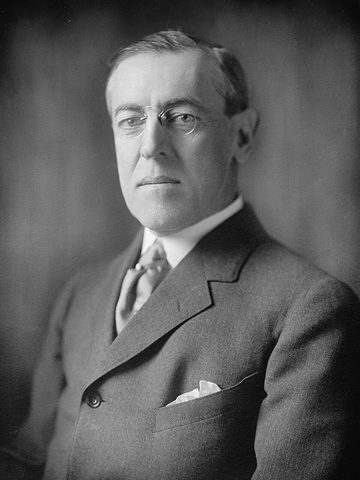
Official portrait
President #28
Woodrow Wilson
1856–1924
Leadership Style
Wilson was the most academically credentialed president—a Princeton professor of political science, university president, and governor of New Jersey for two years before winning the White House. He governed as a theorist of executive leadership: he revived the practice of delivering the State of the Union in person (suspended since Jefferson), worked closely with congressional leadership, and used the presidency as moral instrument. His leadership style was austere, moralistic, and rigid—he was capable of brilliant vision and catastrophic stubbornness in the same hour. After his October 1919 stroke, his second wife Edith effectively ran the executive branch for over a year, in what amounts to the most extreme concealment of presidential incapacity in American history. He held to his beliefs past the point of usefulness.
Greatest Accomplishments
Wilson's first-term domestic legislative record is arguably the most consequential of any single presidential term before the New Deal. The Federal Reserve Act (1913) created the central banking system that still governs American monetary policy. The Underwood Tariff (1913) significantly reduced rates and introduced the modern income tax. The Clayton Antitrust Act (1914) and Federal Trade Commission Act (1914) strengthened antitrust enforcement. The Federal Farm Loan Act (1916), Adamson Act (eight-hour day for railroad workers, 1916), and Keating-Owen Child Labor Act (1916) extended federal labor and rural credit policy. The Nineteenth Amendment granting women's suffrage was ratified in 1920 under his presidency (though he was lukewarm on it for years and only endorsed it under sustained pressure from Alice Paul and the suffragists).
Greatest Failures
Wilson re-segregated the federal civil service. Beginning in 1913, his administration—at the urging of Cabinet members including Treasury Secretary William McAdoo and Postmaster General Albert Burleson—introduced segregated workspaces, restrooms, and cafeterias across federal departments, demoted Black officials, and screened Birth of a Nation at the White House (1915). The Pendleton-era integration was rolled back; thousands of Black federal workers lost positions or were segregated. Wilson defended this personally as conducive to "good administration." It was, by his administration's design, the most significant federal retrenchment on racial equality between Reconstruction and the modern era. He was also the only president to write academic apologetics for the Klan (in his History of the American People, used in Birth of a Nation's title cards).
Greatest Challenge
World War I, the 1918 influenza pandemic, and the postwar Senate fight over the League of Nations—a triple challenge no other president faced. Wilson kept America out of the war through 1916 ("He kept us out of war" was his re-election slogan), then entered in April 1917 after unrestricted U-boat warfare and the Zimmermann Telegram. The wartime mobilization, draft, and industrial conversion succeeded; the 1918 flu killed roughly 675,000 Americans (more than the war itself); the Versailles negotiations gave Wilson the League of Nations but at the cost of harsh terms on Germany; and his refusal to compromise with Senator Lodge over League reservations doomed Senate ratification. The League formed without American membership. Wilson's stroke during his cross-country campaign to save the Treaty left him incapacitated.
Quotes & Slogans
"The world must be made safe for democracy." (war message, April 1917). "A little group of willful men." (on Senate filibusterers). "He kept us out of war." (1916 slogan). "Open covenants of peace, openly arrived at." (Fourteen Points, 1918). "The seed of revolution is repression." His Fourteen Points (Jan 1918) sketched a postwar order of national self-determination, open diplomacy, and collective security. The 1912 campaign ran on the "New Freedom"—a more decentralized progressivism than Roosevelt's New Nationalism. After his stroke he gave no public addresses for the remainder of his term.
Economic Data
The Federal Reserve Act (1913) created the central banking system. The Sixteenth Amendment (ratified 1913) enabled the federal income tax, initially at modest rates but raised sharply during WWI (top rate 77% in 1918). The Underwood Tariff (1913) reduced average duties from about 41% to 27%. World War I expanded federal spending more than tenfold—from about $700 million in 1916 to $18.5 billion in 1919. The federal debt exploded from $1.2 billion (1916) to $25.5 billion (1919). The War Industries Board centrally planned much of the economy 1917-1918. Postwar recession 1920-1921 was sharp but brief. The 1918 flu killed roughly 675,000 Americans.
Quality of Life
The Wilson years brought historic gains and historic horrors. Women gained the vote (1920). Workers gained the eight-hour day in key industries. The federal income tax began funding progressive priorities. But: Black Americans faced federal re-segregation; the Red Summer of 1919 saw white riots across dozens of cities (East St. Louis 1917, Chicago 1919, Tulsa massacre 1921 just after he left office); the Espionage Act (1917) and Sedition Act (1918) jailed Eugene Debs and thousands for war dissent; the Palmer Raids (1919-1920) rounded up suspected radicals; the 1918 flu pandemic killed about 1.5% of those infected. Prohibition (Eighteenth Amendment, 1919) reshaped American social life. Immigration restriction movements gathered strength toward the 1924 quotas.