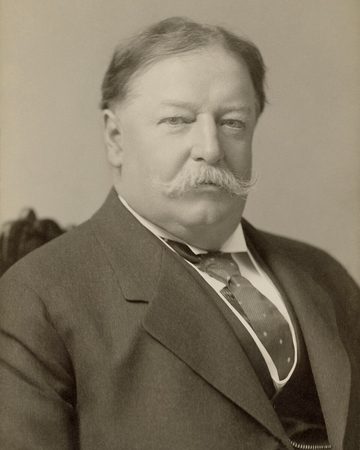
Official portrait
President #27
William Howard Taft
1857–1930
Leadership Style
Taft was a judicial temperament trapped in an executive office. A federal judge, Solicitor General, governor of the Philippines, and Secretary of War, he was supremely qualified by experience but psychologically unsuited to the presidency he never really wanted (his lifelong ambition was the Supreme Court, which he reached as Chief Justice in 1921—the only person to hold both offices). He governed by deliberation, constitutional caution, and legal correctness, declining the dramatic executive expansionism his predecessor had practiced. He weighed 340 pounds, suffered from sleep apnea, and was often visibly exhausted. He was warmer than the public saw, witty in private, and personally beloved by those who knew him—but he lacked the political instincts to manage the progressive-conservative split tearing his party apart.
Greatest Accomplishments
Taft's trust-busting record exceeded Roosevelt's—80 antitrust suits in four years versus Roosevelt's 44 in seven, including the dissolution of Standard Oil (1911) and American Tobacco (1911), the two largest trusts in America. He created the Department of Labor, signed the Mann-Elkins Act (1910) strengthening ICC regulation of railroads and bringing telegraph and telephone companies under its jurisdiction, and proposed the constitutional amendments that became the Sixteenth (federal income tax, ratified 1913) and the Seventeenth (direct election of senators, ratified 1913). He established the Bureau of Mines, the Children's Bureau, and the Postal Savings System. He pursued "Dollar Diplomacy" abroad. He governed competently, made few unforced errors of policy, and pushed reforms whose magnitude his contemporaries undervalued.
Greatest Failures
The Payne-Aldrich Tariff (1909) shattered the Republican coalition. Progressives expected significant tariff reduction—Taft had campaigned for it. The Senate, led by Aldrich, gutted the House's reductions, restoring high rates. Taft signed it anyway and then, disastrously, called it "the best tariff bill that the Republican party has ever passed" in Winona, Minnesota. Progressive Republicans—La Follette, Borah, Cummins—turned against him publicly. The Ballinger-Pinchot affair (1910), in which Taft sided with his Interior Secretary over Roosevelt's conservation appointee Gifford Pinchot, deepened the rift. Roosevelt returned from Africa in 1910 to find his party at war with itself. By 1912 Roosevelt was challenging Taft for the nomination. Taft won the nomination, lost the country, and finished third in November with 23%.
Greatest Challenge
Trying to be Theodore Roosevelt's successor while being constitutionally and temperamentally unwilling to be Theodore Roosevelt. Taft believed presidents must act within explicit statutory and constitutional authority—he literally wrote the book (Our Chief Magistrate and His Powers, 1916). Roosevelt believed presidents could do anything the Constitution didn't forbid. This was not a small disagreement; it was a fundamental theory of executive power. Taft also faced the impossible task of managing the GOP's progressive-conservative split, which was a structural problem his predecessor had personalized and his successor would not have to face (the schism elected Wilson). His judicial mind read the law and applied it; the political moment demanded a different instrument.
Quotes & Slogans
"Politics, when I am in it, makes me sick." "Don't write so that you can be understood; write so that you cannot be misunderstood." "The intoxication of power rapidly sobers off in the knowledge of its restrictions." "Presidents come and go, but the Supreme Court goes on forever." His 1908 campaign ran as Roosevelt's chosen heir on the slogan "Vote for Taft this year, you can vote for Bryan anytime." The 1912 campaign was a salvage operation; he largely conceded the race once Roosevelt bolted. After his presidency he became Chief Justice (1921-1930) and finally found work he loved—"I don't remember that I ever was President," he reportedly said.
Economic Data
The Sixteenth Amendment (ratified 1913, advanced under Taft) authorized the federal income tax, transforming federal revenue. The Seventeenth Amendment (ratified 1913, advanced under Taft) provided direct election of senators. The Payne-Aldrich Tariff (1909) modestly reduced average rates from about 46% to 41% but disappointed reformers. Federal antitrust enforcement reached new heights with Standard Oil and American Tobacco dissolved. The Mann-Elkins Act (1910) strengthened railroad regulation. The economy grew moderately; the 1907 panic's effects had passed. Federal spending crossed $700 million. The Postal Savings System (1910) gave small depositors a federally guaranteed option, anticipating later deposit insurance.
Quality of Life
The Taft years saw progressive reform reaching daily life: pure food labeling, child labor regulation in industry, workmen's compensation laws spreading state by state, the first federal income tax authorization. Automobiles became common in cities; Model T production began in 1908 and the moving assembly line launched in 1913. Aviation matured. For Black Americans, conditions continued worsening; the Springfield, Illinois race riot (1908) prompted the founding of the NAACP (1909). For immigrants, processing through Ellis Island peaked. For women, suffrage activism intensified—Alice Paul began her militant tactics. The Triangle Shirtwaist Fire (March 1911) killed 146 garment workers and shocked the country into stronger workplace safety laws.