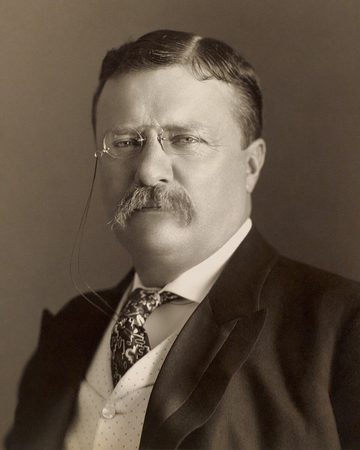
Official portrait
President #26
Theodore Roosevelt
1858–1919
Leadership Style
Roosevelt was the most kinetic president in American history—a force of nature who entered the White House at 42 (the youngest ever) and turned it into what he called a "bully pulpit." He read a book a day, wrote 35 of his own, hunted, boxed, practiced judo, swam the Potomac, led cavalry charges, explored the Amazon, and treated every issue as a moral confrontation. His leadership style was personal, dramatic, and confrontational with concentrated power—whether corporate trusts, recalcitrant Congresses, or foreign rivals. He believed in the strenuous life, masculine virtue, and an active state as a check on private monopoly. He expanded executive power aggressively, governing as much by personality and press conference as by statute. He invented modern presidential communication. Succeeded then elected 1904 with 336.
Greatest Accomplishments
Roosevelt's Square Deal redefined the federal government's role in industrial America. He prosecuted Northern Securities Company (1904)—J.P. Morgan's railroad trust—and won at the Supreme Court, breaking it up and signaling that no business was beyond federal reach. He brokered the 1902 anthracite coal strike, the first time a president intervened on labor's behalf rather than capital's. He signed the Pure Food and Drug Act and Meat Inspection Act (1906) after Upton Sinclair's The Jungle exposed packinghouse horrors. He created the U.S. Forest Service, established five national parks, 18 national monuments, and 150 national forests, conserving roughly 230 million acres of public land. He brokered the end of the Russo-Japanese War (winning the Nobel Peace Prize, 1906) and built the Panama Canal, the strategic infrastructure project of the era.
Greatest Failures
His 1904 pledge not to seek another term—and his 1912 violation of it that split the Republican Party and elected Wilson. On election night 1904, flush with his landslide victory, Roosevelt announced he would not run again, considering his accidental succession in 1901 effectively a first term. He handpicked Taft as successor in 1908, then grew disillusioned with Taft's perceived conservatism. In 1912 Roosevelt sought the Republican nomination, lost to Taft at a contested convention he believed had been stolen, bolted to form the Progressive (Bull Moose) Party, and finished second with 27% of the vote to Wilson's 42%. Taft got 23%. The split shattered the Republican coalition for twenty years and elected Wilson, whose racial policies Roosevelt would have likely never matched.
Greatest Challenge
The great industrial trusts and the related question of how to govern an economy of corporate concentration without destroying its productivity. By 1900 trusts controlled large shares of steel, oil, sugar, tobacco, meat, and railroads; their economic power exceeded that of most states. Roosevelt distinguished "good" trusts (productive, fair) from "bad" trusts (abusive, exploitative) and brought 44 antitrust suits. The Hepburn Act (1906) gave the ICC real power over railroad rates. He intervened in labor disputes as a neutral arbiter—a revolutionary stance. He confronted the problem that classical liberalism had no answer for: private power large enough to dominate public life. His solution—a strong regulatory presidency—shaped the next century of American political economy.
Quotes & Slogans
"Speak softly and carry a big stick; you will go far." "It is not the critic who counts." (Citizenship in a Republic, 1910). "Far better is it to dare mighty things... than to take rank with those poor spirits who neither enjoy much nor suffer much." "A square deal for every man." "Bully!" His 1904 campaign ran on "A Square Deal" against Alton Parker. The 1912 Bull Moose campaign ran on the New Nationalism—a comprehensive progressive program including women's suffrage, social insurance, and direct election of senators. After being shot during a campaign speech in October 1912, he delivered the 84-minute address with the bullet in his chest.
Economic Data
Roosevelt brought 44 antitrust suits, breaking up Northern Securities (1904) and Standard Oil prosecution (initiated 1906, decided under Taft). The Hepburn Act (1906) gave the ICC power to set maximum railroad rates. The Pure Food and Drug Act and Meat Inspection Act (1906) launched federal consumer protection. The Panic of 1907 was contained partly through J.P. Morgan's private intervention, exposing the lack of a central bank and prompting the National Monetary Commission whose work led to the Federal Reserve (1913). Federal spending grew modestly. Railroad regulation strengthened; conservation set aside roughly 230 million acres. The economy grew strongly through most of Roosevelt's term, with the 1907 panic the major exception.
Quality of Life
The Roosevelt years brought visible improvements in food safety, workplace conditions, and public health, alongside intensifying industrial labor conflict. Urban reform—settlement houses, tenement laws, sanitation—accelerated under progressive pressure. Automobiles spread; the Wright brothers flew at Kitty Hawk (1903); the first powered transcontinental flight came in 1911. For Black Americans, conditions remained dire: lynchings continued, Jim Crow tightened, and Roosevelt's 1906 dismissal of Black soldiers after the Brownsville affair was a betrayal. Roosevelt invited Booker T. Washington to dinner at the White House (1901)—the first Black guest at such a dinner—and was savaged for it across the South. Immigration reached record highs; Ellis Island processed over a million annually by 1907.