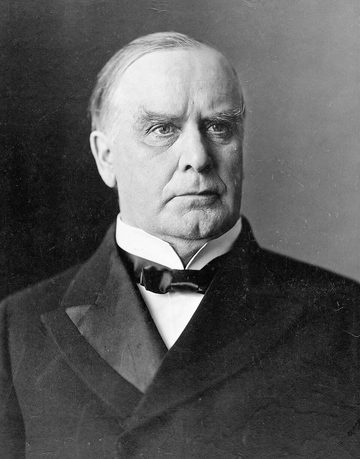
Official portrait
President #25
William McKinley
1843–1901
Leadership Style
McKinley was the last Civil War veteran to serve as president and the first modern one in his use of public communications, polling, and political organization. He was warm, gracious, and famously kind to subordinates—he wore a red carnation as a good-luck charm and gave it away to the next visitor. He governed through consultation: he kept his ear to congressional leaders, his business allies (especially Mark Hanna), and public opinion. His 1896 front-porch campaign saw 750,000 visitors to Canton, Ohio, while Bryan crisscrossed the country on the first true whistle-stop tour. McKinley's leadership was deliberate, conciliatory, and effective at building consensus, though critics found him too cautious. He grew significantly in office, particularly in foreign policy.
Greatest Accomplishments
McKinley presided over America's emergence as a world power. The Spanish-American War (1898), a four-month conflict triggered by the USS Maine explosion and Cuban independence concerns, ended with Spain ceding Puerto Rico, Guam, and the Philippines, plus de facto control of Cuba. He annexed Hawaii (1898) and signed the Open Door notes regarding China (1899-1900), establishing the principle of equal commercial access. Domestically, he signed the Dingley Tariff (1897) reaffirming protection and the Gold Standard Act (1900) formally committing the U.S. to gold convertibility, ending the silver debate. The post-1896 economy boomed, with prosperity reaching farmers and workers and validating McKinley's economic vision. He won re-election in 1900 with Theodore Roosevelt as VP.
Greatest Failures
The Philippine-American War (1899-1902) and the imperial turn it represented. After defeating Spain, McKinley decided—after famously praying about it—to annex the Philippines rather than grant independence. Filipino nationalists under Emilio Aguinaldo, who had fought alongside Americans against Spain, then fought against American occupation. The war killed perhaps 4,000 American soldiers, 20,000 Filipino combatants, and 200,000+ Filipino civilians from violence, famine, and disease. It involved atrocities including the "water cure" (waterboarding) and concentration-camp policies. The Anti-Imperialist League—Mark Twain, Andrew Carnegie, Jane Addams—argued the war betrayed American founding principles. The most direct personal failure was his assassination in September 1901, shot by anarchist Leon Czolgosz at the Pan-American Exposition in Buffalo.
Greatest Challenge
Deciding what kind of world power America would be after the Spanish-American War. The acquisition of Hawaii, Puerto Rico, Guam, the Philippines, and effective protectorate status over Cuba forced fundamental questions: Were these territories part of the United States? Did the Constitution follow the flag? Would inhabitants become citizens? McKinley pursued an imperial path but tried to balance it with assurances about eventual self-government and the Open Door policy in China. The Insular Cases (1901-1904) would partly answer the constitutional questions by holding that the Constitution did not fully apply to unincorporated territories—a doctrine still partially in force today regarding Puerto Rico. McKinley shaped the answer to a question Americans are still arguing.
Quotes & Slogans
"The mission of the United States is one of benevolent assimilation." (on the Philippines). "We need Hawaii just as much and a good deal more than we did California. It is manifest destiny." "Let us ever remember that our interest is in concord, not conflict." His 1896 campaign ran on "A Full Dinner Pail" and sound money against Bryan's "Cross of Gold" silver populism. Mark Hanna's fundraising and organizational machine pioneered modern campaign management. The 1900 rematch with Bryan ran on prosperity and imperialism. His last words after being shot: "It is God's way. His will, not ours, be done."
Economic Data
The Dingley Tariff (1897) raised average duties to about 46%, restoring high protection after the Wilson-Gorman cuts. The Gold Standard Act (1900) formally pegged the dollar to gold at $20.67 per ounce. The economy boomed: GDP grew rapidly after 1896, unemployment fell sharply, and the gold strikes in Alaska and South Africa eased the monetary tightness that had fueled the silver movement. Trust formation accelerated dramatically—2,653 firms consolidated into 269 trusts between 1898 and 1902. U.S. Steel was created in 1901 (the first billion-dollar corporation). Foreign trade expanded as American manufacturers sought export markets. Federal spending rose with war and territorial administration.
Quality of Life
The McKinley years brought "Republican prosperity"—the agrarian depression of the early 1890s lifted, industrial wages rose, and the modern consumer economy began emerging. Automobiles appeared (Ford founded in 1903 just after his death). The first World Series was played in 1903. Yet the costs were uneven: industrial laborers worked 60-hour weeks in dangerous conditions; Black Southerners faced consolidating Jim Crow (Plessy was 1896); the Philippine war killed hundreds of thousands of Filipinos; Cuban civilians had suffered under Spanish concentration camps; Native Americans continued losing land under Dawes Act allotments. Life expectancy reached about 47 for white Americans, lower for Black Americans. The progressive movement was beginning to organize against these conditions.