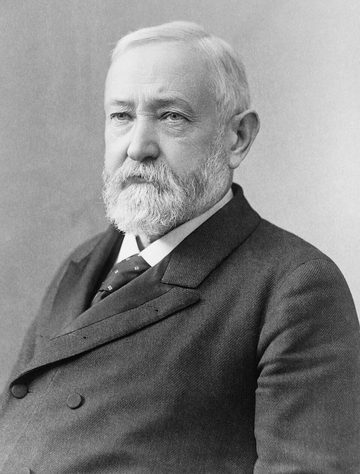
Official portrait
President #23
Benjamin Harrison
1833–1901
Leadership Style
Harrison was the grandson of President William Henry Harrison, a Civil War brigadier general, a former senator from Indiana, and a careful Presbyterian lawyer known as "the human iceberg" for his cool, formal manner. He was an effective public speaker—his front-porch campaign speeches were widely praised—but reserved in private, with a managerial rather than charismatic approach to governance. He delegated extensively to a strong cabinet (Blaine at State, Windom at Treasury) and worked closely with congressional Republicans, who held majorities in both houses for the first two years of his term and passed an ambitious legislative program. Harrison won the electoral vote in 1888 despite losing the popular vote to Cleveland by about 90,000—an outcome that would shadow his presidency.
Greatest Accomplishments
The legislative output of 1890—often called the "Billion Dollar Congress"—was extraordinary. The Sherman Antitrust Act (1890) became the foundation of all subsequent American antitrust law, though its enforcement waited for Theodore Roosevelt. The Dependent and Disability Pension Act (1890) massively expanded Civil War veteran benefits. The McKinley Tariff (1890) raised rates to historic highs in defense of American manufacturing. The Sherman Silver Purchase Act (1890) increased federal silver buys as a compromise with silver-state senators. Six new states entered the Union under Harrison (North Dakota, South Dakota, Montana, Washington, Idaho, Wyoming—the most under any single president). Harrison also pushed for federal protection of Black voting rights via the Lodge Bill, which passed the House but died in the Senate.
Greatest Failures
Losing the 1892 rematch with Cleveland—the only president to lose to the predecessor he had defeated. The McKinley Tariff proved deeply unpopular, raising consumer prices and helping Democrats sweep the 1890 midterms. The Sherman Silver Purchase Act drained gold reserves and helped set up the Panic of 1893 (which broke just weeks after Harrison left office). The Lodge Federal Elections Bill—what would have been the most significant federal voting-rights legislation between Reconstruction and 1965—died when Republicans abandoned it to pass the Silver Purchase Act, a Faustian trade. Harrison's reserved personal style made him politically isolated even within his own party. He lost the 1892 election by 132 electoral votes, the first incumbent rejected since Van Buren in 1840.
Greatest Challenge
Governing as a popular-vote loser while pursuing an ambitious agenda with razor-thin congressional margins and a country shifting beneath him. Industrial consolidation was accelerating—Standard Oil, Carnegie Steel, the sugar trust—prompting demand for federal action that the Sherman Antitrust Act began to address. Agrarian discontent was rising; the Populist Party emerged in 1892 and won 22 electoral votes. Labor conflict was escalating—the Homestead Strike of 1892 saw Pinkerton agents and steelworkers fighting a pitched battle. Wounded Knee occurred in December 1890, the bloody coda to the Plains Indian wars. Harrison faced the structural strains of industrial America with limited political capital and lost the country's mandate before he could consolidate his program.
Quotes & Slogans
"We Americans have no commission from God to police the world." "There is no constitutional or legal requirement that the President shall take the oath of office in the presence of the people." "Great lives never go out; they go on." His 1888 campaign ran on the protective tariff with the slogan "Protection for American Labor." The famous song was "Grandfather's Hat Fits Ben." His 1892 campaign was hampered by his wife Caroline's terminal illness—she died two weeks before the election, and Harrison essentially stopped campaigning. Cleveland, out of respect, did the same. It was the most subdued presidential race of the era.
Economic Data
The McKinley Tariff (1890) raised average duties to about 48%, the highest in U.S. history to that point. Federal revenues remained strong but the tariff's unpopularity contributed to its 1894 reduction. The Sherman Silver Purchase Act required Treasury to buy 4.5 million ounces of silver monthly, contributing to gold drain. The Sherman Antitrust Act (1890) was the first federal law restricting business combinations. Federal spending crossed $1 billion annually for the first time. Six new states added stars to the flag. Railroad mileage grew from 161,000 in 1889 to 176,000 by 1893. Immigration surged—788,000 arrived in 1882, and Ellis Island opened in 1892 to process the flow.
Quality of Life
The Harrison years brought rapid industrial growth, growing inequality, and intensifying conflict. Steel production doubled. Electricity spread to homes and streetcars. Department stores transformed urban shopping. Yet the Homestead Strike (1892) saw Pinkerton men killing workers at Carnegie's mill, with state militia restoring order on capital's behalf. The Populist movement gave voice to crushed farmers facing crop deflation and railroad rate gouging. The Wounded Knee massacre (Dec 1890) killed roughly 250 Lakota men, women, and children. Jim Crow consolidated across the South; lynching reached its statistical peak in the early 1890s. Immigration from Italy, Poland, Russia (especially Jewish refugees from pogroms), and Greece reshaped cities. The era's prosperity and brutality were inseparable.