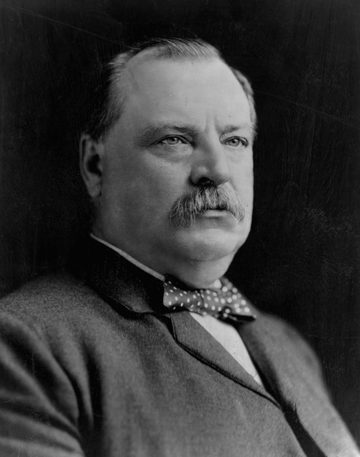
Official portrait
President #22
Grover Cleveland
1837–1908
Leadership Style
Cleveland was the only president to serve two non-consecutive terms—elected in 1884, defeated by Benjamin Harrison in 1888 (despite winning the popular vote), then defeating Harrison in 1892 to reclaim the office. He governed with stubborn integrity, a Bourbon Democrat's faith in limited government, the gold standard, and tariff reduction. He vetoed more bills (584 in his first term alone) than all previous presidents combined—mostly private pension bills for Civil War claimants of dubious merit. He was incorruptible, blunt, and personally austere; his motto "A public office is a public trust" became his political identity. The same rigidity that made him admirable in 1885 left him politically isolated by 1896, when his own party repudiated him.
Greatest Accomplishments
Cleveland extended civil service reform substantially beyond Arthur's Pendleton baseline, bringing tens of thousands of new positions under merit protection. He signed the Interstate Commerce Act (1887), the first major federal regulation of business—aimed at railroad rate discrimination—and creating the Interstate Commerce Commission, the prototype for the entire regulatory state. He signed the Dawes Severalty Act (1887), intended as Indian policy reform (though its consequences were devastating). He vetoed hundreds of pork-barrel pension bills, demanding actual evidence of service-connected disability. In his second term he defended the gold standard against Bryan's silver movement, securing the long-term stability of the dollar at the cost of his party. He demonstrated that a president could say no.
Greatest Failures
His handling of the silver question and the Pullman Strike. After the Panic of 1893, Cleveland forced repeal of the Sherman Silver Purchase Act in 1893, a defensible economic move that nonetheless alienated the agrarian South and West. The deeper failure was his response to the Pullman Strike of 1894: he sent 12,000 federal troops to Chicago over Governor John Altgeld's furious objection, broke the American Railway Union (jailing Eugene Debs), and used a federal injunction to criminalize organized labor's most effective weapon. The strike collapsed; the labor movement learned that the federal government would side with capital. Cleveland's gold-standard intransigence helped split his party and hand Bryan the 1896 nomination on a free-silver platform.
Greatest Challenge
The Panic of 1893 and the depression that followed. A banking panic in May 1893 triggered the worst depression America had yet seen: 500 banks failed, 15,000 businesses collapsed, unemployment hit roughly 18%, and the Treasury's gold reserves dwindled to dangerous levels. Cleveland personally negotiated emergency gold purchases from J.P. Morgan and August Belmont in 1895—a deal that saved the gold standard but inflamed populist fury at Wall Street's leverage over the public Treasury. Coxey's Army marched on Washington in 1894 demanding work relief. The Pullman Strike erupted. The Democratic Party fractured between Cleveland's gold conservatives and Bryan's silver populists. Cleveland's response was firm and unpopular; his party abandoned him in 1896.
Quotes & Slogans
"A public office is a public trust." "What is the use of being elected or re-elected, unless you stand for something?" "It is a condition which confronts us—not a theory." (1887, on the tariff surplus). His 1884 campaign weathered the "Ma, ma, where's my pa?" scandal over his acknowledged illegitimate child, to which his supporters answered after victory: "Gone to the White House, ha, ha, ha!" His 1888 loss came over the tariff issue. The 1892 rematch with Harrison turned on the McKinley Tariff's unpopularity. By 1896 his own party rejected him as Bryan captured it.
Economic Data
Cleveland's economic policy centered on the gold standard, tariff reduction, and balanced budgets. He vetoed pension bills, river-and-harbor pork, and inflationary measures. The Interstate Commerce Act (1887) created the ICC. The Dawes Act (1887) broke up tribal landholdings, eventually transferring 90 million acres from Native Americans to white settlers. The Sherman Silver Purchase Act was repealed in 1893 at his demand. The Panic of 1893 collapsed GDP by roughly 12%; unemployment peaked around 18%. The Treasury's gold reserves required Morgan-Belmont bond syndicate rescues. The Wilson-Gorman Tariff (1894) modestly reduced rates and included a 2% income tax later struck down by the Supreme Court (Pollock, 1895).
Quality of Life
The late 1880s were prosperous; the mid-1890s were catastrophic. The 1893 depression threw millions out of work without any safety net—Coxey's Army was the first significant march on Washington for federal relief. Urban tenements festered; Jacob Riis's How the Other Half Lives (1890) documented New York's squalor. Immigration from Eastern and Southern Europe accelerated—Ellis Island opened in 1892. For Black Southerners, lynching peaked in the 1890s, and Plessy v. Ferguson (1896) constitutionalized segregation in Cleveland's final year. For Native Americans, the Dawes Act dispossessed them of half their land. The Wounded Knee massacre occurred in 1890 (between Cleveland's terms, under Harrison). Labor violence—Homestead 1892, Pullman 1894—revealed the era's class conflict.