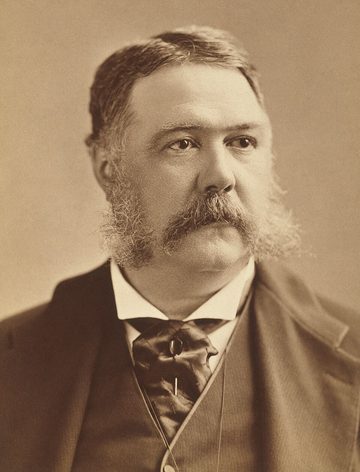
Official portrait
President #21
Chester A. Arthur
1829–1886
Leadership Style
Arthur was the surprise of the Gilded Age. A New York Stalwart, longtime lieutenant of Roscoe Conkling, and former Collector of the Port of New York (the spoils system's crown jewel), he was expected to be a machine president. Instead he governed with dignity, independence, and quiet reformism that disappointed his old patrons and shocked his critics. He dressed impeccably, redecorated the White House (with help from Louis Comfort Tiffany), and entertained graciously. He carried a secret: Bright's disease, a fatal kidney condition diagnosed in 1882, which he concealed and which likely informed his decision not to fight for renomination in 1884. He let his presidency be defined by the cause his old friends most opposed. Succeeded to presidency on Garfield assassination.
Greatest Accomplishments
The Pendleton Civil Service Reform Act of 1883. Passed in the wake of Garfield's assassination by a disappointed office-seeker, it created the merit-based federal civil service: open competitive exams, protection from political firing for covered positions, and a Civil Service Commission to oversee it. Initially it covered only about 10% of federal jobs, but the Act allowed presidents to extend coverage by executive order, and they steadily did. Arthur—the consummate spoils-system beneficiary—championed and signed it, ending the system that had elevated him. He also signed the Tariff Act of 1883 (the "Mongrel Tariff"), began rebuilding the Navy with the first modern steel cruisers (ABCD ships), and improved postal service. The Pendleton Act alone reshaped American governance.
Greatest Failures
The Chinese Exclusion Act of 1882. Arthur initially vetoed a 20-year exclusion bill on treaty grounds, but signed a revised 10-year version that suspended Chinese laborer immigration—the first federal law to bar immigration on the basis of nationality and race. It would be renewed and expanded for sixty years, hardening into permanent statute, and its logic seeded later restrictionist policies (national origin quotas, Japanese exclusion). Arthur's veto was principled; his signature on the revised bill was a political accommodation with brutal long-term consequences for Chinese Americans and for the country's character as a nation of immigrants. He could have used the veto pen more firmly.
Greatest Challenge
Establishing legitimacy as an accidental president from the discredited spoils faction, governing a Republican Party furious at his defection on civil service reform, while concealing a fatal illness. Arthur came to office under suspicion—rumors swirled that his Stalwart allies had something to do with Garfield's death (untrue). He had to demonstrate independence quickly and did, vetoing a Rivers and Harbors pork bill in 1882 (Congress overrode him) and refusing patronage demands from Conkling himself. He prosecuted the Star Route postal frauds that had implicated members of his own party. Knowing he was dying, he served competently and walked away, declining serious effort toward the 1884 nomination.
Quotes & Slogans
"Men may die, but the fabrics of free institutions remain unshaken." "I may be President of the United States, but my private life is nobody's damned business." "Good ball players make good citizens." He had no signature campaign slogan because he never campaigned for the presidency—he succeeded Garfield and did not seek the 1884 nomination. Mark Twain wrote: "I am but one in 55,000,000; still, in the opinion of this one-fifty-five-millionth of the country's population, it would be hard indeed to better President Arthur's administration." From his old enemies' perspective, he had betrayed them. From history's, he had grown into the office.
Economic Data
The federal Treasury continued running large surpluses—often $100 million annually—raising debates over tariff reduction, debt retirement, and infrastructure spending. The Tariff Act of 1883 modestly reduced some rates but left protection largely intact. Federal debt continued to decline. Arthur authorized construction of the first steel-hulled warships (USS Atlanta, Boston, Chicago, Dolphin), beginning the modern American Navy. Railroad expansion continued—mileage grew from 93,000 in 1880 to 125,000 by 1885. The Standard Time system was adopted by railroads in 1883, dividing the country into four time zones. Immigration averaged about 500,000 per year. The Brooklyn Bridge opened in 1883.
Quality of Life
The early 1880s were prosperous but unequal. Industrialists like Rockefeller, Carnegie, and Vanderbilt were amassing fortunes; workers labored 60+ hour weeks in dangerous conditions without protections. Urban populations exploded—New York passed two million; Chicago boomed after its 1871 fire. Electric lighting spread; telephones multiplied. For Chinese immigrants, the Exclusion Act ended a community's lawful growth and unleashed violence. For Black Southerners, Jim Crow consolidated. For Plains tribes, the buffalo herds were nearly extinct by 1884 and reservation life was brutal. The Edmunds Act (1882) criminalized polygamy and disenfranchised Mormons in Utah. The country's prosperity was real and its injustices were deepening simultaneously.