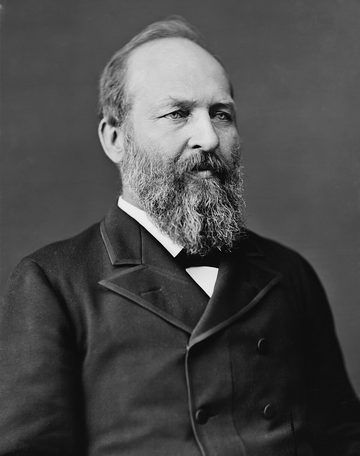
Official portrait
President #20
James A. Garfield
1831–1881
Leadership Style
Garfield was the last president born in a log cabin and one of the most intellectually gifted ever to hold the office—a former college president, Civil War major general, and nine-term congressman fluent in Latin, Greek, and mathematics (he produced an original proof of the Pythagorean theorem). He was a conciliator by temperament, capable of bridging Republican factions, and a skilled parliamentarian. He approached the presidency intending to restore its prestige after Hayes's contested tenure and to confront the patronage system head-on. His brief presidency showed flashes of decisiveness, particularly in defying Roscoe Conkling over New York appointments, but his program was cut short before its character could fully develop.
Greatest Accomplishments
Garfield's most consequential act in his 200 days was his confrontation with Senator Roscoe Conkling over the Collector of the Port of New York. By nominating William H. Robertson—a Conkling enemy—Garfield asserted that the president, not senators, controlled federal appointments. Conkling resigned his Senate seat in protest, expecting the New York legislature to re-elect him in vindication. It refused. The senatorial "courtesy" that had given bosses veto power over federal jobs was broken. Garfield's stand created the political space for the Pendleton Civil Service Act that Arthur would sign two years later. He also began modernizing the Post Office and exposing the Star Route mail-contract frauds.
Greatest Failures
His failure was running out of time. Shot by Charles Guiteau, a deranged disappointed office-seeker, at the Baltimore and Potomac train station on July 2, 1881, Garfield lingered for eleven weeks while doctors probed his wound with unsterilized fingers and instruments, almost certainly causing the infection that killed him on September 19. His reformist agenda—civil service overhaul, expanded Black education in the South, modernizing the executive branch—was barely beginning when he was struck down. The failure was not his but his era's: of medicine, of presidential security, and of a patronage system whose victim sought revenge for not being given a consulship.
Greatest Challenge
The patronage wars within his own Republican Party. The GOP was split between Stalwarts (Conkling, machine-loyal, pro-spoils) and Half-Breeds (Blaine, reformist-leaning). Garfield was a Half-Breed who had won the nomination on the 36th ballot at a deadlocked convention; his vice president, Chester Arthur, was Conkling's man. Every appointment became a faction war. Office-seekers besieged the White House from dawn—Garfield wrote that he had "hardly a moment to think" between job-seekers. His decision to confront Conkling directly was politically risky but established that the presidency would not be a subsidiary of Senate bosses. He won the principle and lost his life partly because of it.
Quotes & Slogans
"A pound of pluck is worth a ton of luck." "The truth will set you free, but first it will make you miserable." "Ideas control the world." His 1880 campaign ran from his Mentor, Ohio front porch—the original "front porch campaign"—on themes of sound money, protective tariffs, and civil rights for Black Southerners. The slogan emphasized continuity with Lincoln and Grant Republicanism. After his death, his last words—addressed to General David Swaim—were reportedly about pain in his heart. His funeral was the largest national mourning since Lincoln's.
Economic Data
Garfield's economic program emphasized sound money (gold standard), debt reduction, and the protective tariff. Federal revenues exceeded expenditures by roughly $100 million annually, raising the policy question of what to do with surpluses—a problem unimaginable to later administrations. The economy was in strong expansion after the Long Depression; railroad mileage, steel production, and immigration all surged. The Treasury continued retiring Civil War debt. Garfield's Treasury Secretary William Windom executed a successful refunding of $682 million in federal bonds at lower interest rates, saving the government roughly $10 million annually. The Star Route postal frauds Garfield exposed involved millions in stolen contract money.
Quality of Life
The country in 1881 was prosperous on the surface and turbulent underneath. Industrial output was booming, wages were rising, and immigration from Germany, Ireland, Italy, and increasingly Eastern Europe was reshaping cities. The Brooklyn Bridge was under construction; the first electric streetlights were appearing. Telephone networks were spreading. For Black Southerners, conditions continued to deteriorate after the 1877 troop withdrawal. Garfield had spoken in favor of federal aid for Black education and his death cut off what might have been a meaningful federal recommitment. Medical care remained primitive—the doctors who killed Garfield through sepsis were considered the nation's best. Public health was beginning to professionalize but still lagged disease.