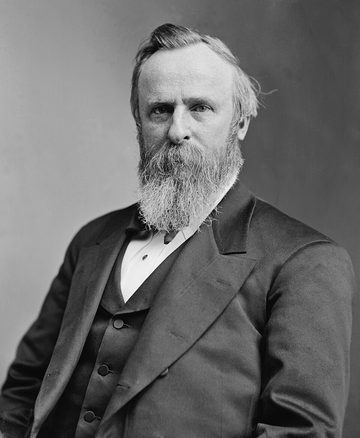
Official portrait
President #19
Rutherford B. Hayes
1822–1893
Leadership Style
Hayes was a Union general and three-term Ohio governor with a reputation for integrity, intelligence, and reformist instincts. He governed deliberately, kept a detailed diary, and brought a clergyman's moral seriousness to the office (his wife Lucy, called "Lemonade Lucy," banned alcohol from the White House). He believed strongly in civil service reform and pursued it against fierce resistance from his own party's spoils-system bosses, especially Roscoe Conkling of New York. He refused to seek a second term, signaling the office should be served, not held. His leadership was earnest and competent, but he was crippled from the start by the manner of his election, which deprived him of moral authority.
Greatest Accomplishments
Civil service reform was the cause Hayes pursued most consistently. He ordered an investigation of the New York Custom House—the largest patronage operation in the country—and ultimately fired Chester Arthur as Collector, defying Conkling's machine. He issued an executive order forbidding federal employees from managing political campaigns. He vetoed a bill that would have demonetized greenbacks in a way he saw as unsound. He defended the gold standard via the Specie Resumption Act, which took effect in 1879 and restored confidence in the dollar. He also began modernizing the federal bureaucracy in ways that prefigured the Pendleton Act of 1883. His insistence on appointing officials by merit set a precedent his successors built upon.
Greatest Failures
The Compromise of 1877. To resolve the disputed 1876 election—where Hayes trailed Samuel Tilden in the popular vote and the electoral count hinged on contested returns from South Carolina, Florida, and Louisiana—an Electoral Commission awarded all disputed electors to Hayes by an 8-7 party-line vote. In exchange, Hayes withdrew the remaining federal troops protecting Reconstruction governments in the South. The Bourbon Democrats took power; Black voting rights collapsed; Jim Crow began its eighty-year reign. Whether Hayes had genuine alternatives is debated, but the consequence is not: roughly four million Americans were abandoned to violent disenfranchisement. It is the single most damaging act of Reconstruction's end.
Greatest Challenge
Hayes inherited a fractured nation that did not consider him legitimately elected. Democrats called him "Rutherfraud" and "His Fraudulency." The Long Depression was still grinding on. The Great Railroad Strike of 1877 erupted that July—the first major nationwide labor uprising in U.S. history—and Hayes deployed federal troops to break it, killing dozens of strikers. He had to navigate a Democratic House determined to repeal Reconstruction laws, a Republican Party split between Stalwarts (Conkling) and Half-Breeds (Blaine), and a country exhausted by twelve years of post-war conflict. He restored some dignity to the office but at the cost of Black Southern lives and freedoms.
Quotes & Slogans
"He serves his party best who serves his country best." (Inaugural Address, 1877). "Let no man be put in any place under me except on his merits." "Nothing brings out the lower traits of human nature like office-seeking." His campaign in 1876 ran on civil service reform and "sound money"—the gold standard versus Democratic and Greenback inflationism. After his presidency, he devoted himself to prison reform and education, particularly for Black Southerners, perhaps in partial atonement for the Compromise. His diary contains anguished reflections on the failure of Reconstruction.
Economic Data
The Specie Resumption Act took effect January 1, 1879, restoring gold convertibility of greenbacks and ending years of paper-money inflation debate. The Long Depression finally ended in 1879, and the economy boomed for the remainder of Hayes's term. He vetoed the Bland-Allison Act (silver coinage), but Congress overrode him; limited silver purchases resumed. Federal debt continued to decline. Railroad construction surged again, with mileage growing from about 79,000 in 1877 to 93,000 by 1880. Tariffs remained high, generating most federal revenue. The Treasury operated at surplus by 1880.
Quality of Life
Recovery from the Long Depression brought rising wages and falling unemployment after 1879, though the gains were uneven. The Great Railroad Strike exposed the brutal conditions of industrial labor—wage cuts, dangerous work, no recourse—and was crushed with federal force. For Southern Blacks, life worsened drastically. The withdrawal of troops meant the end of meaningful federal protection; lynchings began rising; Black officeholders were driven from power; schools were defunded. Chinese immigrants on the West Coast faced escalating violence, leading toward the 1882 Exclusion Act under Arthur. Immigration from Europe surged. Cities grew rapidly; sanitation and housing lagged badly. Life expectancy remained around 40.