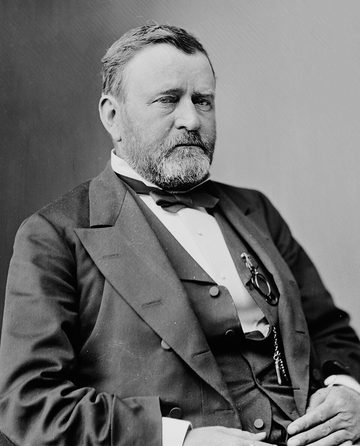
Official portrait
President #18
Ulysses S. Grant
1822–1885
Leadership Style
Grant brought to the presidency the same qualities that won him the war: quiet determination, loyalty to subordinates, and a soldier's faith in the chain of command. He was unpretentious, plainspoken, and uncomfortable with the political performance the office demanded. He trusted friends and former staff officers more than he should have, which exposed him to scandals he did not initiate but failed to prevent. On matters he cared about—Reconstruction, civil rights, Native American policy reform, currency stability—he could be firm and decisive. On matters of patronage and political management, he was often passive, deferring to Cabinet members and party bosses. His military command instincts did not translate cleanly to a system designed around bargaining and faction.
Greatest Accomplishments
Grant was the most pro-civil-rights president between Lincoln and LBJ. He oversaw ratification of the Fifteenth Amendment (1870) guaranteeing Black male suffrage. He signed the Enforcement Acts of 1870-1871 and the Ku Klux Klan Act, then used them—deploying federal troops and suspending habeas corpus in nine South Carolina counties—to break the first Klan as a paramilitary organization. Thousands of Klansmen were indicted; hundreds convicted. For a brief window, Black Southerners voted, held office (including two U.S. senators from Mississippi), and built schools and institutions. He also signed the Civil Rights Act of 1875. The federal government would not protect Black political rights this aggressively again until the 1960s.
Greatest Failures
His administration was riddled with corruption scandals: Crédit Mobilier (railroad fraud involving congressmen and his VP Schuyler Colfax), the Whiskey Ring (distillers and Treasury officials defrauding excise taxes—Grant's personal secretary Orville Babcock was implicated), the Belknap scandal (War Secretary selling trading post appointments), Gold Ring (Jay Gould and Fisk attempting to corner gold with help from Grant's brother-in-law). Grant himself was not personally corrupt and died nearly broke, but his loyalty to friends and inability to demand accountability let the rot spread. The scandals exhausted public patience with Reconstruction itself.
Greatest Challenge
Reconstruction—holding the federal commitment to Black citizenship against escalating Southern white terrorism, Northern fatigue, and economic collapse after the Panic of 1873. Grant had to decide repeatedly whether to send troops to protect elections and Black lives, knowing each deployment cost political capital. He sent them more often than any other 19th-century president and less often than he should have. By 1875 he declined to intervene in Mississippi, citing Northern weariness. The Panic of 1873 (triggered by Jay Cooke's bank failure) launched a five-year depression that hollowed out support for the costly federal presence in the South. Reconstruction died on his watch, though the killing blow came under Hayes.
Quotes & Slogans
"Let us have peace." (acceptance of 1868 nomination, became campaign slogan). "I know no method to secure the repeal of bad or obnoxious laws so effective as their stringent execution." "The art of war is simple enough. Find out where your enemy is. Get at him as soon as you can. Strike him as hard as you can, and keep moving on." His 1872 campaign emphasized continuity and Union, running against Liberal Republican Horace Greeley. "Grant us another term" was a common slogan. His memoirs, written while dying of throat cancer to support his family, are considered among the finest by any American.
Economic Data
The Coinage Act of 1873 demonetized silver—later denounced by silver advocates as the "Crime of '73"—and committed the U.S. toward the gold standard. The Panic of 1873 collapsed Jay Cooke & Company, triggered widespread bank failures, and launched the Long Depression that lasted until 1879. Unemployment hit double digits; railroad construction halted; 18,000 businesses failed by 1875. Grant vetoed the Inflation Bill of 1874, which would have expanded greenbacks, prioritizing sound money over relief. The Resumption Act (1875) committed to redeeming greenbacks in gold by 1879. Federal debt was steadily reduced. Tariffs remained high. Railroad mileage doubled despite the depression.
Quality of Life
The Grant years saw the Gilded Age begin in earnest—conspicuous wealth among industrialists alongside grinding poverty for workers and farmers. The 1873 panic threw millions out of work without any safety net. Urban tenements multiplied; New York's Lower East Side became one of the densest neighborhoods on earth. Immigration surged from Germany, Ireland, and increasingly Scandinavia. For freedpeople, the brief flowering of political participation, schools, and landownership in the early 1870s was crushed by white-supremacist violence and economic depression by 1876. For Plains Indians, Grant's "Peace Policy" was contradicted by ongoing wars—Red Cloud, the Modoc War, and culminating in Custer's defeat at Little Bighorn (1876).