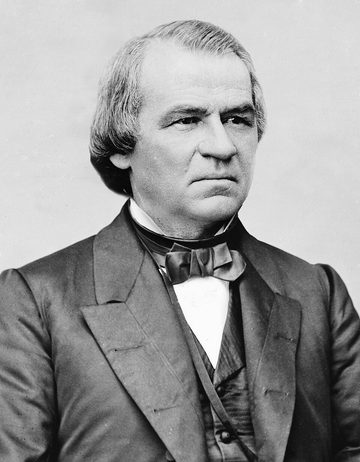
Official portrait
President #17
Andrew Johnson
1808–1875
Leadership Style
Johnson governed by confrontation. A self-made Tennessee tailor who had risen through state politics as a champion of poor whites, he carried into the presidency a stubborn streak, a thin skin, and a deep racial conservatism. He was the only Southern senator to remain loyal to the Union during secession, which made him Lincoln's natural running mate in 1864—but his loyalty to Union did not extend to racial equality. Johnson preferred public combat over private negotiation, gave intemperate "swing around the circle" speeches in 1866 that damaged his standing, vetoed bill after bill, and treated Congress as an enemy rather than a coequal branch. He confused obstinacy with principle. Succeeded to presidency on Lincoln assassination.
Greatest Accomplishments
Honest historians struggle to identify a positive achievement of consequence. His defenders point to the completion of the Alaska Purchase (1867)—Secretary of State Seward negotiated the $7.2 million acquisition from Russia, ridiculed at the time as "Seward's Icebox" but later vindicated by gold and oil. Johnson supported it and got it ratified. He also pushed for swift reconciliation with the defeated South, which was his stated purpose, though the manner of that reconciliation became his defining failure. The Alaska Purchase is essentially the one durable, unambiguous positive of his presidency.
Greatest Failures
Johnson's presidency was, on balance, a catastrophe for Reconstruction. He vetoed the Civil Rights Act of 1866 and the Freedmen's Bureau bill (Congress overrode both). He opposed the Fourteenth Amendment, urging Southern states to reject it. He issued sweeping pardons to former Confederates, allowing the antebellum political class to return to power. Southern states enacted Black Codes that re-imposed near-slavery on freedmen. He was impeached by the House in 1868 over the Tenure of Office Act dispute (firing Edwin Stanton) and acquitted in the Senate by a single vote. He restored the architecture of white supremacy that his successors and the freedpeople would spend a century trying to dismantle.
Greatest Challenge
Reconstructing a nation after civil war—how to readmit eleven seceded states, what citizenship and rights to extend to four million freedpeople, and how to balance reconciliation with justice. Johnson believed the South should be restored quickly with minimal federal interference and that the freedmen's fate should be left to the states. Radical Republicans in Congress believed the opposite. The collision was inevitable, but Johnson's combative temperament guaranteed it would be ruinous. He faced the hardest political problem in American history and got nearly every major decision wrong, leaving the country with Reconstruction half-built and ultimately abandoned.
Quotes & Slogans
"This is a country for white men, and by God, as long as I am President, it shall be a government for white men." (private letter, 1866). "I am right. I know I am right and I am damned if I do not adhere to it." His public rhetoric leaned on Jacksonian populism—the common man against the elite—but his presidency had no enduring slogan. He campaigned in 1866 against Radical Republicans during the "swing around the circle," trading insults with hecklers and damaging the dignity of the office.
Economic Data
The postwar economy was turbulent. The federal debt stood at $2.7 billion, an unprecedented figure. The Treasury under Hugh McCulloch began contracting the greenback money supply to return to specie payments, contributing to deflation that hurt debtors and farmers. The South was economically devastated—its wealth in enslaved people erased, infrastructure destroyed, capital obliterated. Sharecropping emerged as the new labor system, trapping freedmen in cyclical debt. The transcontinental railroad construction continued. The Alaska Purchase added 586,000 square miles for about two cents per acre. Federal revenues remained dependent on tariffs and excise taxes; the wartime income tax was retained through 1872.
Quality of Life
For freedpeople, the gap between formal emancipation and actual freedom widened during Johnson's term. The Freedmen's Bureau provided some education and food relief but was undermined by Johnson's hostility. Black Codes restricted movement, contracts, and gun ownership. Violence by groups that would coalesce into the Klan began rising in 1866-1868. For white Southerners, daily life meant rebuilding amid poverty. Northern industry boomed—coal, steel, railroads—but wages stagnated against deflation. The country was exhausted, grieving, and bitterly divided. Cholera epidemics struck major cities in 1866. Public health, sanitation, and labor protections remained essentially nonexistent.