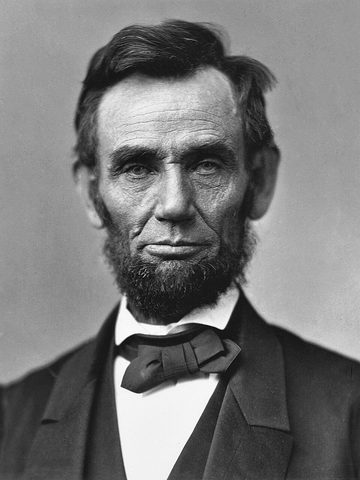
Official portrait
President #16
Abraham Lincoln
1809–1865
Leadership Style
Lincoln led through moral clarity wrapped in political pragmatism. He assembled a cabinet of rivals—Seward, Chase, Stanton—men who had opposed him for the nomination, because he believed the nation needed its strongest minds at the table regardless of personal slight. He governed by patient persuasion rather than command, using humor, parables, and self-deprecation to disarm opponents. He read deeply, wrote his own speeches, and revised them obsessively. Lincoln tolerated dissent within his administration but maintained ultimate control over war strategy, eventually finding in Grant a general who matched his resolve. His leadership combined the lawyer's caution with the prophet's vision, slow to commit but unshakeable once decided.
Greatest Accomplishments
Preserving the Union and issuing the Emancipation Proclamation. When seven states seceded before he even took office, Lincoln refused to recognize secession as legitimate and waged a four-year war to keep the nation whole. The Emancipation Proclamation (Jan 1, 1863) transformed the war's moral character, redefining it as a struggle against slavery itself and clearing the path for the Thirteenth Amendment, which he shepherded through Congress in January 1865. He demonstrated that constitutional democracy could survive its gravest internal threat. The Gettysburg Address—272 words delivered in November 1863—reframed the American founding around the proposition that all men are created equal, giving the war a meaning that outlasted its battles.
Greatest Failures
Lincoln's suspension of habeas corpus and the broader wartime curtailment of civil liberties remain his most troubling legacy. In Ex parte Merryman (1861), Chief Justice Taney ruled the suspension unconstitutional, and Lincoln simply ignored him. Thousands of civilians were detained without trial, opposition newspapers were shuttered, and Copperhead Democrats like Clement Vallandigham were arrested for speech. Lincoln defended these measures as necessary to save the Constitution itself, but they established precedents that later presidents would invoke in less existential circumstances. The tension between liberty and security in wartime was not resolved—merely deferred.
Greatest Challenge
The Civil War—the bloodiest conflict in American history, with roughly 750,000 dead. Lincoln inherited a fractured nation, lost battle after battle in the war's first two years, cycled through generals (McDowell, McClellan, Burnside, Hooker, Meade) before finding Grant, and faced a hostile press, draft riots in New York, and a re-election campaign in 1864 that he expected to lose until Sherman took Atlanta. He had to simultaneously prosecute total war, hold border states (Kentucky, Maryland, Missouri) in the Union, manage a fractious cabinet, navigate emancipation's political risks, and plan a reconstruction he would not live to oversee. He absorbed it all and never broke.
Quotes & Slogans
"A house divided against itself cannot stand." "With malice toward none, with charity for all." "Government of the people, by the people, for the people, shall not perish from the earth." "The dogmas of the quiet past are inadequate to the stormy present." "I am a slow walker, but I never walk back." His 1860 campaign ran on "Vote Yourself a Farm" (Homestead Act) and free-soil principles, but Lincoln's enduring slogans came from his presidency itself—the Gettysburg Address and Second Inaugural reshaped American political language permanently.
Economic Data
Lincoln presided over a wartime economy that transformed America. The Legal Tender Act (1862) introduced "greenbacks," fiat paper currency. The National Banking Acts (1863-1864) created a uniform national currency and federal banking system. The Homestead Act (1862) opened 160-acre parcels of public land to settlers. The Pacific Railway Act (1862) chartered the transcontinental railroad. The Morrill Land-Grant Act (1862) founded state universities. Federal spending exploded from $63 million in 1860 to over $1 billion by 1865. The income tax was introduced (1861) to fund the war. Northern industrial capacity surged while the Southern economy collapsed under blockade.
Quality of Life
For most Americans, the Lincoln years meant sacrifice and grief. Roughly 2% of the population died in the war—proportionally equivalent to about 7 million Americans today. Inflation eroded Northern wages; the South suffered famine and devastation. Yet for four million enslaved people, emancipation began the largest expansion of human freedom in American history. Immigration continued (especially Irish and German), the West opened to homesteaders, and the foundations of mass public education were laid via land-grant colleges. Medical care remained primitive—more soldiers died of disease than combat. Life expectancy hovered around 40. Lincoln's America was simultaneously breaking and being remade.