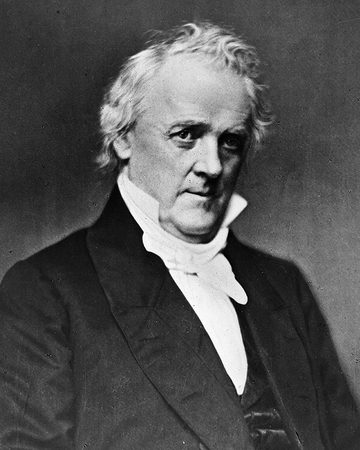
Official portrait
President #15
James Buchanan
1791–1868
Leadership Style
Buchanan was, on paper, one of the most experienced men ever elected to the presidency—four decades in public life as congressman, senator, ambassador to Russia and Britain, and Secretary of State under Polk. In practice, his leadership during the secession crisis was catastrophically passive and sympathetic to the South. He believed, like many Northern Democrats, that the Constitution protected slavery, that abolitionists were the true threat to the Union, and that the federal government had no constitutional authority to coerce a state. He surrounded himself with a Southern-dominated cabinet, was manipulated by friends, and treated the most acute crisis since 1776 as a matter for legal hair-splitting rather than executive action. He is widely considered the worst president in American history.
Greatest Accomplishments
Buchanan's accomplishments are extraordinarily thin given the catastrophe of his presidency. He continued the Walker Tariff regime initially, then signed the Tariff of 1857 lowering rates further. He oversaw the laying of the first transatlantic telegraph cable (briefly operational in 1858) and exchanged the first transatlantic telegrams with Queen Victoria. He resolved the Utah War (1857–1858) with Mormon settlers through negotiation rather than extended conflict. He continued Manifest Destiny diplomacy and pursued (unsuccessfully) the acquisition of Cuba. These modest achievements are dwarfed by his catastrophic failures; honest assessment must acknowledge that almost nothing constructive emerged from his four years sufficient to balance the destruction he enabled.
Greatest Failures
Buchanan is widely considered the worst president in American history because he actively enabled Southern secession during the four-month interval between Lincoln's election in November 1860 and inauguration in March 1861. He declared in his December 1860 annual message that secession was unconstitutional, but that the federal government had no constitutional power to prevent it—an absurd doctrinal split that effectively legitimized disunion. He failed to reinforce federal forts in seceding states until it was too late; he allowed his Southern cabinet officers (including War Secretary John B. Floyd) to transfer arms to Southern states; he kept Southern officials in place as they prepared their states for rebellion. By the time Lincoln took office, seven states had seceded and formed the Confederacy. He also pressured the Supreme Court to issue the Dred Scott decision (1857), denying Black citizenship and ruling Congress could not prohibit slavery in territories—a ruling that destroyed the political middle. He endorsed the fraudulent proslavery Lecompton Constitution for Kansas, splitting his own party permanently. His passivity during the secession winter remains the most consequential dereliction of presidential duty in American history.
Greatest Challenge
Buchanan faced the disintegration of the American constitutional order—the gravest challenge in American history short of the Revolution. He inherited the Kansas crisis, the radicalized Republican Party, John Brown's raid on Harpers Ferry (October 1859), the Panic of 1857, and a Democratic Party already split between Northern and Southern factions. The 1860 election split the Democrats into two tickets and produced Lincoln's Republican victory; seven Deep South states seceded within weeks. Buchanan had to decide whether to use federal power to preserve the Union, whether to compromise further with slaveholders, and whether to hold federal property in seceded states. He chose paralysis—affirming federal sovereignty in theory while declining all means of enforcing it. The Civil War he passed to Lincoln was his moral inheritance.
Quotes & Slogans
The 1856 Democratic campaign emphasized continuity: "We Polked 'em in 1844, we Pierced 'em in 1852, we'll Buchan 'em in 1856." Buchanan's First Inaugural famously predicted the Dred Scott decision he had privately lobbied for: "A difference of opinion has arisen in regard to the point of time when the people of a Territory shall decide this question for themselves...To their decision, in common with all good citizens, I shall cheerfully submit, whatever this may be." In December 1860, defending his inaction: "The South has no right to secede, but I have no right to prevent them from seceding." This formulation captures his fatal jurisprudential paralysis.
Economic Data
The Panic of 1857 struck within months of Buchanan's inauguration—triggered by railroad overextension, declining grain prices, and the failure of the Ohio Life Insurance and Trust Company. It produced a sharp recession lasting through 1859, particularly devastating Northern industry while leaving Southern cotton economy relatively unscathed—a divergence Southerners read as proof of their economic superiority. Buchanan opposed federal economic intervention. The Tariff of 1857 (lowering duties) was passed just before the Panic and was widely blamed for it by protectionists. Federal revenue collapsed; the federal debt began rising. Railroad construction slowed but continued. By 1860, recovery was underway in much of the country, but the political wreckage of his administration was far more lasting than the economic disruption.
Quality of Life
American life under Buchanan was politically poisoned and increasingly violent. Population grew from approximately 28 million in 1857 to over 31 million by 1860. Minnesota (1858), Oregon (1859), and Kansas (admitted just before Lincoln took office in January 1861) became states. The Dred Scott decision in March 1857 denied citizenship to all Black Americans, free or enslaved. The Lincoln-Douglas debates of 1858 transformed national political discourse. John Brown's raid at Harpers Ferry in October 1859 terrified the South. The Panic of 1857 caused unemployment and bread riots in Northern cities. The 1860 election cycle was the most consequential in American history. By March 4, 1861, seven states had seceded; federal authority was collapsing; Fort Sumter was under siege. Buchanan handed Lincoln a shattered nation.