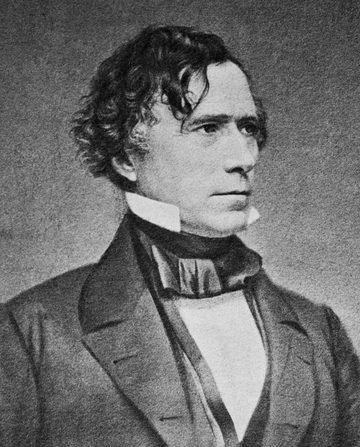
Official portrait
President #14
Franklin Pierce
1804–1869
Leadership Style
Pierce was a charming, handsome New Hampshire politician—a "doughface," Northern man with Southern sympathies—who proved fatally weak as a leader. He took office at 48 (then the youngest president), grieving the death of his 11-year-old son in a train accident two months before his inauguration; his wife Jane never recovered and was largely absent from the White House. Pierce led through accommodation of pro-Southern Democrats and signed legislation he privately doubted. His style was deferential to powerful party figures, particularly Senator Stephen Douglas and Secretary of War Jefferson Davis. He drank heavily—"the hero of many a well-fought bottle," enemies said—and could not impose direction on a cabinet that essentially ran without him. He left office discredited and was denied renomination in 1856.
Greatest Accomplishments
Pierce's positive accomplishments were modest and largely foreign-policy related. The Gadsden Purchase of 1853 acquired about 30,000 square miles of present-day southern Arizona and New Mexico from Mexico for $10 million, primarily to facilitate a southern transcontinental railroad route. The Kanagawa Treaty of 1854 (Perry's mission, executed under Pierce) formally opened Japan to American trade. The Reciprocity Treaty of 1854 with Britain liberalized U.S.-Canadian trade. Domestically, Pierce achieved very little of constructive value—his administration is mostly remembered for what it broke rather than what it built. The federal debt was reduced; the economy generally prospered; routine government continued.
Greatest Failures
Pierce signed the Kansas-Nebraska Act of May 1854, which repealed the Missouri Compromise's prohibition of slavery north of 36°30′ and opened Kansas and Nebraska Territories to slavery via popular sovereignty. The Act detonated the political order. It destroyed the Whig Party, split the Democratic Party along sectional lines, produced the new antislavery Republican Party within months, and ignited "Bleeding Kansas"—a guerrilla war between proslavery and antislavery settlers that killed scores. Pierce sided with the fraudulent proslavery Lecompton government and used federal force against free-state settlers. He also endorsed the Ostend Manifesto (1854) urging the U.S. to seize Cuba from Spain to expand slavery. Historians consistently rank Pierce among the worst presidents largely because of these decisions.
Greatest Challenge
Pierce's challenge was governing a Democratic Party already fracturing under the strain of slavery while a hostile sectional crisis demanded leadership he could not provide. He inherited the Compromise of 1850 as supposedly final settlement of the slavery question; Stephen Douglas's transcontinental railroad ambitions and Southern demands then reopened the question through the Kansas-Nebraska Act. Pierce signed it, hoping to preserve the Democratic coalition; instead he detonated it. He then had to manage the violence in Kansas, the rise of the Republican Party, the collapse of his own political authority, and the increasing radicalization of both sections. His personal grief, his alcoholism, and his deference to stronger Southern Democrats meant he met none of these challenges adequately.
Quotes & Slogans
Pierce's 1852 campaign deployed "We Polked you in 1844; we shall Pierce you in 1852" and "Young Hickory of the Granite Hills," linking him to Jackson and Polk. His First Inaugural promised "I fervently hope that the question [of slavery] is at rest." The Kansas-Nebraska Act made that hope ridiculous within sixteen months. He famously stated, "You have summoned me in my weakness; you must sustain me by your strength," addressing the nation after his son's death—revealing emotional fragility his enemies later exploited. He spent his post-presidency drinking and grew bitterly opposed to the Civil War, sympathizing openly with the Confederacy.
Economic Data
Pierce's economy generally prospered. Federal revenue from tariffs and land sales remained strong; the federal debt declined to roughly $28 million by 1857—the lowest point in the entire nineteenth century. The Gadsden Purchase cost $10 million. Railroad mileage continued its explosive growth—from about 21,000 miles in 1853 to over 28,000 by 1857. The clipper ship era continued. Cotton prices reached record highs; Southern wealth concentrated dramatically. Immigration peaked under Pierce; over 400,000 immigrants arrived in 1854 alone—mostly Irish and German. Speculation in railroads, land, and Western banking grew; the Panic of 1857 would arrive months after Pierce left office, but its causes accumulated during his term.
Quality of Life
American life under Pierce was prosperous on the surface but politically poisoned by the slavery extension crisis. Population grew from approximately 24 million in 1853 to over 28 million by 1857. Mass Irish and German immigration transformed Northern cities. The first World's Fair in the United States (the New York Crystal Palace Exhibition) opened in 1853. The Republican Party was founded in 1854 in direct response to the Kansas-Nebraska Act. "Bleeding Kansas" violence escalated through 1855–1856—the sacking of Lawrence in May 1856, John Brown's massacre at Pottawatomie in retaliation, and the caning of Senator Charles Sumner on the Senate floor by Representative Preston Brooks that same month. Pierce's America was rich and tearing apart.