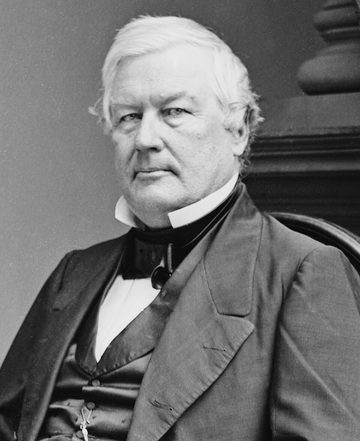
Official portrait
President #13
Millard Fillmore
1800–1874
Leadership Style
Fillmore led as a conciliator who believed sectional compromise could preserve the Union—a fundamentally different theory from Taylor's confrontational stance. He reversed Taylor's position within days of taking office, replaced the entire cabinet with Compromise of 1850 supporters (Daniel Webster as Secretary of State), and used presidential influence to push Clay's compromise package through Congress. His style was methodical, careful, and accommodating. He was a self-made New York lawyer of modest background—born in a log cabin and largely self-educated—who genuinely believed political compromise was a moral good. His willingness to enforce the Fugitive Slave Act vigorously made him hated in the North; his role in securing the Compromise made him useful to slaveholders. He pleased no one fully.
Greatest Accomplishments
Fillmore's principal accomplishment was the passage and implementation of the Compromise of 1850, which postponed the Civil War by a decade. The compromise admitted California as a free state, organized New Mexico and Utah Territories with popular sovereignty on slavery, settled the Texas-New Mexico boundary, abolished the slave trade (though not slavery) in the District of Columbia, and enacted a stringent Fugitive Slave Act. He also dispatched Commodore Matthew Perry's expedition to Japan, which arrived in 1853 just after Fillmore left office—forcing the opening of Japan to American trade and beginning Japan's confrontation with industrial modernity. He signed legislation enlarging the U.S. Capitol and adding the current dome.
Greatest Failures
Fillmore's enforcement of the Fugitive Slave Act of 1850 was a profound moral failure that radicalized Northern abolitionism and accelerated the sectional crisis. The Act required federal commissioners and ordinary citizens to assist in capturing escaped enslaved people, denied accused fugitives jury trials, and offered commissioners financial incentives to rule for slaveholders. Fillmore deployed federal troops to enforce it, including in the dramatic Anthony Burns case in Boston and others. The Act spawned Uncle Tom's Cabin (1852), made the Underground Railroad a desperate necessity, and convinced many Northerners that the federal government itself had become an instrument of the slave power. His support of the Know-Nothing nativist movement in 1856 further damaged his legacy.
Greatest Challenge
Fillmore inherited the unresolved territorial crisis from Taylor's death and the threat of Southern secession unless slavery's expansion was guaranteed. He had to navigate between Northern free-soilers who refused to admit more slave states or strengthen fugitive-slave enforcement, and Southern fire-eaters who threatened secession if slavery's protections were not expanded. He had to manage the Compromise of 1850 through Congress without alienating either faction past the breaking point. He had to enforce the Fugitive Slave Act in hostile Northern cities while preserving federal authority. He had to keep his Whig Party intact despite its catastrophic sectional divisions—an effort that ultimately failed; the Whig Party would dissolve by 1856, replaced by the antislavery Republicans.
Quotes & Slogans
Fillmore acceded to the presidency on Taylor's death and never won a presidential election—no campaign slogans applied to him directly until 1856, when he ran as the American (Know-Nothing) Party candidate under nativist themes ("Americans must rule America"). His enduring statements emphasized union and law: "God knows that I detest slavery, but it is an existing evil, for which we are not responsible, and we must endure it and give it such protection as is guaranteed by the Constitution." On the Fugitive Slave Act: "The law must be obeyed." These quotes capture both his moral discomfort and his fatal commitment to legal formalism over moral judgment.
Economic Data
Fillmore's economy benefited from California gold, expanding railroads, and growing trade. Federal revenue from tariffs grew with import volumes. The Walker Tariff of 1846 remained in place; the Independent Treasury continued. The Gadsden Purchase was negotiated under his successor Pierce but the diplomatic ground was prepared under Fillmore. Railroad construction accelerated dramatically—total U.S. mileage roughly doubled from about 9,000 miles in 1850 to over 21,000 by 1853. The clipper ship era reached its peak with the California and China trades. Cotton prices were strong; Southern wealth grew; Northern manufacturing expanded. The economy was prospering; the political union was fracturing.
Quality of Life
California became the 31st state in September 1850. The population was 23.2 million in 1850, growing fast. The Fugitive Slave Act dramatically affected Black communities, free and enslaved—many free Blacks in Northern cities fled to Canada to avoid potential kidnapping. Uncle Tom's Cabin was published in 1852, selling 300,000 copies in its first year. Steam navigation transformed transatlantic travel. The Erie Railroad was completed (1851). Commodore Perry's squadron departed for Japan in 1852. Mass immigration from Ireland (fleeing famine) and Germany (fleeing 1848 revolutions) transformed Northern cities. Nativist anti-Catholic movements grew, producing the Know-Nothing political wave Fillmore would later ride.