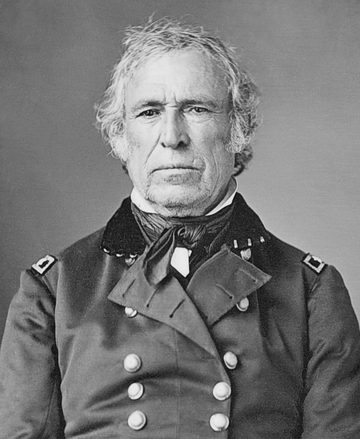
Official portrait
President #12
Zachary Taylor
1784–1850
Leadership Style
Taylor was a career military officer—40 years in the Army—with no political experience and no clear party convictions before being recruited as the Whig nominee in 1848 on the strength of his Mexican-American War celebrity ("Old Rough and Ready"). His leadership style was blunt, soldierly, and surprisingly independent of party expectation. Though a Louisiana slaveholder owning roughly 150 enslaved people, he opposed the extension of slavery into the territories and supported the immediate admission of California and New Mexico as free states. He defied Southern threats of secession with characteristic military directness, reportedly threatening to personally lead troops against any state that rebelled. His sixteen months in office were marked by conflict with Henry Clay and the congressional Whig leadership over the Compromise of 1850.
Greatest Accomplishments
Taylor's most consequential accomplishment was his uncompromising stance against the extension of slavery and against Southern secession threats during the territorial crisis of 1849–1850. He encouraged California and New Mexico to apply directly for statehood with their own (likely free) constitutions, bypassing congressional debate over slavery in the territories. He threatened to use force against any state that attempted secession—remarkable from a Southern slaveholder. His firmness may have postponed the secession crisis by a decade; had he lived to veto the more concession-laden elements of the Compromise of 1850, the outcome might have differed substantially. The Clayton-Bulwer Treaty of 1850 with Britain, regulating future Central American canals, was negotiated under his administration.
Greatest Failures
Taylor's principal failure was his political inexperience and abrupt management style, which alienated Whig congressional leaders—particularly Henry Clay—and produced a Whig administration unable to work effectively with its own party in Congress. His refusal to support Clay's Compromise of 1850 stalled urgent legislation during a constitutional crisis. The Galphin Affair scandal involving cabinet members took up time and damaged his administration's reputation. He died in July 1850 before any of these conflicts could be resolved on his terms; his successor Millard Fillmore promptly reversed Taylor's position and supported the Compromise. Taylor's brief tenure makes "failure" assessment difficult, but his inability to convert military authority into political effectiveness was clear.
Greatest Challenge
Taylor faced the most acute sectional crisis of the antebellum period: the question of slavery in the territories acquired from Mexico. The Wilmot Proviso had failed but the issue would not die. California's population had exploded with the Gold Rush, demanding immediate statehood. New Mexico, Utah, and the broader Mexican Cession needed organization. Southern states threatened secession if slavery were excluded; Northern states refused to admit more slave states. Taylor's strategy—bypass the territorial question by admitting states directly with their own constitutions—was politically clever but unacceptable to Clay's compromisers and to Southern hardliners. He had to navigate this while learning the political role for which forty years of military service had not prepared him.
Quotes & Slogans
The 1848 Whig campaign deployed "Old Rough and Ready" (Taylor's army nickname) and "For President of the People" emphasizing his outsider status. His personal political statements were sparse. To Southern threats of secession in early 1850, Taylor reportedly told a delegation he would hang anyone caught in rebellion "with less reluctance than I hung deserters and spies in Mexico." His First Inaugural was unusually brief and offered little policy substance. His final words on his deathbed, July 9, 1850: "I have endeavored to do my duty. I am ready to die. My only regret is for the friends I leave behind me."
Economic Data
Taylor's brief tenure overlapped a strong economy. The California Gold Rush flooded the United States and the world with gold—an estimated $200 million produced in California in the four years after discovery, fundamentally reshaping global monetary supply. Federal revenue from tariffs and land sales grew with expanding trade and migration. The Walker Tariff of 1846 remained in force; the Independent Treasury continued operating. Railroad construction accelerated nationally. Federal debt continued to decline from war peaks. Taylor's death in July 1850 transferred economic policy to Fillmore before any distinctive Taylor program could emerge. The economy he left was prosperous, expanding, and increasingly knitted by rail and telegraph.
Quality of Life
American life under Taylor was transformed by the Gold Rush and accelerating modernization. California's non-Native population exploded from about 14,000 in 1848 to over 100,000 by late 1849 and 250,000 by 1852. San Francisco grew from village to instant city. The first transcontinental migrations of 1849 sent tens of thousands across plains and mountains. The population was approximately 23 million by 1850. The Census of 1850 was the first to record names of all free persons (not just heads of household). The Fugitive Slave Act controversy intensified, and the Underground Railroad expanded. The first women's medical college graduated Elizabeth Blackwell in 1849. Cholera epidemics killed thousands, including former President Polk in June 1849.