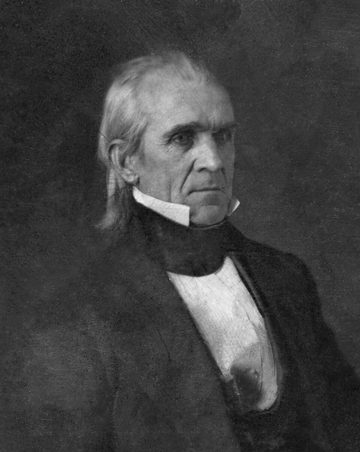
Official portrait
President #11
James K. Polk
1795–1849
Leadership Style
Polk was the most disciplined, focused, and workaholic president of the nineteenth century. He took office at 49 (then the youngest president) with four explicit objectives—reduce the tariff, restore the Independent Treasury, settle the Oregon boundary, and acquire California—and he accomplished all four in a single term he had pledged not to seek reelection from. He worked relentlessly, taking only six weeks of vacation in four years. He micromanaged his cabinet, kept exhaustive diaries, and personally directed war strategy. His leadership style was cold, secretive, and utterly transactional—he saw subordinates as instruments. He drove himself to death; he died three months after leaving office at age 53, the shortest post-presidential life in American history.
Greatest Accomplishments
Polk added more territory to the United States than any president except Jefferson, completing the continental American empire. The Oregon Treaty of 1846 with Britain secured the Pacific Northwest at the 49th parallel (despite the campaign slogan "Fifty-Four Forty or Fight"). The Mexican-American War (1846–1848) produced the Treaty of Guadalupe Hidalgo, which transferred California, Nevada, Utah, most of New Mexico and Arizona, and parts of Colorado and Wyoming—roughly 525,000 square miles—to the United States for $15 million. Combined with the Texas annexation completed at his inauguration, Polk added about 1.2 million square miles. He also achieved his domestic agenda: the Walker Tariff of 1846 (lowering rates) and the restoration of the Independent Treasury (1846).
Greatest Failures
Polk's war with Mexico was provoked, expansionist, and dishonest about its origins—he ordered Zachary Taylor's army into disputed territory specifically to trigger a Mexican response, then told Congress "American blood has been shed on American soil." A young Whig congressman named Abraham Lincoln demanded he identify the "spot" where this occurred (the "Spot Resolutions"). The war killed an estimated 25,000 Mexicans and 13,000 Americans (mostly from disease), and the territorial spoils detonated the slavery extension crisis the Founders had postponed. The Wilmot Proviso, the Compromise of 1850, Bleeding Kansas, Dred Scott, and ultimately the Civil War flowed directly from the lands Polk seized. His success became the country's catastrophe.
Greatest Challenge
Polk's challenge was executing a vastly ambitious agenda—territorial expansion, tariff reduction, financial restructuring—in a single term against a hostile Whig opposition and an increasingly antislavery Northern Democratic faction. He had to wage two simultaneous foreign confrontations (Britain over Oregon, Mexico over Texas and California) while managing the political fallout of the Wilmot Proviso, which proposed banning slavery in any territory acquired from Mexico. The Proviso passed the House repeatedly and shattered the Democratic Party along sectional lines. Polk had to fight a foreign war, conduct delicate boundary diplomacy, restructure federal finances, and watch slavery politics begin tearing apart the coalition that had elected him—all while working himself literally to death.
Quotes & Slogans
Polk's 1844 campaign deployed "Fifty-Four Forty or Fight!" (demanding all of Oregon up to 54°40′ N), "Re-Annexation of Texas and Re-Occupation of Oregon" (rebranding expansion as restoration of older claims), and "Young Hickory" (linking him to Jackson). His war message of May 11, 1846 declared: "Mexico has passed the boundary of the United States, has invaded our territory and shed American blood upon the American soil." In his diary, recording his exhaustion: "No president who performs his duty conscientiously can have any leisure." His farewell address defended Manifest Destiny without using the term.
Economic Data
Polk restructured American economic policy in fundamentally Jacksonian Democratic terms. The Walker Tariff of 1846 substantially lowered duties, shifting toward a revenue tariff and freer trade—the dominant Democratic policy until the Civil War. The Independent Treasury Act of 1846 restored the system Tyler's Whigs had repealed; it lasted until 1913. Federal land sales boomed with western migration. The Mexican-American War cost approximately $100 million and added $15 million in Mexican Cession purchase—doubling the national debt to about $63 million, manageable given postwar growth. California gold was discovered at Sutter's Mill in January 1848, just before the war ended; news reached the East in late 1848, triggering the Gold Rush.
Quality of Life
American life under Polk was transformed by territorial expansion and accelerating modernization. The U.S. acquired roughly 1.2 million square miles; population grew from 19.5 million to 22 million. Iowa (1846) and Wisconsin (1848) became states. The Mexican-American War sent tens of thousands of young men west; many stayed. The Mormon migration to Utah occurred in 1846–1847; Brigham Young entered the Salt Lake Valley in July 1847. The Seneca Falls Convention launched the women's rights movement in July 1848. Gold was discovered in California in January 1848. The first sewing machines appeared; railroad mileage continued doubling. The Communist Manifesto and revolutions across Europe in 1848 echoed faintly in American politics.