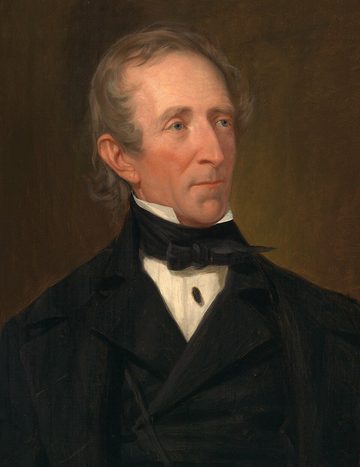
Official portrait
President #10
John Tyler
1790–1862
Leadership Style
Tyler led as a stubborn, principled, and politically isolated executive—"His Accidency," his enemies called him. A states-rights Democrat-turned-Whig who had broken with Jackson over Nullification, he reverted to his Democratic instincts immediately upon taking office. He vetoed two consecutive bank bills proposed by his own Whig party in 1841; the entire cabinet except Secretary of State Daniel Webster resigned in protest; the Whig caucus formally expelled him from the party in September 1841. He governed for nearly four years without a party, ruling by veto and pursuing his own agenda—Texas annexation chief among it—through cabinets of personal loyalists. His style was confrontational, ideological, and ultimately effective at his chosen objective.
Greatest Accomplishments
Tyler's most consequential accomplishment was the annexation of Texas in March 1845, completed in the final days of his term through a joint congressional resolution that bypassed the two-thirds Senate treaty requirement he could not have met. The annexation set the stage for the Mexican-American War, added the future state of Texas to the Union, and dramatically expanded slave territory—Tyler was a slaveholder who saw expansion as essential to slavery's survival. He also established the constitutional principle of full vice-presidential succession—the "Tyler Precedent"—signed the Webster-Ashburton Treaty of 1842 resolving the Maine-Canada boundary with Britain, and signed the Preemption Act of 1841 helping settlers secure western lands they occupied.
Greatest Failures
Tyler's failure to govern collaboratively with his nominal party destroyed the Whig program of 1840 and ultimately the Whig Party itself. By vetoing the Bank bills he made the entire Whig legislative agenda impossible; by being expelled he made coalition government impossible; by pursuing Texas annexation he ensured no future Whig coalition could include him. He left office without a party, ran for reelection in 1844 as a third-party candidate before withdrawing, and ended his life in 1862 as a member of the Confederate Congress—the only former U.S. president to formally side with the South. His enabling of slavery's territorial expansion contributed materially to the conflict that destroyed the Union he had served.
Greatest Challenge
Tyler's challenge was governing without a political base after his own party disowned him. He inherited the presidency under constitutionally contested circumstances—was he "President" or "Acting President"?—and resolved the question by simply asserting full presidential powers. He then faced the choice of accommodating Whig orthodoxy he had never accepted or pursuing his own states-rights, expansionist vision. He chose the latter, accepting the political cost of total isolation. He had to assemble cabinets from loyalists rather than party leaders; sustain executive operations through congressional hostility; and pursue Texas annexation against Whig opposition, antislavery resistance, and Mexican threats of war. He succeeded at his core objective despite having no political coalition.
Quotes & Slogans
Tyler succeeded to the presidency on Harrison's death—no campaign slogan applied to him personally. The 1840 "Tippecanoe and Tyler Too" jingle was Harrison's. As president, Tyler defended his vetoes by arguing he had pledged fidelity to constitutional principles, not party platforms. His annexation arguments emphasized national security and the inevitability of Texas joining the Union. His most consequential pre-presidential statement was his refusal as senator to vote for the Force Bill against South Carolina in 1833. His decision to side with the Confederacy in 1861 remains the most stunning denouement of any American presidential career.
Economic Data
Tyler's vetoes of the Whig bank bills killed any attempt to restore a national bank, leaving the Independent Treasury repealed but no replacement system in place. Federal finance limped along on tariff revenue and land sales as the depression of 1837–1843 finally lifted. The Tariff of 1842 raised duties significantly after the Compromise Tariff of 1833 expired, infuriating the South but funding the government. Texas annexation was financed through joint resolution rather than treaty, allowing Tyler to assume Texas's substantial debt and lands. The economy began recovering in 1843; railroad construction accelerated; cotton prices stabilized. Tyler left office with the economy on a clear upswing his successor Polk would inherit.
Quality of Life
American life under Tyler entered economic recovery after years of depression. Population grew from 17.1 million in 1841 to about 19.5 million by 1845. Florida (1845) became a state in the final days of Tyler's presidency, along with the immediate prospect of Texas. Telegraph lines were strung—Samuel Morse sent "What hath God wrought?" between Washington and Baltimore in May 1844. Railroad mileage doubled during Tyler's term. The Great Migration along the Oregon Trail began in 1843. Mormon settlers in Illinois faced increasing violence; Joseph Smith was murdered in 1844. The abolition movement grew more militant; the Liberty Party ran candidates for president in 1844, draining Whig votes from Henry Clay and helping elect Polk.