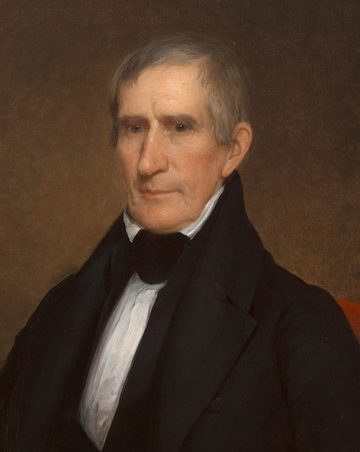
Official portrait
President #9
William Henry Harrison
1773–1841
Leadership Style
Harrison's leadership style as president cannot meaningfully be assessed—he died 31 days into his term. Based on his pre-presidential career as soldier, territorial governor, and congressman, he was a traditional Whig: pro-Congress, anti-Jackson on executive overreach, deferential to legislative leadership. His Inaugural Address explicitly promised to restore the Whig vision of a weaker presidency, fewer vetoes, single-term service, and congressional supremacy. He came to office at age 68—the oldest president until Reagan—after a campaign that portrayed him as a frontier log-cabin hero (he was actually born to Virginia aristocracy). The brief glimpses of his style suggest deference to Henry Clay and the Whig congressional leadership rather than independent assertion.
Greatest Accomplishments
Harrison's principal presidential accomplishment was delivering the longest inaugural address in American history—8,445 words, nearly two hours long—on a cold, wet March 4, 1841, without overcoat or hat. The address itself articulated a coherent Whig theory of restrained executive power, promising to limit veto use, serve only one term, and defer to Congress on policy. His pre-presidential accomplishments were substantial: military victory at Tippecanoe (1811) and the Thames (1813), and decades of territorial and congressional service. His campaign of 1840—"Log Cabin and Hard Cider," "Tippecanoe and Tyler Too"—pioneered modern image-based mass campaigning, with rallies, songs, slogans, and merchandise that transformed American electoral politics.
Greatest Failures
Harrison's failure was operational rather than political: he died of illness 31 days into his term—likely typhoid or enteric fever from contaminated White House water, though pneumonia was the contemporary diagnosis (and the long, hatless inaugural was long blamed). His death created the first major constitutional crisis of presidential succession. The Constitution was ambiguous about whether Vice President John Tyler became president fully or merely "acting" president. Tyler's aggressive seizure of full presidential powers—the "Tyler Precedent"—was contested at the time but ultimately determined American practice for 120 years, until the 25th Amendment codified it in 1967. Harrison cannot be blamed for dying, but the consequences for his party were catastrophic.
Greatest Challenge
Harrison's defining challenge was simply his thirty-one days. The challenge he expected to face was governing as the first Whig president, dismantling Jackson's executive imperium, restoring the Bank of the United States, and implementing Henry Clay's American System of tariffs and internal improvements. Instead, he faced the immediate challenge of mortality. Within weeks of taking office he was bedridden; within a month he was dead—the first president to die in office. His true challenge had been winning the campaign of 1840, which he accomplished with a popular vote landslide reversal of his 1836 defeat by Van Buren, propelled by the depression and the most innovative campaign organization yet seen.
Quotes & Slogans
The 1840 campaign was a slogan factory: "Tippecanoe and Tyler Too," "Log Cabin and Hard Cider," "Van, Van, the Used-Up Man" (against the incumbent), and "Matty's Policy: 50 Cents a Day and French Soup; Our Policy: Two Dollars a Day and Roast Beef." Harrison's Inaugural Address contained occasional pearls: "The strongest of all governments is that which is most free," and his promise to be a "servant" of the people, not their master. He explicitly disclaimed re-election ambitions—a Whig orthodoxy. Within 31 days he was dead; his words remain mostly remembered for their length, not their content.
Economic Data
Harrison inherited the ongoing depression from the Panic of 1837 and died before he could implement any economic policy. The Whig program he intended to enact—repeal the Independent Treasury, charter a Third Bank of the United States, raise protective tariffs, fund internal improvements—was Henry Clay's American System. None of it was enacted under Harrison. The depression continued; federal revenue from tariffs and land sales remained depressed; state bond defaults rippled through international credit markets. Harrison's death postponed the Whig economic counterrevolution that the 1840 election had seemed to mandate—and after Tyler vetoed bank legislation, the Whig program was largely dead anyway.
Quality of Life
Thirty-one days is too brief to measure quality-of-life changes attributable to Harrison's administration. American life under his presidency continued the patterns of the late Van Buren years—lingering depression, expanding migration westward, intensifying sectional conflict over slavery, growing temperance and abolitionist movements. The country mourned its first presidential death; black mourning bands appeared everywhere; church bells tolled across the nation. The succession crisis itself was a profound constitutional moment that quietly reshaped American governance. The population was approximately 17.1 million in 1840. Harrison's brief tenure is significant less for what he did than for what his death revealed about the system's unresolved questions.