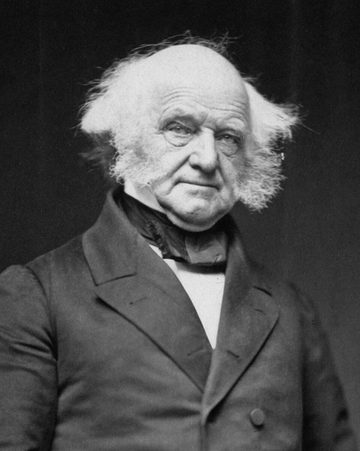
Official portrait
President #8
Martin Van Buren
1782–1862
Leadership Style
Van Buren—the "Little Magician"—was the architect of the modern Democratic Party and one of the most skilled political operators ever to hold the office. As a leader, however, he was cautious, calculating, and constrained. He preserved Jackson's policies and personnel rather than charting independent course. He worked through party machinery rather than personal charisma; he was a manager, not an evangelist. His style was diplomatic, indirect, and famously evasive—he could speak at length without committing himself. He kept Jackson's cabinet, continued the Indian Removal policy he had helped design, and tried to navigate the catastrophic Panic of 1837 through orthodox hard-money policies that prolonged the depression and ended his presidency in defeat.
Greatest Accomplishments
Van Buren's most enduring accomplishment was the Independent Treasury system, established by Congress in 1840, which separated federal funds from private banks and held them in government depositories ("sub-treasuries"). The system aimed to insulate federal finances from banking panics and end the chaos of Jackson's pet-bank policy. Though repealed by Whigs in 1841, it was reinstated under Polk in 1846 and lasted until the Federal Reserve System in 1913. Van Buren also kept the United States out of war during the Caroline Affair and the Aroostook "War" with Britain over the Maine boundary, defusing both crises through patient diplomacy when domestic hawks demanded confrontation.
Greatest Failures
Van Buren inherited the Panic of 1837 within weeks of taking office and responded with orthodox laissez-faire policies that worsened and prolonged the depression. He refused federal relief, refused to halt the Specie Circular promptly, and pursued hard-money policies that contracted credit further. Hundreds of banks failed; unemployment in cities reached 25–33%; cotton prices collapsed; western land values evaporated. The depression lasted through his entire term—the worst until 1893. Additionally, Van Buren enforced the Indian Removal Act ruthlessly; the Cherokee Trail of Tears occurred under his administration in 1838–1839, killing approximately 4,000 Cherokee. He owned the moral consequences of a policy he had helped Jackson design.
Greatest Challenge
Van Buren took office in the worst economic moment any new president had faced, with the financial system collapsing around him. The Panic of 1837 was a structural crisis—the bursting of a speculative bubble built on Jackson's bank destruction and the Specie Circular, compounded by British credit contraction. He had to manage the economic catastrophe with limited federal tools and rigid ideological constraints from the Democratic doctrine of small government and hard money. Simultaneously, he faced border tensions with Britain over Canada, growing sectional conflict over slavery (he opposed Texas annexation because of slavery politics), the Amistad case, and the brutal implementation of Indian Removal. He met none of these challenges with notable success.
Quotes & Slogans
His 1836 campaign deployed "Van, Van, the Used-Up Man" (used against him by Whigs in 1840) and Democratic slogans about continuing Jackson's legacy. Whig opponents in 1840 also coined "Martin Van Ruin." Van Buren himself offered few memorable phrases—his political style was deliberately bland. From his message vetoing federal relief: "All communities are apt to look to government for too much." His later opposition to slavery's expansion produced eloquent statements—he ran for president in 1848 on the Free Soil ticket, denouncing the spread of slavery into the territories.
Economic Data
The Panic of 1837 defined Van Buren's economy. Roughly 343 of 850 banks failed entirely or partially; cotton prices fell 50%; commodity prices collapsed; unemployment soared. A brief recovery in 1838 was followed by a second crash in 1839 that extended the depression through 1843. Federal revenue plunged with declining tariffs and land sales. The Independent Treasury Act (1840) separated public funds from the banking system. The states defaulted in waves—nine states and the Territory of Florida defaulted on bonds in 1841–1842. Van Buren held to gold-standard orthodoxy throughout, refusing to use federal power to alleviate suffering.
Quality of Life
Economic depression devastated ordinary American life under Van Buren. Urban workers faced mass unemployment; bread riots occurred in New York in 1837. Farmers lost land to foreclosure across the West and South. Westward migration intensified as displaced families sought new starts. The Trail of Tears occurred (1838–1839), killing thousands of Cherokee. The Underground Railroad expanded; abolitionist activity intensified. Population grew from 15.4 million in 1837 to 17.1 million by 1840. The Mormon community was driven from Missouri to Illinois in 1838–1839. The first photograph in America was made; the telegraph was being developed; American technological progress quietly continued beneath the surface of crisis.