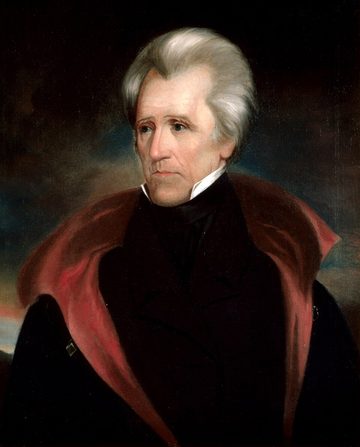
Official portrait
President #7
Andrew Jackson
1767–1845
Leadership Style
Jackson transformed the presidency into a personal, populist, and confrontational institution. He claimed direct democratic mandate over Congress, vetoed more bills (12) than all previous presidents combined, and used the veto for policy reasons rather than constitutional ones—an enormous expansion of executive power. He governed through a "Kitchen Cabinet" of informal advisors, sidelining the formal cabinet. He introduced the spoils system—rotating government jobs to political loyalists—as a democratic principle. His style was direct, combative, and personal: he viewed political opponents as enemies, fought duels, and physically caned a would-be assassin. He embodied a frontier democratic ideal that was simultaneously expansive (white male suffrage) and brutal (Indian Removal, slavery).
Greatest Accomplishments
Jackson's defining accomplishment was the Nullification Crisis of 1832–1833, in which he confronted South Carolina's attempt to nullify federal tariffs and unequivocally asserted federal supremacy. His Nullification Proclamation declared the Union "perpetual" and called nullification "incompatible with the existence of the Union." He secured the Force Bill authorizing military action against South Carolina while simultaneously supporting Henry Clay's compromise tariff—stick and carrot together. The crisis was resolved without violence and established the principle that no state could unilaterally void federal law, a doctrine that would matter enormously in 1861. He also destroyed the Second Bank of the United States, which he saw as a monopoly that subverted democracy—a decision still debated by historians.
Greatest Failures
Jackson's Indian Removal Act of 1830 and its enforcement constitute one of the gravest moral failures in American presidential history. The Act authorized the forced relocation of Native nations from the Southeast to lands west of the Mississippi. When the Supreme Court ruled in Worcester v. Georgia (1832) that Georgia had no authority over Cherokee lands, Jackson allegedly responded, "John Marshall has made his decision, now let him enforce it." Under his successor Van Buren but pursuant to Jackson's policy, the Cherokee, Choctaw, Chickasaw, Creek, and Seminole nations were forcibly removed. The Cherokee Trail of Tears (1838–1839) killed approximately 4,000 of 16,000 Cherokee from disease, exposure, and starvation. The policy was ethnic cleansing.
Greatest Challenge
Jackson confronted simultaneous structural challenges: the rising sectional tension over slavery and tariffs (Nullification Crisis); the question of federal economic power (Bank War); the ongoing dispossession of Native peoples and Southern demand for their lands; and the transformation of American politics from elite caucus to mass democracy. He had to define what "Jacksonian Democracy" meant in practice—expanded suffrage and political participation for white men, the spoils system, presidential supremacy—while holding together a fragile Democratic coalition spanning slaveholding South and small-producer North. He faced an assassination attempt in 1835 (the first against a U.S. president; both pistols misfired) and survived a censure by the Senate, the only president ever censured (later expunged).
Quotes & Slogans
Jackson's 1828 campaign deployed slogans like "Jackson and Reform" and "Let the People Rule." Famous quotes: "Our Federal Union: It must be preserved!"—his April 1830 Jefferson Day toast aimed at John C. Calhoun. From his Bank Veto Message (July 1832): "It is to be regretted that the rich and powerful too often bend the acts of government to their selfish purposes." His Farewell Address (1837) warned against "the money power" and sectionalism. The taunt "King Andrew the First"—from Whig opponents—reflected how thoroughly he had remade the presidency.
Economic Data
Jackson destroyed the Second Bank of the United States in stages: vetoing its recharter in 1832, removing federal deposits to state "pet banks" in 1833, and letting the charter expire in 1836. The Specie Circular of 1836 required gold or silver for federal land purchases, contributing to the Panic of 1837 that crushed his successor. Federal land sales boomed amid speculation; the national debt was fully retired in January 1835—the only time in American history. Cotton prices and Western land speculation drove a frenzied economy that collapsed weeks after Jackson left office. Tariff revenue from the 1828 Tariff of Abominations and the compromise tariff of 1833 funded most federal operations.
Quality of Life
Property qualifications for voting were abolished in nearly all states; white male suffrage became near-universal. The first nominating conventions replaced congressional caucuses. The penny press emerged in 1833, democratizing news. Steam railroads spread rapidly—by 1837 over 1,500 miles of track existed. The Erie Canal's success spawned imitators throughout the North. Population grew from 12.9 million in 1830 to over 15 million by 1837. Texas declared independence from Mexico in 1836. Cholera epidemics swept the country in 1832–1834. For Native peoples, life was destroyed: forced removal began under Jackson and would kill thousands of Cherokee, Creek, Choctaw, Chickasaw, and Seminole.