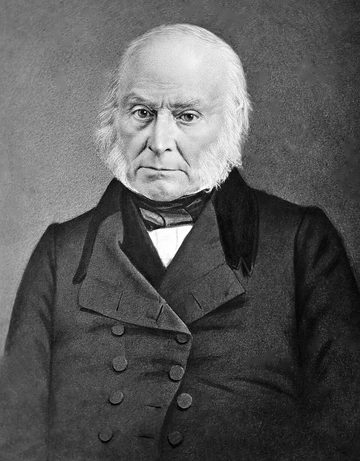
Official portrait
President #6
John Quincy Adams
1767–1848
Leadership Style
Adams was perhaps the most intellectually accomplished man ever to hold the presidency—former diplomat, secretary of state, and architect of the Monroe Doctrine—but his leadership style was disastrously unsuited to the emerging democratic age. Brilliant, austere, hardworking, and constitutionally incapable of political accommodation, he refused to use patronage for partisan advantage and disdained the new mass politics Andrew Jackson was perfecting. He proposed an ambitious nationalist program—federal universities, observatories, scientific expeditions, internal improvements—then watched it die in a Congress controlled by his enemies. He worked alone, rose before dawn, swam in the Potomac, kept exhaustive diaries, and refused to fight the political war being waged against him.
Greatest Accomplishments
Adams's presidency itself produced few accomplishments because Congress blocked nearly his entire program, but his vision of national investment in infrastructure, science, and education was prophetic. He signed the Tariff of 1828 (the "Tariff of Abominations") to protect industry, supported significant internal improvements where possible, and continued the work of his diplomatic career by maintaining peace and expanding trade. His true greatest accomplishment came after his presidency, when he returned to the House of Representatives and served seventeen years as the leading anti-slavery voice in Congress, fighting the "gag rule," arguing the Amistad case before the Supreme Court (1841), and dying at his desk in the Capitol in 1848.
Greatest Failures
The "Corrupt Bargain" of 1824–1825 doomed Adams's presidency before it began. In a four-way race, Andrew Jackson won the most popular and electoral votes (99) but no majority; the election went to the House of Representatives. Henry Clay, who had finished fourth and was thus eliminated, threw his support to Adams, who then won the House vote and immediately appointed Clay Secretary of State—then considered the path to the presidency. The optics were ruinous. Jackson supporters spent the next four years portraying Adams as a usurper of the popular will. Adams compounded the damage by governing as if politics didn't matter, leaving Jacksonians to organize, mobilize, and crush him in 1828.
Greatest Challenge
Adams faced the impossible challenge of governing without a political base in an era when mass democratic politics was being invented around him. He won the presidency through a House vote that half the country considered illegitimate. The old Democratic-Republican consensus had shattered into hostile factions, and Andrew Jackson—the man Adams had defeated—immediately began the first modern presidential campaign for 1828, attacking Adams from outside Washington while Adams's nominal allies in Congress could deliver nothing. Adams refused to remove hostile officeholders, refused to build a partisan press, refused to campaign. He governed as if competence and vision would suffice in an age that increasingly rewarded populism, organization, and personal magnetism.
Quotes & Slogans
No campaign slogan in 1824; the 1828 rematch produced Jacksonian attacks rather than Adams slogans. Adams's enduring formulations include his July 4, 1821 declaration that America "goes not abroad in search of monsters to destroy. She is the well-wisher to the freedom and independence of all. She is the champion and vindicator only of her own." His First Inaugural urged using federal power for "the common defence and general welfare." In his House years he became famous for thunderous anti-slavery oratory that earned him the nickname "Old Man Eloquent."
Economic Data
Adams pursued an ambitious nationalist economic program largely frustrated by Congress. He supported the Second Bank of the United States, internal improvements (roads, canals, harbors), and protective tariffs. The Tariff of 1828, designed by Jacksonian congressmen as a political trap, raised duties dramatically and was furiously denounced in the South as the "Tariff of Abominations." It would set the stage for the Nullification Crisis under Jackson. The economy generally prospered during Adams's term as the postwar recovery continued; the Erie Canal opened in 1825, dramatically reducing freight costs and transforming New York into the dominant commercial city of the nation.
Quality of Life
The Erie Canal opened October 1825, slashing the cost of moving freight from Buffalo to New York City by roughly 95% and triggering canal-building manias across the Northeast. Commercial agriculture expanded westward; manufacturing concentrated in New England mill towns. The first American passenger railroad—the Baltimore & Ohio—was chartered in 1827. The 50th anniversary of the Declaration of Independence on July 4, 1826, was marked by the deaths of both Jefferson and Adams's father, John Adams, within hours of each other—a coincidence widely interpreted as providential. Population grew from 11 million to over 12 million. Native American removal pressure intensified as Georgia demanded Cherokee lands.