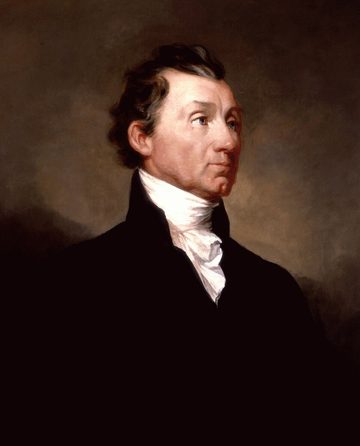
Official portrait
President #5
James Monroe
1758–1831
Leadership Style
Monroe led with quiet dignity and consensual administration during the "Era of Good Feelings," the brief period when partisan opposition essentially collapsed. He assembled perhaps the strongest cabinet in early American history—John Quincy Adams at State, John C. Calhoun at War, William Crawford at Treasury—and let these formidable rivals advise him while reserving final judgment. He toured the country extensively, the first president since Washington to do so, deliberately performing national unity. His style was deliberate, methodical, and unifying; he sought to be a president of all Americans rather than a party leader, and he largely succeeded—running essentially unopposed for reelection in 1820.
Greatest Accomplishments
The Monroe Doctrine of December 1823 announced—largely drafted by John Quincy Adams—that the Western Hemisphere was closed to further European colonization and that the United States would view any such attempt as a hostile act. Though militarily unenforceable in 1823 (Britain's Royal Navy actually guaranteed it), the Doctrine became the foundational principle of American foreign policy for the next century and beyond. Monroe also acquired Florida from Spain through the Adams-Onís Treaty of 1819, which defined the boundary of the Louisiana Purchase and gave the United States a transcontinental claim. He oversaw the Missouri Compromise of 1820, postponing the slavery crisis another generation.
Greatest Failures
Monroe's greatest failure was his administration's handling of the Panic of 1819—the first major American financial crisis—and his inability to provide meaningful federal relief. The Second Bank of the United States, which Monroe supported, contracted credit sharply in 1818–1819, triggering bank failures, foreclosures, and widespread unemployment, particularly in the West and South. Monroe's strict constructionist views limited federal response, and he vetoed internal improvement bills he believed exceeded constitutional authority. The Missouri Compromise, while preserving Union, embedded the geographic line of slavery into national policy and—as Jefferson said—rang "like a fire bell in the night," foreshadowing the sectional crisis Monroe's generation lacked the will to resolve.
Greatest Challenge
Monroe's defining challenge was managing the emerging sectional crisis over slavery while simultaneously projecting American power abroad. Missouri's application for statehood in 1819 detonated a Congressional confrontation that nearly broke the Union. Spain's empire in the Americas was disintegrating, creating both opportunity (Florida) and risk (European intervention to restore Spanish rule). Britain remained the dominant global power; Russia was expanding down the Pacific Northwest coast. The Panic of 1819 devastated the economy mid-presidency. Monroe had to navigate all of this while leading a one-party state where personal and factional rivalries—particularly among his cabinet members angling to succeed him—replaced the discipline of party competition.
Quotes & Slogans
No campaign slogans—Monroe's 1820 reelection was essentially uncontested. The Monroe Doctrine's core formulation from his December 1823 annual message: "The American continents... are henceforth not to be considered as subjects for future colonization by any European powers." And: "We should consider any attempt on their part to extend their system to any portion of this hemisphere as dangerous to our peace and safety." His First Inaugural emphasized "national strength and respectability" as the foundation of "national happiness."
Economic Data
Monroe presided over the postwar boom, the Panic of 1819, and the slow recovery that followed. The Tariff of 1816 protected American manufacturing; the Second Bank of the United States stabilized currency until its credit contraction triggered the Panic of 1819. Cotton prices collapsed, land values plummeted in the West and South, and banks failed in waves. The Land Act of 1820 ended credit sales of federal land—requiring cash—to halt speculative bubbles. By 1823–1824 the economy was recovering; protective tariffs were raised again in 1824. Federal debt declined from about $127 million to $84 million. The American System of Henry Clay—tariffs, bank, internal improvements—emerged during Monroe's terms.
Quality of Life
Five new states joined the Union under Monroe—Mississippi (1817), Illinois (1818), Alabama (1819), Maine (1820), Missouri (1821)—bringing the total to 24. The population grew from 8.5 million in 1817 to over 11 million by 1825. The Erie Canal began construction in 1817 and opened in 1825, revolutionizing American commerce. The first steamboat crossed the Atlantic in 1819. Florida became a U.S. territory in 1821. The Santa Fe Trail opened the Southwest to trade. The American Colonization Society founded Liberia in 1822 to resettle freed Black Americans abroad—a project Monroe supported and which produced the country's capital, Monrovia, named in his honor.