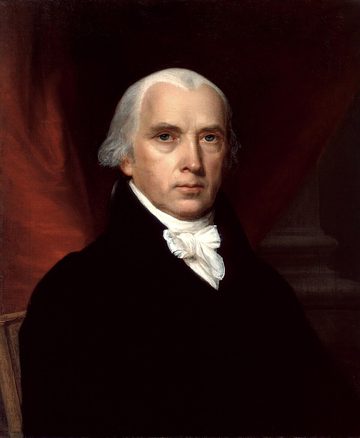
Official portrait
President #4
James Madison
1751–1836
Leadership Style
Madison was a scholar-statesman whose strengths in constitutional theory and legislative architecture did not always translate to executive leadership. Small, soft-spoken, and bookish, he led through reasoned persuasion rather than charisma or command. He worked closely with congressional allies but proved unable to discipline a fractious party, and his cabinet was often weak—a reflection of his preference for collegiality over hierarchy. He delegated military operations to commanders who frequently failed him. Dolley Madison's social genius compensated significantly for his reserved manner. His leadership style suited deliberative bodies more than crisis management, which made the War of 1812 a brutal test he survived more through American resilience than executive brilliance.
Greatest Accomplishments
Madison's greatest accomplishment was preserving the Republic and its constitutional order through the War of 1812—the "Second War of Independence." Despite the burning of Washington, repeated military disasters, and New England Federalists openly discussing secession at the Hartford Convention, Madison maintained civil liberties, held no political prisoners, allowed free criticism of his war policy, and conducted the war without suspending constitutional norms. The Treaty of Ghent ended the war with American sovereignty intact; Andrew Jackson's victory at New Orleans (after the treaty) crystallized national pride. Postwar, Madison signed the charter of the Second Bank of the United States and a protective tariff, pragmatically adopting Federalist economic tools to strengthen American independence.
Greatest Failures
Madison's failure to adequately prepare the United States for the War of 1812 he declared was profound. The army was tiny, poorly trained, and led by aged Revolutionary veterans. State militias refused to cross into Canada. The Treasury was inadequate after the First Bank's charter was allowed to lapse in 1811. The opening campaigns were catastrophic—Detroit surrendered without a fight; multiple Canadian invasions collapsed. In August 1814, British forces marched into Washington virtually unopposed and burned the Capitol, the White House, and the Treasury. Madison fled on horseback. The humiliation was largely the product of his administration's failure to build the military and financial machinery required to fight the war it chose.
Greatest Challenge
Madison inherited a deteriorating diplomatic crisis with Britain, an economy still recovering from the embargo, and a federal government deliberately weakened by Jeffersonian retrenchment. He had to confront British impressment of American sailors and violations of neutral rights while leading a country and party philosophically opposed to a strong military and central bank—the very tools needed to wage war. Once war was declared in June 1812, he had to conduct it with inadequate forces, a divided nation (New England near-rebellion), and incompetent generals, while simultaneously holding the constitutional order together. The war's near-disaster and ultimate stalemate-as-victory tested every assumption of small-government Republicanism.
Quotes & Slogans
No campaign slogans of the modern sort. Madison's most famous formulations come from his earlier writings: "If men were angels, no government would be necessary" (Federalist 51). From his war message of June 1, 1812, he catalogued British offenses including impressment of "thousands of American citizens." His First Inaugural promised "to cherish peace and friendly intercourse with all nations." His Second Inaugural, delivered during the war, argued the conflict was waged "in maintenance of the rights of an independent nation."
Economic Data
Madison's economy was shaped by the lapse of the First Bank of the United States in 1811, the disruption of war, and postwar reconstruction. War financing was chaotic—the Treasury nearly defaulted in 1814; revenues collapsed as British blockade strangled trade. State-chartered banks proliferated and issued unstable currency. Madison reversed course pragmatically, signing the Second Bank of the United States charter in 1816 and the Tariff of 1816, the first explicitly protective tariff, to shield infant American manufacturing that had grown during the war. The national debt nearly tripled, from about $45 million to $127 million, but the postwar economy entered a boom called the "Era of Good Feelings."
Quality of Life
American life under Madison was reshaped by war, then by accelerating expansion. The 1810 Census counted 7.2 million; by 1817 the nation had crossed 8.5 million. Louisiana (1812), Indiana (1816), and—just after—Mississippi (1817) joined the Union. The War of 1812 ravaged frontier settlements and the Chesapeake but stimulated domestic manufacturing in the Northeast. Native American resistance under Tecumseh was crushed at the Battle of the Thames (1813). The American Colonization Society was founded in 1816. Steamboats began operating on the Mississippi (1811–1812), and the National Road reached Wheeling, Virginia by 1818—threading the country together as Madison left office.