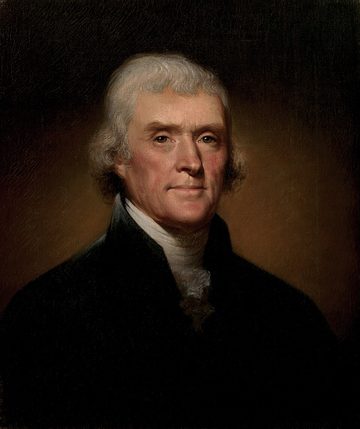
Official portrait
President #3
Thomas Jefferson
1743–1826
Leadership Style
Jefferson cultivated a deliberately republican simplicity that masked sophisticated political operation. He walked to his inauguration, dressed plainly, ended formal court etiquette, and answered his own door at the President's House. Behind this democratic theater he was an exceptionally skilled political manager, working closely with Madison and Albert Gallatin, coordinating with congressional Republicans through evening dinners, and using patronage strategically. He governed through party discipline rather than open coercion. He cut the military, slashed the diplomatic corps, and shrank federal spending while simultaneously expanding presidential power through bold executive action when he deemed it necessary—most famously in the Louisiana Purchase, which he privately admitted exceeded constitutional authority.
Greatest Accomplishments
The Louisiana Purchase of 1803 doubled the size of the United States for $15 million—roughly four cents per acre—acquiring 828,000 square miles from Napoleon's France. The purchase secured the Mississippi River, the port of New Orleans, and opened the continent to American expansion. Jefferson recognized the constitutional difficulty (no enumerated power authorized acquiring territory) but acted decisively anyway, justifying it as necessary for the nation's future. He immediately commissioned the Lewis and Clark Expedition (1804–1806) to map the new territory, beginning the systematic American engagement with the West. The purchase reshaped American geopolitics, removed European powers from the heartland, and created the territorial canvas on which the nineteenth-century United States would be built.
Greatest Failures
The Embargo Act of 1807 was Jefferson's catastrophic attempt to coerce Britain and France through economic pressure by halting all American foreign trade. Instead of pressuring the European belligerents, it devastated the American economy—particularly New England shipping. Exports collapsed from $108 million to $22 million. Smuggling exploded; federal enforcement grew increasingly authoritarian, with Jefferson authorizing warrantless searches and military deployment against American citizens. The policy revived the Federalist Party, alienated his New England base, and accomplished none of its diplomatic goals. He signed the act's repeal three days before leaving office. The episode demonstrated how the strict-constructionist president would expand executive power when ideologically committed to a policy.
Greatest Challenge
Jefferson faced the challenge of governing as a self-described revolutionary in opposition to the system he now controlled. He had to dismantle Federalist excesses (the Alien and Sedition Acts, internal taxes, military buildup) without dismantling the functioning federal government. Simultaneously, the Napoleonic Wars created continuous threats to American neutrality and shipping. Barbary pirates extorted American commerce in the Mediterranean. The Burr conspiracy raised the specter of western secession. Federalist judges, particularly John Marshall, were entrenching judicial review against him. He had to balance ideological purity with practical governance, manage the Louisiana acquisition's constitutional implications, and navigate worsening relations with Britain that would ultimately produce the War of 1812 under his successor.
Quotes & Slogans
No campaign slogan in the modern sense, though 1800 partisans rallied around "Jefferson and Liberty." His First Inaugural offered the conciliatory "We are all Republicans, we are all Federalists," and the principle "equal and exact justice to all men, of whatever state or persuasion, religious or political." From his pen elsewhere: "The tree of liberty must be refreshed from time to time with the blood of patriots and tyrants." His self-composed epitaph notably omitted the presidency, listing only the Declaration, the Virginia Statute for Religious Freedom, and the founding of the University of Virginia.
Economic Data
Jefferson and Treasury Secretary Gallatin pursued aggressive debt reduction, cutting federal spending and shrinking the national debt from $83 million to $57 million by 1809 despite the $15 million Louisiana Purchase. They eliminated internal taxes (including the despised whiskey excise), funding the government almost entirely through tariffs and land sales. The economy boomed from 1801–1807 as neutral American shipping profited from European war. The Embargo Act of 1807 then crashed the economy, collapsing exports by 80% and devastating port cities. Manufacturing modestly expanded as a substitute for blocked imports—an unintended birthright of American industrial development.
Quality of Life
American territory doubled; the population grew from 5.3 million in 1800 to over 7 million by 1810. Ohio joined the Union in 1803. The slave trade from abroad was constitutionally prohibited starting January 1, 1808, and Jefferson signed the implementing legislation—though domestic slavery expanded dramatically. The Lewis and Clark Expedition captured the national imagination. Steamboats began commercial service on the Hudson in 1807. Religious revivals (the Second Great Awakening) transformed American spiritual life. The embargo's final years brought genuine hardship—unemployment in port cities, bankrupt merchants, idle ships rotting at anchor—souring Jefferson's farewell.