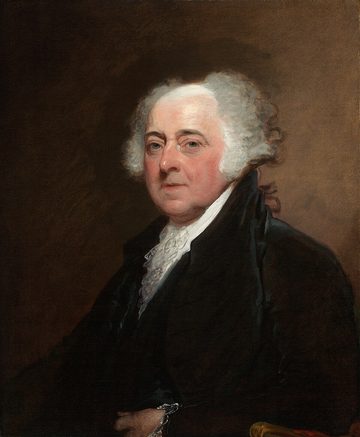
Official portrait
President #2
John Adams
1735–1826
Leadership Style
Adams led with fierce intellectual independence and notorious prickliness. A brilliant lawyer and political theorist, he distrusted parties even as he nominally led the Federalists, and he kept Washington's cabinet largely intact—a fateful mistake, since Hamilton secretly manipulated those secretaries against him. Adams was principled to the point of self-sabotage, refusing to play the political games his office required. He worked from his Massachusetts farm for long stretches, communicated by letter, and made consequential decisions based on conscience rather than calculation. His willingness to defy his own party and pursue peace with France cost him reelection but spared the nation a disastrous war—a trade he accepted.
Greatest Accomplishments
Adams's greatest accomplishment was averting war with France during the Quasi-War crisis (1798–1800). After the XYZ Affair inflamed public opinion and his own Federalist Party demanded full-scale war, Adams resisted enormous pressure and sent a second peace mission to Paris. The resulting Convention of 1800 ended hostilities and dissolved the troublesome 1778 alliance with France. He built the U.S. Navy from almost nothing, establishing the Navy Department in 1798 and commissioning frigates that would prove decisive against the Barbary states and in 1812. He also oversaw the federal government's move to the new capital city of Washington in 1800 and presided over the first peaceful transfer of power between rival parties in 1801.
Greatest Failures
Adams signed the Alien and Sedition Acts of 1798, the most serious assault on civil liberties in early American history. The Sedition Act criminalized criticism of the federal government and was used to prosecute Democratic-Republican newspaper editors and even a sitting congressman. The Alien Acts targeted immigrants, particularly French and Irish refugees suspected of Jeffersonian sympathies. The laws provoked the Virginia and Kentucky Resolutions asserting state nullification—a doctrine that would echo destructively into the Civil War era. Adams later regretted signing them, but the damage was done: he had used federal power to suppress political speech and weaponized xenophobia.
Greatest Challenge
Adams inherited a nation careening toward war with France while his own party splintered between his moderate faction and Hamilton's war hawks. The French Directory was seizing American shipping; the XYZ Affair humiliated American diplomats; Federalists demanded full mobilization; Democratic-Republicans accused Adams of monarchism. Inside his own cabinet, Hamilton's allies—Pickering, McHenry, Wolcott—were funneling information to their true patron and undermining presidential authority. Adams had to navigate undeclared naval war, raise a provisional army (with Washington insisting on Hamilton as second-in-command), maintain neutrality between Britain and France, and govern a country where his own administration was conspiring against him. He met the challenge by choosing peace over party loyalty.
Quotes & Slogans
No campaign slogan—the 1796 election was fought through newspapers and surrogates. Adams's enduring quotes include his prediction to Abigail about July 2 (which became July 4): "It ought to be solemnized with Pomp and Parade, with Shews, Games, Sports, Guns, Bells, Bonfires and Illuminations from one End of this Continent to the other." From his presidency: "Facts are stubborn things." His toast at the White House (which he was the first to occupy): "May none but honest and wise Men ever rule under this roof."
Economic Data
Adams inherited Hamilton's financial system and largely preserved it. The Direct Tax of 1798 (on dwellings, land, and slaves) funded military preparedness and triggered Fries's Rebellion in Pennsylvania—which Adams ultimately defused by pardoning the rebels. Naval expansion was the largest federal expenditure, building the foundation of American sea power. The economy benefited from European war demand for American shipping despite French and British depredations. Federal revenue grew with expanding trade. The national debt rose modestly to fund the Quasi-War buildup, but Adams resisted the deeper militarization Hamilton wanted, leaving office with a solvent treasury and a functioning navy.
Quality of Life
American life in the late 1790s was shadowed by political polarization, war fever, and partisan press warfare more virulent than anything since. The federal capital moved from Philadelphia to Washington in 1800—a swampy, half-built city. The 1800 Census counted 5.3 million Americans. The Naturalization Act of 1798 extended residency requirements from five to fourteen years (later repealed under Jefferson). Yellow fever epidemics ravaged Philadelphia. The first federal copyright extensions and postal expansions continued. Ordinary citizens experienced their first taste of federal taxation reaching into their homes and their first government prosecutions for political speech.