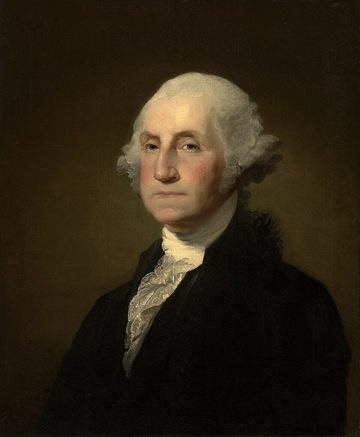
Official portrait
President #1
George Washington
1732–1799
Leadership Style
Washington led with a deliberate, almost reluctant authority that defined the presidency as an office of restraint rather than dominance. He assembled a cabinet of brilliant rivals—Hamilton, Jefferson, Knox, Randolph—and let them argue policy openly while he served as final arbiter. His style was formal, dignified, and consciously theatrical; he understood every gesture would become precedent. He preferred consensus when possible but acted decisively when needed. Most consequentially, he voluntarily relinquished power after two terms, refusing the monarchical trappings many expected. He chaired meetings rather than commanded them, demanded professional expertise over loyalty, and modeled civilian control of the military by personally leading troops then returning home.
Greatest Accomplishments
Washington's supreme accomplishment was establishing the executive branch itself—translating constitutional abstractions into functioning government. He created the cabinet system, defined the scope of executive privilege, set foreign policy through neutrality in the French Revolutionary Wars, and demonstrated federal authority by personally leading 13,000 militia to suppress the Whiskey Rebellion in 1794. He proved the federal government could enforce its laws without becoming tyrannical. Crucially, his voluntary departure after two terms established the peaceful transfer of power as bedrock American principle—a precedent unbroken until FDR and then re-enshrined in the 22nd Amendment. Every executive norm we have descends from choices Washington made when no rulebook existed.
Greatest Failures
Washington's profound moral failure was slavery. He owned enslaved people throughout his life, brought them to the presidential residence in Philadelphia (rotating them to evade Pennsylvania's gradual emancipation law), and pursued runaway Ona Judge with federal resources. Though he freed his slaves in his will—the only Founding Father slaveholder to do so—he had the unique moral authority to challenge the institution during his presidency and did not. He also signed the Fugitive Slave Act of 1793, embedding slavery's enforcement into federal law. His silence on slavery during the Constitutional Convention and presidency allowed the institution to entrench itself for another seventy years.
Greatest Challenge
Washington faced the unprecedented challenge of inventing the executive office from a blank constitutional page. Every action—how to be addressed, how to interact with Congress, whether to veto, how to conduct foreign policy, whether to tour the country—established precedent. He navigated a cabinet split between Hamilton's centralizing Federalists and Jefferson's agrarian Democratic-Republicans while the French Revolution polarized American politics. He had to assert federal taxing power (Whiskey Rebellion), maintain neutrality between Britain and France despite treaty obligations, negotiate the controversial Jay Treaty, and manage relations with Native nations and Spanish-held territories—all while convincing skeptical Americans that a strong executive wouldn't become a king.
Quotes & Slogans
No campaign slogans existed—Washington was elected unanimously without campaigning. His most enduring words come from the 1796 Farewell Address: "Observe good faith and justice towards all nations; cultivate peace and harmony with all." He warned against "the baneful effects of the spirit of party" and "permanent alliances with any portion of the foreign world." His First Inaugural declared "the preservation of the sacred fire of liberty" was "deeply, perhaps finally, staked on the experiment entrusted to the hands of the American people."
Economic Data
The Washington administration adopted Hamilton's full financial program: federal assumption of state Revolutionary War debts ($25 million), creation of the First Bank of the United States (1791), establishment of the U.S. Mint, and the Whiskey Tax to fund debt service. The tariff system funded the federal government. Federal debt was restructured into reliable instruments, establishing American creditworthiness internationally. The economy expanded modestly with population growth and westward settlement. The Whiskey Tax sparked rebellion in western Pennsylvania (1794) but the financial system Hamilton built—endorsed by Washington—became the foundation of American capitalism for the next century.
Quality of Life
Ordinary American life changed substantially during Washington's terms. The Bill of Rights was ratified in 1791, guaranteeing core civil liberties. The first federal Census (1790) counted 3.9 million people, including roughly 700,000 enslaved. The Post Office Department was established in 1792, dramatically expanding mail routes and newspaper circulation that knit the young republic together. Vermont (1791), Kentucky (1792), and Tennessee (1796) joined the Union. The Coinage Act of 1792 created the dollar. Cities remained small—Philadelphia, the capital, had about 44,000 residents—and 95% of Americans lived rural agricultural lives largely unchanged from the colonial era.