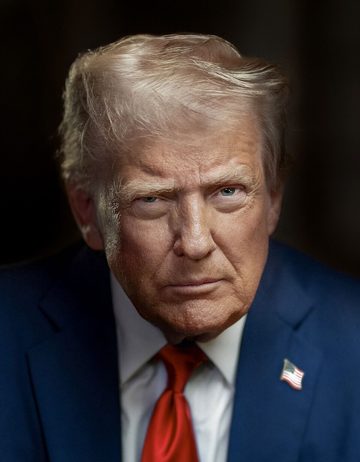
Official portrait
President #47
Donald Trump (second term)
1946–
Leadership Style
Trump's second-term style is more confident, more disciplined in personnel selection, and less constrained than his first. He returned to office with a deeper bench of loyalists (Project 2025 alumni, second-term cabinet picks selected for ideological alignment and personal fidelity rather than establishment credentials), a Supreme Court he had reshaped, a Republican Congress with both chambers, and the immunity protections of Trump v. United States (July 2024). He delegates more readily to a smaller circle (Vance as VP, Susie Wiles as chief of staff — the first female White House chief of staff — Stephen Miller, Russell Vought at OMB) and has moved faster through executive action than any modern administration. He governs as if he has a clear mandate, treats the institutional opposition as evidence of resistance to be overcome rather than feedback to be incorporated, and approaches both foreign and domestic policy with the conviction his first term lacked the staff and time to execute.
Greatest Accomplishments
The administration's most concrete documentable achievements through mid-2026 are at the southern border — illegal crossings collapsed dramatically (CBP encounters fell from over 200,000 per month in late 2023 to roughly 8,000–11,000 monthly by mid-2025, the lowest in decades), achieved through a combination of executive orders, Remain in Mexico reinstatement, and pressure on Mexico that the prior administration had been unwilling to apply. The Abraham Accords framework has been extended, with active negotiations on Saudi-Israeli normalization continuing. He brokered an Israel-Hamas ceasefire framework in early 2025 that secured the release of remaining living hostages, ending the active phase of the post-October 7 war. Federal workforce reductions and the dismantling of USAID and consolidation of agencies under DOGE (Department of Government Efficiency, led initially by Elon Musk) have produced the most aggressive executive-branch restructuring since the New Deal — with effects still being adjudicated in courts.
Greatest Failures
The 'Liberation Day' tariffs announced April 2, 2025 (10% baseline on nearly all imports plus 'reciprocal' rates ranging up to 145% on China) triggered the sharpest equity market drop since March 2020, the largest one-week loss in dollar terms in market history, a bond-market revolt that forced a 90-day pause on most reciprocal tariffs within a week, and a sustained inflationary pulse that has kept core PCE elevated above the Fed's 2% target through 2026. The on-again, off-again tariff regime — pausing, restoring, exempting, retaliating — has produced policy uncertainty that businesses cite repeatedly as a brake on investment. The Musk-Trump public falling-out in mid-2025 made DOGE's mass terminations politically and legally vulnerable; multiple federal court rulings have ordered reinstatements. Deportation operations have produced documented cases of legal residents and U.S. citizens being detained, generating ongoing litigation. Relations with Canada and the EU are at their worst point since the 1930s by most diplomatic measures.
Greatest Challenge
He inherited an economy with cumulative 20% inflation from the Biden years, a southern border that had seen record encounters, an ongoing war in Ukraine, the post-October 7 Israel-Hamas-Iran conflict, an Iran enrichment program at near-weapons-grade thresholds, a Chinese economy and military both more capable than at the end of his first term, and a federal debt above $36 trillion with interest payments now exceeding defense spending. He has had to manage the U.S.-Iran direct strike exchanges (June 2025, the Israeli and U.S. strikes on Iranian nuclear facilities and Iran's retaliation against U.S. bases in the Gulf — the largest direct U.S.-Iran military exchange since 1988), a Ukraine war he campaigned on ending 'in 24 hours' that has continued, fentanyl deaths still elevated, and the political consequences of governing with a Supreme Court that has granted broad immunity but a federal judiciary that has issued hundreds of injunctions against his executive orders.
Quotes & Slogans
Campaign 2024: 'Make America Great Again' (continued) and 'Promises Made, Promises Kept.' Second inaugural (January 20, 2025): 'The golden age of America begins right now.' On the 'Liberation Day' tariffs (April 2, 2025): 'This is one of the most important days in American history.' On the assassination attempt (July 13, 2024, Butler, PA, before his inauguration but defining for his second-term mandate): 'Fight, fight, fight!' On Ukraine: 'I will end this war on Day One' (which did not happen). On his second term: 'We have a mandate. We have a movement.' On the federal workforce: 'They work for us.' On the courts blocking his orders: a sustained pattern of public attacks on individual judges that has triggered Chief Justice Roberts to issue rare public rebukes.
Economic Data
The second-term economy has been turbulent. The Dow opened at roughly 43,500 at inauguration, peaked above 45,000 in February 2025, fell to under 37,000 in the April 2025 tariff selloff, and has traded in a wide range since. GDP growth has slowed from 2.7% (2024) to a projected 1.5–2.0% for 2025 — the slowdown attributed by most economists to tariff uncertainty, reduced immigration flows tightening labor supply, and federal workforce reductions. Unemployment has crept up from 4.1% to roughly 4.5% by mid-2026. Inflation, having been near 2.5% at inauguration, has run 3.0–3.5% through 2026, with tariff pass-through visible in specific categories (consumer electronics, autos, apparel). The federal deficit is projected above $2 trillion for FY2026. The Federal Reserve has held rates steady through most of 2025 and begun a cautious easing cycle in early 2026. The 2017 tax cuts were extended through reconciliation in mid-2025, adding to the long-term debt trajectory.
Quality of Life
American daily life in the second Trump term reflects deep continuity with the late Biden era plus the disruptions of accelerated policy change. AI deployment has continued accelerating — generative AI is now embedded in workflows across white-collar professions, and labor market displacement is becoming measurable in entry-level knowledge work. The southern border looks dramatically different than in 2024. Federal agency staffing is materially lower. Universities, law firms, and media organizations have faced sustained pressure (executive orders restricting federal funding tied to DEI programs, security clearance revocations for specific firms, lawsuits and antitrust threats against media outlets). Life expectancy continues recovering from COVID lows, now near 79.0. Fentanyl deaths have declined modestly from peak. Political violence remains elevated — the July 2024 assassination attempt on Trump, a September 2024 second attempt, and subsequent threats against judges, election officials, and members of Congress have driven security costs sharply higher. The country he is governing remains, by every survey measure, deeply divided about whether the second term represents necessary correction or constitutional rupture.