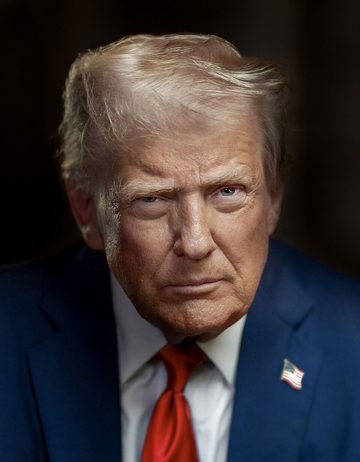
Official portrait
President #45
Donald Trump (first term)
1946–
Leadership Style
Trump's first-term style broke nearly every convention of the modern presidency. He governed by Twitter (until banned in January 2021), by gut, by personal loyalty, and by the news cycle. He rejected the briefing book tradition — preferring oral briefings and television — and ran a White House with the highest senior-staff turnover in modern history (Cabinet and senior advisers cycled at roughly 4x the rate of his predecessors). He treated foreign policy as personal relationship management (his rapport with Xi, Putin, Kim Jong Un, MBS, Netanyahu, Modi). He fought constantly with his own appointees when they declined to follow him into territory they considered illegal or unwise. He communicated directly with voters in a register no predecessor had used. His supporters saw authenticity; his critics saw chaos. Both readings captured real things.
Greatest Accomplishments
The Tax Cuts and Jobs Act (December 2017) was the largest tax overhaul since 1986 — corporate rate dropped from 35% to 21%, individual brackets reduced, standard deduction doubled, and the territorial tax system replaced the worldwide one. The Abraham Accords (August–December 2020) normalized Israeli relations with the UAE, Bahrain, Sudan, and Morocco — the first Arab-Israeli normalization since 1994, achieved without resolving the Palestinian question that previous administrations had treated as prerequisite. He appointed three Supreme Court justices (Gorsuch 2017, Kavanaugh 2018, Barrett 2020) and over 200 federal judges — reshaping the federal judiciary for a generation. Operation Warp Speed (May 2020) compressed vaccine development from years to months and delivered the Pfizer and Moderna COVID-19 vaccines for emergency use in December 2020 — a public-private mobilization of historic scale.
Greatest Failures
On January 6, 2021, after two months of falsely claiming the 2020 election had been stolen (every court that reviewed the claims, including judges he had appointed, rejected them), Trump summoned supporters to Washington, addressed them at the Ellipse, and directed them to march on the Capitol. A mob breached the building during the Electoral College certification, five people died in connection with the attack, and Congress was forced into emergency recess for the first time since the British burned the building in 1814. He was impeached a second time on January 13, 2021 (the only president impeached twice) on a charge of incitement of insurrection; the Senate vote was 57–43 to convict — short of the two-thirds required, but the largest bipartisan impeachment-conviction vote in U.S. history. His COVID-19 response — particularly early downplaying ('one day it's like a miracle, it will disappear,' February 27, 2020), the disinfectant remarks (April 23, 2020), and his own super-spreader Rose Garden event (September 26, 2020) — preceded a U.S. death toll above 400,000 by his exit.
Greatest Challenge
COVID-19 was the defining external crisis of his term. Declared a pandemic by the WHO on March 11, 2020, it killed 400,000 Americans by his exit, drove 14.7% unemployment in April 2020 (highest since 1948), and reshaped daily life through lockdowns, school closures, supply-chain shocks, and remote work. His administration also faced the 2017 hurricanes (Harvey, Irma, Maria — Puerto Rico's death toll reached an estimated 2,975), the killing of Iranian General Qassem Soleimani (January 2020), the murder of George Floyd (May 25, 2020) and the protests that followed, and the long Mueller investigation into Russian interference and obstruction (March 2017–March 2019), which found insufficient evidence to charge conspiracy with Russia but documented multiple instances of potential obstruction it explicitly did not exonerate him on.
Quotes & Slogans
Campaign 2016: 'Make America Great Again.' Inaugural (2017): 'American carnage stops right here and stops right now.' On the 2018 Helsinki summit with Putin: 'I don't see any reason why it would be' Russia that interfered. On COVID (February 27, 2020): 'It's going to disappear. One day it's like a miracle, it will disappear.' January 6, 2021 (at the Ellipse): 'We fight like hell. And if you don't fight like hell, you're not going to have a country anymore.' On his governing style: 'I alone can fix it' (2016 convention). On his predecessors: a steady stream of personalized attacks unprecedented in twentieth-century presidential rhetoric. Campaign 2020: 'Keep America Great' — until COVID rendered the slogan untenable.
Economic Data
Pre-COVID, the Trump economy continued the Obama-era expansion. GDP grew 2.5% annually 2017–19. Unemployment fell to 3.5% in 2019 — a 50-year low — and stayed there until COVID. The Dow rose from 19,827 at inauguration to a pre-COVID peak of 29,551 (February 2020), then collapsed in March 2020 to 18,591 before recovering. COVID drove the deepest quarterly contraction in U.S. history (Q2 2020: -31.4% annualized) and then the fastest recovery. Federal deficit rose from $585 billion (FY2016) to $984 billion pre-COVID (FY2019) — the largest peacetime non-recession deficit increase — driven by the 2017 tax cuts and spending increases. COVID relief (CARES Act $2.2 trillion, December 2020 package $900 billion) pushed FY2020 deficit to $3.1 trillion. He left an economy at 6.7% unemployment, recovering from the pandemic, with the largest peacetime debt accumulation in history.
Quality of Life
American daily life under Trump was reshaped by political polarization and then by the pandemic. Trust in government, media, and institutions fell to historic lows. The opioid epidemic continued — overdose deaths rose to 91,000 in 2020 (60,000 higher than when Obama left office). Life expectancy fell sharply during COVID (from 78.8 to 77.0 — the largest drop since WWII). Black Lives Matter protests after George Floyd's murder were the largest protest movement in American history by participation. Same-sex marriage remained legal (Bostock 2020 extended employment discrimination protections to LGBTQ workers, a Gorsuch opinion). The pandemic accelerated remote work, e-commerce, and digital infrastructure changes that have not reversed. Two impeachments, a Russia investigation, January 6, and the pandemic produced a level of sustained civic crisis the country had not experienced since 1968–74.