The Global Cycle: Earth's Ice Ages, the Pulse of a Planet, and the Civilization That Changed the Clock
Earth breathes on a timescale that dwarfs human history. Every hundred thousand years or so, the planet exhales — and the cold returns. Glaciers a kilometer thick grind southward from the poles, locking up so much ocean water that coastlines shift hundreds of kilometers into what was once open sea. Then, as slowly as it came, the freeze relents. Ice retreats, forests reclaim tundra, and a warm window opens — an interglacial — in which, for a brief geological moment, life flourishes in the temperate zones. We are living inside one of those windows now. What drives this ancient rhythm, how long it has been turning, and whether our civilization has done something unprecedented — something that may have broken the clock entirely — is one of the most consequential stories in all of Earth science.
What Is an Ice Age?

The term "ice age" is commonly used to describe any prolonged cooling of Earth's surface that results in the expansion of polar and mountain glaciers. In strict geological usage, however, an ice age refers to a long-duration period during which Earth maintains permanent ice sheets at one or both poles. By that definition, we are technically still inside an ice age today — the Late Cenozoic Ice Age, which began roughly 34 million years ago when the Antarctic ice sheet first formed, and intensified about 2.6 million years ago when northern hemisphere glaciation became substantial.
Within an ice age, climate does not stay constant. It oscillates between glacial periods (informally called "ice ages" in popular usage), when ice sheets advance dramatically and global temperatures plummet, and interglacials, warmer intervals when ice retreats and conditions resemble or exceed today's climate. These oscillations are Earth's great metronome, and they have been ticking with extraordinary regularity for millions of years.
To avoid confusion, this article uses "glacial period" for the cold pulses and "ice age" in the broader geological sense — an era of polar ice. The Holocene, the epoch we live in, is a warm interglacial within the ongoing Late Cenozoic Ice Age.
The Architect of the Cycles: Milutin Milanković
The mechanism driving glacial-interglacial oscillations was identified, in its mathematical essentials, by a Serbian geophysicist working under extraordinary circumstances. Milutin Milanković was a professor of applied mathematics at the University of Belgrade when the First World War broke out. Interned by Austro-Hungarian authorities, he spent years in Budapest, where — with access to a library and little else to do — he calculated by hand how changes in Earth's orbital geometry would alter the distribution of solar radiation reaching the planet's surface across enormous spans of time.
His 1941 monograph, Canon of Insolation and the Ice Age Problem, presented the first comprehensive mathematical theory of ice age forcing. It was largely ignored for decades, then spectacularly vindicated in 1976 when James Hays, John Imbrie, and Nicholas Shackleton published their landmark paper, "Variations in the Earth's Orbit: Pacemaker of the Ice Ages," in Science — demonstrating from deep-sea sediment cores that glacial cycles were paced precisely by the orbital periodicities Milanković had calculated.
Today, these orbital variations are known as Milanković cycles.
The Three Orbital Cycles
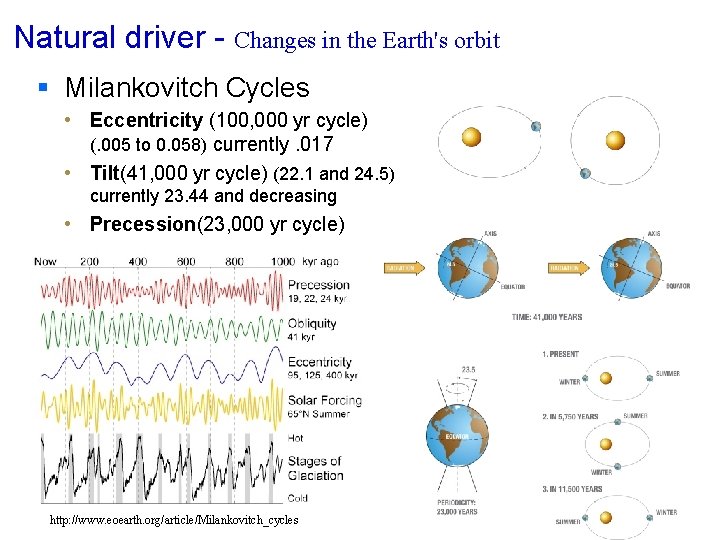
Eccentricity: The Shape of the Orbit (~100,000-Year Cycle)
Earth's orbit around the Sun is not a perfect circle — it is an ellipse. But the degree of that ellipticity, called eccentricity, is not fixed. Gravitational interactions with Jupiter, Saturn, and the other planets cause the orbit to vary between nearly circular and more elongated on a timescale of approximately 100,000 years (with a secondary cycle around 413,000 years).
When eccentricity is high, the difference in solar energy received at perihelion (closest approach to the Sun) versus aphelion (farthest point) can vary by as much as 30%. When eccentricity is low, the orbit is more circular and the seasonal contrast driven by orbital distance is reduced. Crucially, eccentricity modulates the effectiveness of the other two cycles by controlling how extreme Earth's closest and farthest points from the Sun are at any given point in its orbit.
Currently, Earth's eccentricity is relatively low and decreasing — our orbit is close to circular — which tends to moderate the severity of the seasonal cycle.
Obliquity: The Tilt of the Axis (~41,000-Year Cycle)
Earth's rotational axis is not perpendicular to its orbital plane; it is tilted. This tilt, called obliquity, is currently 23.44 degrees, but it oscillates between approximately 22.1 and 24.5 degrees over a cycle of roughly 41,000 years, currently declining toward its minimum.
The tilt angle determines how extreme the seasons are. A larger tilt means hotter summers and colder winters at high latitudes; a smaller tilt means milder seasons with less contrast. The key insight, counterintuitively, is that glaciation is favored by low tilt, not high. When summers are relatively cool (low tilt means less solar radiation in summer at high latitudes), winter snowfall at high latitudes survives into the following summer and accumulates year over year. This is the mechanism by which ice sheets grow.
Obliquity was the dominant pacemaker of glacial cycles during an earlier period — from about 3 million to 1.2 million years ago, glaciations recurred approximately every 41,000 years, matching the obliquity cycle almost exactly.
Precession: The Wobble (~19,000–23,000-Year Cycle)
The third and fastest Milanković cycle is axial precession — a slow wobble of Earth's rotational axis, like a spinning top that is gradually toppling. This wobble completes a full circuit in roughly 26,000 years. A related but distinct effect, the precession of the ellipse itself, operates on a roughly 21,000-year cycle. Together they produce a combined precession signal of about 19,000 to 23,000 years.
Precession determines which hemisphere experiences summer when Earth is nearest the Sun. Currently, the Northern Hemisphere summer coincides with aphelion (Earth's farthest point from the Sun), meaning Northern Hemisphere summers are slightly cooler than they would otherwise be — a configuration that marginally favors ice sheet growth.
Feedbacks That Amplify the Signal
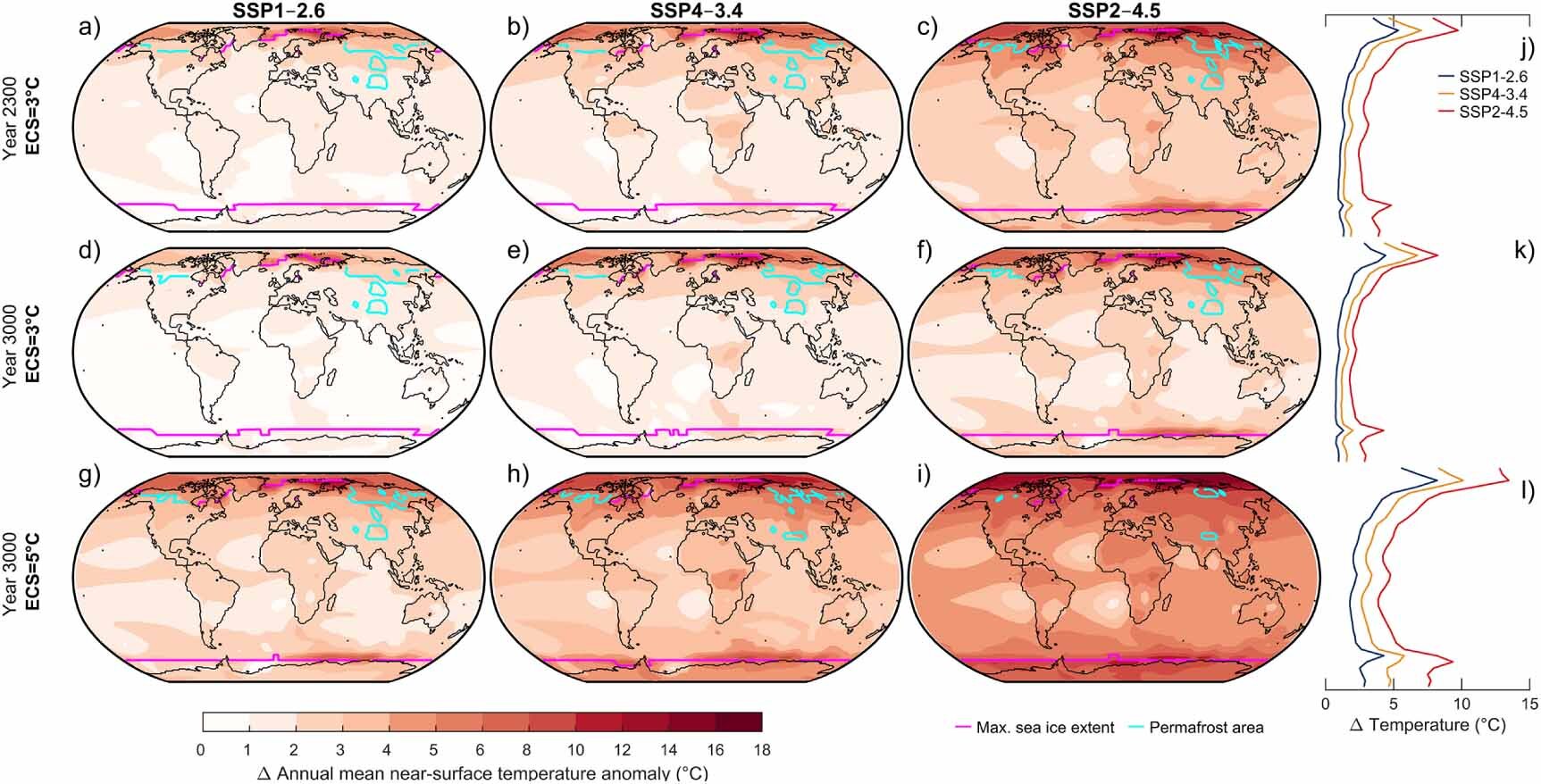
The orbital forcings from Milanković cycles are, in isolation, relatively weak — they rearrange the distribution of sunlight across Earth's surface more than they change the total amount. A crucial scientific question for decades was: how can these gentle nudges produce the dramatic temperature swings recorded in the geological record?
The answer lies in feedback mechanisms — processes that amplify the initial orbital forcing by orders of magnitude.
Ice-Albedo Feedback
Ice and snow reflect about 80–90% of incoming solar radiation back into space (high albedo), while open ocean and dark soil absorb most of it (low albedo). When Milanković forcing initiates even a modest cooling and ice begins to expand, the growing ice sheets reflect more sunlight, causing further cooling, causing further ice expansion — a powerful positive (amplifying) feedback. In reverse, when orbital forcing warms high latitudes, melting ice exposes darker surfaces, increasing heat absorption and accelerating warming.
Greenhouse Gas Feedbacks
Perhaps the most critical amplifier is atmospheric carbon dioxide. Ice core records — most famously from the Soviet drilling project at Vostok, Antarctica, and later from the European Project for Ice Coring in Antarctica (EPICA) at Dome C — have revealed, with startling clarity, that CO₂ levels and global temperatures have marched in lock-step for at least 800,000 years.
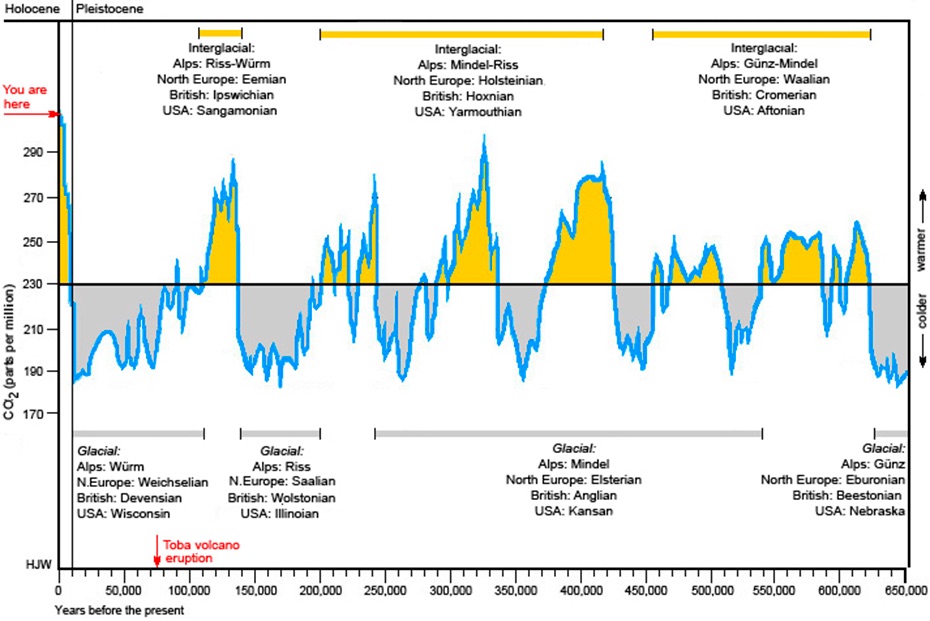
During glacial periods, atmospheric CO₂ has consistently dropped to around 180 parts per million (ppm). During interglacials, it has risen to roughly 280–300 ppm. When orbital forcing begins a warming cycle, the oceans — which store vast quantities of dissolved CO₂ — warm slightly and outgas carbon dioxide into the atmosphere. The elevated CO₂ then acts as a greenhouse gas, amplifying the warming far beyond what the orbital change alone would produce. The process reverses during cooling phases: colder oceans absorb more CO₂, deepening the cold.
The Vostok ice core, drilled to a depth of 3,623 meters and extending 420,000 years into the past, first established this correlation in detail in a landmark 1999 Nature paper by Jean-Robert Petit and colleagues. The EPICA Dome C core, extending to 800,000 years and encompassing eight full glacial cycles, confirmed and extended the picture. Over eight full glacial cycles, CO₂ fluctuated between 170 and 300 ppm with near-perfect correspondence to Antarctic temperature.
Today, atmospheric CO₂ stands at approximately 424 ppm — higher than at any point in those 800,000 years of ice core record, and almost certainly higher than at any time in the past 3 million years.
Ocean Circulation Feedbacks
The Atlantic Meridional Overturning Circulation (AMOC), the ocean conveyor belt that transports warm tropical water northward and cold deep water southward, plays a significant role in amplifying and occasionally reversing glacial climate signals. During the last glacial period, multiple abrupt warming events called Dansgaard-Oeschger events occurred — rapid warmings of up to 15°C in Greenland within decades — likely related to switches in AMOC strength. The transition out of the last glacial period was itself punctuated by a dramatic cold reversal, the Younger Dryas (~12,900 to 11,700 years ago), when a massive pulse of glacial meltwater from the collapsing Laurentide Ice Sheet appears to have disrupted AMOC and briefly plunged the North Atlantic region back into near-glacial conditions.
The History of the Glaciations: A Record in Ice and Stone
The Quaternary Ice Age (2.6 Million Years to Present)
The most recent intensification of Earth's long ice age history began approximately 2.6 million years ago at the onset of the Quaternary Period. Before this, glaciers were largely confined to Antarctica and high mountain ranges. As the Isthmus of Panama closed (cutting off ocean circulation between the Atlantic and Pacific), and as atmospheric CO₂ gradually declined due to tectonic weathering processes over millions of years, the stage was set for repeated northern hemisphere glaciation.
The early Quaternary glaciations followed a roughly 41,000-year rhythm driven by obliquity. Then, approximately 1.2 million years ago, something changed: glacial periods became longer, more intense, and began spacing out to approximately 100,000-year intervals. This shift — known as the Mid-Pleistocene Transition — is one of paleoclimate science's most intriguing unsolved problems. The 100,000-year cycle matches the eccentricity cycle, but eccentricity produces the smallest direct change in solar insolation of the three Milanković parameters. Why the climate system should lock onto this rhythm so strongly, rather than the more powerful obliquity or precession signals, remains an active area of research. Leading hypotheses involve long-term erosion of pre-existing soil under glaciers, allowing ice sheets to rest on bedrock and become larger and more stable; and gradual drawdown of atmospheric CO₂ over geological time that lowered the threshold for ice sheet initiation.
A remarkable milestone was reached in 2025 when a research team announced the recovery of an ice core from Antarctica spanning 1.2 million years — the oldest possibly unbroken ice core record ever obtained — extending back through the Mid-Pleistocene Transition itself. Initial analyses confirmed the ice samples are indeed more than 1.2 million years old, potentially offering an unprecedented window into why the glacial cycle changed period.
Eight Glacial Cycles: The EPICA Record
The EPICA Dome C ice core documents eight complete glacial-interglacial cycles stretching back 800,000 years. In each cycle, the pattern is broadly similar: a long, gradual slide into glaciation over approximately 80,000–90,000 years, followed by a rapid deglaciation — a "sawtooth" pattern. The asymmetry reflects the different physics of glaciation (gradual accumulation of ice) versus deglaciation (rapid, feedback-amplified melting).
Within this 800,000-year window, certain interglacials were notably warmer and longer than others. The interglacial approximately 400,000 years ago (Marine Isotope Stage 11, sometimes called MIS-11) is of particular interest to scientists studying the future trajectory of the Holocene, because Earth's orbital configuration at that time was similar in key ways to today's.
The Last Glacial Maximum: 26,500 to 19,000 Years Ago
The most recent glacial period reached its peak — the Last Glacial Maximum (LGM) — between approximately 26,500 and 19,000 years ago. At this apex of cold, the scale of transformation was staggering:
- Ice sheets covered approximately 8% of Earth's total surface
- The Laurentide Ice Sheet buried most of North America under ice averaging 2 kilometers in thickness, with some regions reaching 4 kilometers
- The Fennoscandian Ice Sheet covered northern Europe and extended into what is now northern Germany and the British Isles
- Sea levels were approximately 125 meters (410 feet) lower than today, exposing vast continental shelves: the English Channel was dry land, the Bering Land Bridge connected Asia to North America, and Australia was connected to New Guinea
- Global average temperatures were approximately 6°C (11°F) cooler than today
- The Northern Hemisphere treeline was pushed thousands of kilometers south; vast areas of Eurasia and North America were tundra or polar desert
- Atmospheric CO₂ was at approximately 190 ppm — barely above the minimum recorded in ice cores
Human populations during this period were small, scattered, and under extraordinary pressure. Archaeological evidence suggests bottleneck events in several lineages. Yet anatomically modern humans persisted and, as the ice retreated, spread rapidly to fill newly habitable landscapes.
The Current Cycle: The Holocene Interglacial
How We Got Here
Deglaciation began around 19,000 years ago as orbital changes — specifically, increasing Northern Hemisphere summer insolation driven by precession — began to tip the balance. The process was not smooth. The Younger Dryas cold reversal (~12,900–11,700 years ago) interrupted the warming for about 1,200 years before an extraordinarily rapid transition — some records suggest warming of several degrees within decades — launched the Holocene.
The Holocene began officially at approximately 11,700 years before present (defined by a boundary marker in the North Greenland Ice Core Project ice core, preserving a sharp chemical signature of that transition). It is the twelfth consecutive interglacial of the Quaternary, and the civilization that would transform the planet emerged within it.
The Holocene Climatic Optimum
The early-to-mid Holocene, roughly 9,000 to 5,000 years before present, was in many ways warmer than today in the high latitudes — a period known as the Holocene Thermal Maximum or Holocene Climatic Optimum. This warmth was not driven by elevated greenhouse gases (CO₂ remained near 280 ppm throughout the pre-industrial Holocene) but by orbital geometry: Northern Hemisphere summers received significantly more solar radiation than today because Earth's axial tilt was slightly higher and the timing of perihelion fell closer to the Northern Hemisphere summer.
In Greenland, mean annual temperatures were 2–3°C warmer than today. Arctic sea ice was substantially reduced; some models and proxy records suggest ice-free or near-ice-free Arctic summers. The Sahara was green — the African Humid Period saw lakes, grasslands, and human habitation across what is now hyper-arid desert.
This optimum was interrupted approximately 8,200 years ago by the 8.2 ka event, one of the most dramatic abrupt climate changes of the Holocene. Triggered by a catastrophic drainage of proglacial lakes Agassiz and Ojibway into the North Atlantic — adding an enormous pulse of freshwater that disrupted AMOC — global temperatures, especially in the North Atlantic region and Greenland, dropped sharply for approximately 150 years. The event is recorded in ice cores, speleothems, pollen records, and marine sediments across four continents.
The Neoglacial and the Late Holocene
After the Holocene Thermal Maximum, orbital forcing shifted: Northern Hemisphere summer insolation gradually declined as the axial tilt decreased and perihelion moved away from summer. From about 5,000 years before present, a gradual cooling began — the Neoglacial — during which mountain glaciers worldwide re-advanced after their mid-Holocene retreat. This cooling continued with fluctuations through the Late Holocene, culminating in the Little Ice Age (approximately 1300–1850 CE), a period of expanded mountain glaciers, severe winters, and notable disruption to agricultural societies in Europe and Asia. The Little Ice Age was not an ice age in the geological sense, but it illustrates the sensitivity of human civilization to even modest climate variability within an interglacial.
Where Earth Stands Today in Its Orbital Cycle
As of 2026, Earth's Milanković parameters are configured as follows:
- Eccentricity: Relatively low (~0.017) and decreasing, indicating an orbit close to circular. This tends to reduce the amplitude of seasonal variation and, crucially, provides less orbital energy to trigger a glacial inception
- Obliquity: 23.44°, currently declining from a recent near-peak and heading toward a minimum roughly 10,000 years from now. Decreasing tilt, by reducing summer insolation at high latitudes, is the configuration most favorable for ice sheet initiation
- Precession: Northern Hemisphere summer currently occurs near aphelion (Earth's farthest point from the Sun), slightly cooling Northern Hemisphere summers — another marginally favorable configuration for ice growth
Under natural, pre-industrial conditions, the combination of declining obliquity and low eccentricity would, over the coming tens of thousands of years, progressively reduce Northern Hemisphere summer insolation — exactly the configuration that has initiated past glacial periods. Without human influence, the best estimates place the next glacial inception approximately 50,000 years in the future, with the current interglacial being relatively long but not anomalous by geological standards.
The comparison point often cited by scientists is Marine Isotope Stage 11 (~420,000–370,000 years ago), an interglacial with similarly low eccentricity that lasted about 28,000 years. The Holocene, now at ~11,700 years, would by natural Milanković dynamics still have tens of thousands of years before glacial inception — but the question of whether that transition will ever occur at all now has a new and deeply unsettling dimension.
Civilization Rewrites the Clock
The Carbon Anomaly
Pre-industrial Holocene atmospheric CO₂ fluctuated modestly between approximately 260 and 285 ppm, with no dramatic trend until the Industrial Revolution. In 1750, CO₂ concentration was approximately 280 ppm — consistent with previous interglacials. By 1958, when Charles David Keeling established the first continuous atmospheric CO₂ monitoring station at Mauna Loa, it had risen to 316 ppm. In 2013, it briefly crossed 400 ppm for the first time in at least 3 million years. By mid-2026, it stands at approximately 424 ppm.
The rate of increase is as significant as the level: CO₂ is rising at roughly 2–3 ppm per year — a rate that has no geological parallel in the ice core record. Past natural increases during deglaciations, driven by warming oceans, raised CO₂ at rates of perhaps 0.01 ppm per year over thousands of years. Humans are increasing it 200 to 300 times faster.
This was not incidental. It was driven by the burning of fossil fuels — coal, oil, and natural gas — the industrialization of agriculture, and large-scale deforestation, all commencing in earnest after approximately 1750 and accelerating dramatically through the 20th century. Global cumulative carbon emissions since the Industrial Revolution now stand at approximately 650–700 petagrams of carbon (PgC, or gigatons of carbon), with most of the total accumulated since 1950.
The Potsdam Study: Changing the Timing of the Next Ice Age
The scientific case that human CO₂ emissions have materially altered the glacial cycle was made with particular force in a 2016 study published in Nature by Andrey Ganopolski, Ricarda Winkelmann, and Hans Joachim Schellnhuber of the Potsdam Institute for Climate Impact Research. Their analysis, titled "Critical insolation–CO₂ relation for diagnosing past and future glacial inception," used an Earth system model to identify the specific combination of orbital insolation and atmospheric CO₂ that had triggered each of the last eight glacial inceptions.
Their key finding was a threshold relationship: glaciation initiates when Northern Hemisphere summer insolation drops below a level inversely proportional to atmospheric CO₂. The lower the CO₂, the higher the insolation threshold — meaning a small orbital nudge can trigger glaciation. The higher the CO₂, the more powerful an orbital forcing is required.
Running this model forward, they found that under pre-industrial CO₂ levels of ~280 ppm, the next glacial inception would naturally occur approximately 50,000 years from now. But given the CO₂ already emitted by human civilization, that threshold has been pushed dramatically upward. Their central estimate: human emissions will delay the next glacial inception by approximately 100,000 years, causing Earth to skip an entire glacial cycle.
"By burning fossil fuel over just one century," Ganopolski stated, "we will affect climate for at least 100,000 years or even more." The study introduced a concept — geological power — to describe the unprecedented scale of human influence: "We have a geological power now. We can change the natural sequence of events for tens of thousands of years."
The 2025 Update: A More Nuanced Picture
A follow-up study published on December 4, 2025, in Communications Earth & Environment — "Timing of a future glaciation in view of anthropogenic climate change" — extended and refined this picture using more sophisticated Earth system model simulations covering the next 200,000 years, with dynamic ice sheets and interactive atmospheric CO₂.
The 2025 study introduced an important nuance: the timing of the next glaciation is sensitive to the long-term carbon budget:
- Historical emissions of ~500 PgC alone are unlikely to delay the next glaciation, which would occur naturally around 50,000 years from now, by more than a modest amount
- Doubling current cumulative emissions to ~1,000 PgC would delay glaciation by approximately 50,000 years beyond that natural timing
- More aggressive emission scenarios would push glaciation further, though for any realistic emission scenario below 5,000 PgC, a next glaciation remains expected within the next 200,000 years
The study also flagged that geological carbon cycling — the slow exchange between the atmosphere, ocean, rock weathering, and volcanic outgassing — will gradually draw down the anthropogenic CO₂ pulse over tens to hundreds of thousands of years. As that human-added CO₂ is absorbed, orbital forcing will eventually reassert itself. The question is not whether glaciation will ever return, but how far into the future the human carbon pulse has displaced it.
Critically, the 2025 study also noted that variability in the Atlantic Meridional Overturning Circulation affects the exact timing of inception — introducing uncertainty of several thousand years around any model projection.
Pre-Industrial Human Influence: An Earlier Hypothesis
The Ganopolski and subsequent analyses addressed the industrial CO₂ spike. A more provocative hypothesis, advanced by University of Virginia paleoclimatologist William Ruddiman in 2003, proposes that human agricultural activity began altering atmospheric greenhouse gases thousands of years before industrialization.
Ruddiman observed that, unlike previous interglacials, CO₂ and methane in the Holocene did not follow the downward trajectory expected from orbital forcing; instead, they reversed trends and began rising gently around 7,000 to 5,000 years ago. He attributed this "early anthropogenic hypothesis" to forest clearing for agriculture (releasing stored carbon) and rice paddy cultivation (releasing methane). If correct, humans may have already modestly offset natural Holocene cooling beginning in the Neolithic.
The early anthropogenic hypothesis remains debated; critics point to natural carbon cycle variability as an alternative explanation for the anomalous Holocene CO₂ trend. But it sits uncomfortably alongside a related observation: the natural cooling trajectory of the late Holocene — the Neoglacial — appears to have been interrupted in the industrial era, with global temperatures now rising sharply in the opposite direction.
The Orbital Signal Is Now Invisible
NASA has addressed this directly. In its public scientific documentation, the agency notes that current Milanković cycles would not produce significant warming over the next few centuries — in fact, they would produce a very slight cooling tendency. The observed warming since industrialization, running at approximately +1.2–1.3°C above pre-industrial levels and accelerating, cannot be explained by orbital forcing. The signal from natural Milanković cycles has been overwhelmed by the greenhouse forcing from human emissions.
This is perhaps the most profound single fact in Earth's climatic history: for the first time in billions of years of orbital cycling, a species on Earth's surface has generated a forcing powerful enough not merely to resist the orbital pacemaker, but to invert it.
The Geological Stakes
An Ice Core Perspective
The EPICA ice core that extended the record to 800,000 years showed CO₂ oscillating between 170 and 300 ppm across eight complete glacial cycles. Today's 424 ppm is not merely outside the range of the Holocene — it is outside the range of the entire EPICA record. The 2025 Antarctic ice core project, drilling to 2,800 meters and reaching 1.2 million years into the past through the Mid-Pleistocene Transition, is expected to further contextualize just how anomalous the current atmospheric composition is.
Even if all anthropogenic emissions were to cease today, the CO₂ already in the atmosphere would persist for centuries to millennia due to the slow processes of ocean uptake and rock weathering. The planetary commitment to warming — and to glacial suppression — already embedded in the atmosphere is therefore considerable.
What This Means for Future Generations
Over the coming centuries, the primary concern is not the onset of the next ice age — it is the opposite: continued warming, sea-level rise from melting ice sheets, and reorganized precipitation patterns. The Greenland Ice Sheet and the West Antarctic Ice Sheet, together capable of raising sea levels by many meters if substantially destabilized, are now losing mass at accelerating rates measured by GRACE satellite gravity missions.
On the timescale of tens of thousands of years, the delayed next glaciation means that the Holocene interglacial — which has already hosted the entirety of recorded human civilization — may persist far longer than any comparable warm period in the Quaternary record. That has complex implications: the conditions that have supported agriculture and dense settlement will not end in the geological near-term due to ice age onset. But the character of those conditions is being altered rapidly and unpredictably by the same human activity that has suppressed the ice age itself.
Conclusion
Earth's glacial cycles are among the most powerful and regular processes in the planet's history — a thermodynamic clock wound by orbital mechanics, amplified by greenhouse gases and ice-albedo feedbacks, and marked in ice, sediment, and stone across hundreds of thousands of years. The three Milanković parameters — eccentricity, obliquity, and precession — conspire with the carbon cycle to transform Earth from a world of mile-thick ice sheets and ice-free coasts and back again, in a cycle that has driven the rise and fall of entire ecosystems and shaped the migrations of early humans.
We are living in the Holocene, a warm interglacial now approximately 11,700 years old, positioned within a broader ice age that has lasted tens of millions of years. By natural orbital dynamics, the next glacial inception would lie tens of thousands of years in the future. But the human civilization that emerged, flourished, and industrialized within this interglacial has, over the course of a single century, injected enough carbon dioxide into the atmosphere to fundamentally alter that timeline — likely by 50,000 to 100,000 years, possibly more.
The Potsdam research group's description of humanity as wielding "geological power" is not hyperbole. The ice core record is unambiguous: CO₂ has never risen this high, this fast, in at least 800,000 years of documented Earth history. The feedback mechanisms that once amplified orbital cooling into glaciation are now running in reverse, amplifying an anthropogenic warming signal that has no natural analog in the Quaternary.
Earth's great glacial clock has not stopped — but for the first time in the 4.5-billion-year history of this planet, a biological species has reached into the mechanism and moved the hands.
Sources:
- Milankovitch Cycles - AntarcticGlaciers.org
- Why Milankovitch (Orbital) Cycles Can't Explain Earth's Current Warming - NASA Science
- Explainer: How the rise and fall of CO2 levels influenced the ice ages - Carbon Brief
- Milutin Milankovitch: Seeking the Cause of the Ice Ages | AMNH
- Where is Earth in the Milankovitch Cycle? - ScienceWatch.blog
- How long can we expect the present Interglacial period to last? | U.S. Geological Survey
- Interglacials of the last 800,000 years - Reviews of Geophysics
- Human emissions will delay next ice age by 50,000 years - Carbon Brief
- Human-made climate change suppresses the next ice age - Potsdam Institute for Climate Impact Research
- Human-made climate change suppresses the next ice age - ScienceDaily
- Critical insolation–CO₂ relation for diagnosing past and future glacial inception - PubMed
- Timing of a future glaciation in view of anthropogenic climate change | Communications Earth & Environment
- Human-caused emissions have delayed Earth's next ice age, study says - Euronews
- Last Glacial Maximum | Britannica
- Historical Carbon Dioxide Record from the Vostok Ice Core
- 800,000-year Ice-Core Records of Atmospheric Carbon Dioxide (CO2)
- EPICA Members: Eight glacial cycles from an Antarctic ice core - ResearchGate
- Glacial-Interglacial Cycles - NOAA National Centers for Environmental Information
- Milankovitch hypothesis | Astronomy and Astrophysics - EBSCO