Planetary-Scale Geomagnetic Storm Strikes Earth on August 18, Exposing a Critical Gap in Space Weather Defense
Global magnetic observatories simultaneously registered the onset of a planetary-scale geomagnetic storm on August 18, 2026, with the disturbance confirmed between 7:00 and 8:00 Moscow time. The event marks the culmination of a solar sequence that began four days earlier and arrives at an uncomfortable moment: Earth's new frontline space weather satellite is still finding its footing.
The Storm and Its Origins
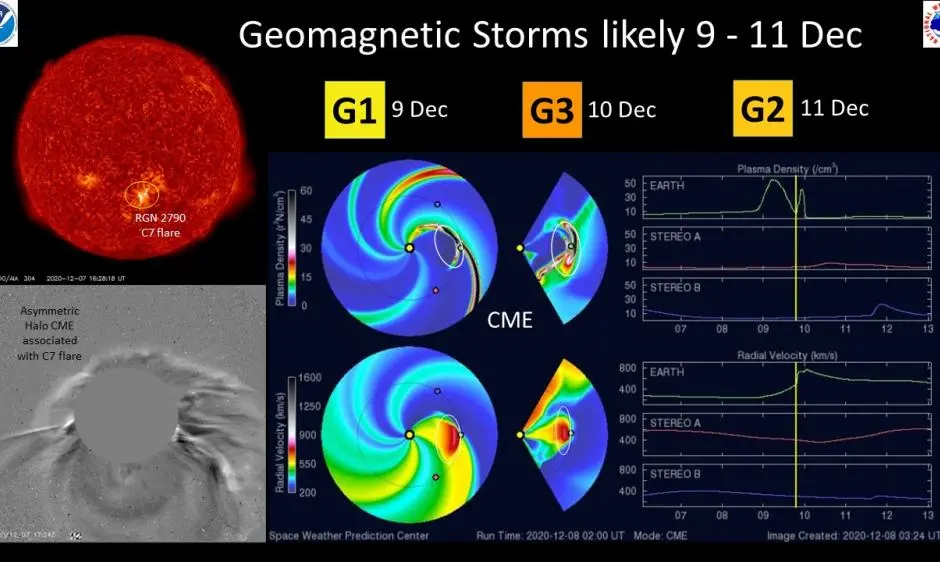
The geomagnetic disturbance traces back to a magnetic filament eruption on the Sun on August 14 that launched a coronal mass ejection (CME) on a trajectory toward Earth. NOAA's Space Weather Prediction Center had flagged the August 17–19 window as elevated-risk, with forecasters projecting G1 (minor) to G2 (moderate) storm conditions upon arrival — a classification that corresponds to planetary K-index (Kp) values of 5 to 6 on NOAA's nine-point scale.
The CME made a glancing blow at Earth, and by the early morning hours of August 18 Moscow time, the planetary disturbance was confirmed across the global observatory network. XRAS tracking data for August 2026 shows the month's maximum Ap index reaching 27, with multiple active-storm periods logged. The storm compresses Earth's magnetosphere on the dayside and stretches it into a long tail on the nightside, inducing powerful electrical currents that ripple through the ionosphere and — critically — through long-distance power infrastructure on the ground.
Aurora watchers from northern Scandinavia to Iceland to northern Canada reported sightings overnight, as the geomagnetic disturbance pushed the auroral oval to lower latitudes. The Geophysical Institute at the University of Alaska flagged active conditions. Starlust's space weather coverage noted that auroras were possible across the northern tier of the United States if Kp climbed toward 5 — which it did.
The New Sentinel at L1 — And Its Blind Spot
The timing of August 18's storm throws into sharp relief a transition that has been underway since June 2026: Earth is now relying on a brand-new space weather satellite for its advance warning system.
SOLAR-1 — formally the Space Weather Follow On-Lagrange 1 (SWFO-L1) satellite — launched in September 2025 aboard a SpaceX Falcon 9, reached the gravitational vantage point known as the Sun-Earth L1 Lagrange point by January 2026, and was declared fully operational in June 2026, the same month NOAA terminated the data feed from DSCOVR, its predecessor. According to CIRES, the Cooperative Institute for Research in Environmental Sciences, DSCOVR had served as the primary CME arrival detector for over eight years.
The August storm is one of SOLAR-1's first major operational tests — and it did not go entirely smoothly. TechTimes reported that the critical Bz component of the solar wind — the magnetic field orientation that determines whether a CME will couple powerfully with Earth's magnetosphere and supercharge a storm — remained unreadable from SOLAR-1's instruments until the CME had already made contact. Bz is the single most important variable in geomagnetic storm forecasting; a southward-pointing Bz dramatically amplifies storm intensity, while a northward Bz blunts it. Forecasters flying blind on Bz until the moment of impact cannot provide meaningful upgraded warnings to grid operators, pipeline managers, or satellite operators.
SOLAR-1 does still provide a 15-to-60-minute advance warning window on solar wind arrival in general — the same broad service DSCOVR provided. But the Bz gap represents a real limitation in the quality of that warning, not just its existence.
Why This Matters Beyond Aurora Photography
Geomagnetic storms are not just a light show. At G2 levels, they can cause voltage irregularities in power systems at higher latitudes, degrade HF radio propagation, increase atmospheric drag on low-Earth-orbit satellites (a significant concern given the density of commercial satellite constellations), and disrupt GPS accuracy. EarthSky's ongoing solar coverage and Space Weather Live's SWPC alert feed both tracked the storm's approach with alerts issued to aviation and grid operators.
The August 18 event is not, by historical standards, extreme — the May 2024 Gannon storm reached G5, the highest category, for the first time in two decades. But it is a pointed reminder that the infrastructure for predicting these events is itself in a period of vulnerability, with SOLAR-1 young and DSCOVR gone, at a time when both solar activity and our dependence on space-sensitive technology are near peaks.
Key Takeaways
- A planetary-scale geomagnetic storm was confirmed on August 18, 2026, registered by global magnetic observatories between 7:00–8:00 Moscow time, driven by a filament-eruption CME that left the Sun on August 14.
- Earth's new space weather sentinel, SOLAR-1, faced one of its first major operational tests — and exposed a critical weakness: the Bz solar wind component was unreadable until the CME had already arrived, undermining the quality of advance warnings.
- Storm impacts were real but moderate (G1–G2 range), including aurora sightings across northern latitudes, potential HF radio disruption, and elevated satellite drag — manageable now, but a dress rehearsal for something larger.
- The transition from DSCOVR to SOLAR-1 leaves a capability gap that the August 18 event has put on record; forecasters and policymakers will need to assess whether SOLAR-1's instrument suite is sufficient for the increasingly active solar cycle ahead.
Sources:
- SOLAR-1 Debut Storm: DSCOVR Gone, Bz Still Unreadable Until CME Impact — TechTimes
- Geomagnetic Storms in August 2026 — XRAS
- CIRES' Space Weather Forecasters Bid Farewell to DSCOVR — CIRES
- Planetary K-index — NOAA SWPC
- Sun News: Sun-Stuff Blast Headed to Earth — EarthSky
- High Geomagnetic Activity Could Trigger Aurora on August 17 — Starlust
- Geomagnetic Storm Forecast August 2026 — Pogodnik
- NOAA SWPC Alerts, Watches and Warnings — SpaceWeatherLive
- Aurora Forecast — Geophysical Institute, University of Alaska