The Top 10 Amazing Galaxies: Islands of Light in the Cosmic Dark
The Andromeda Galaxy: Two Trillion Stars Suspended in a Winter Sky
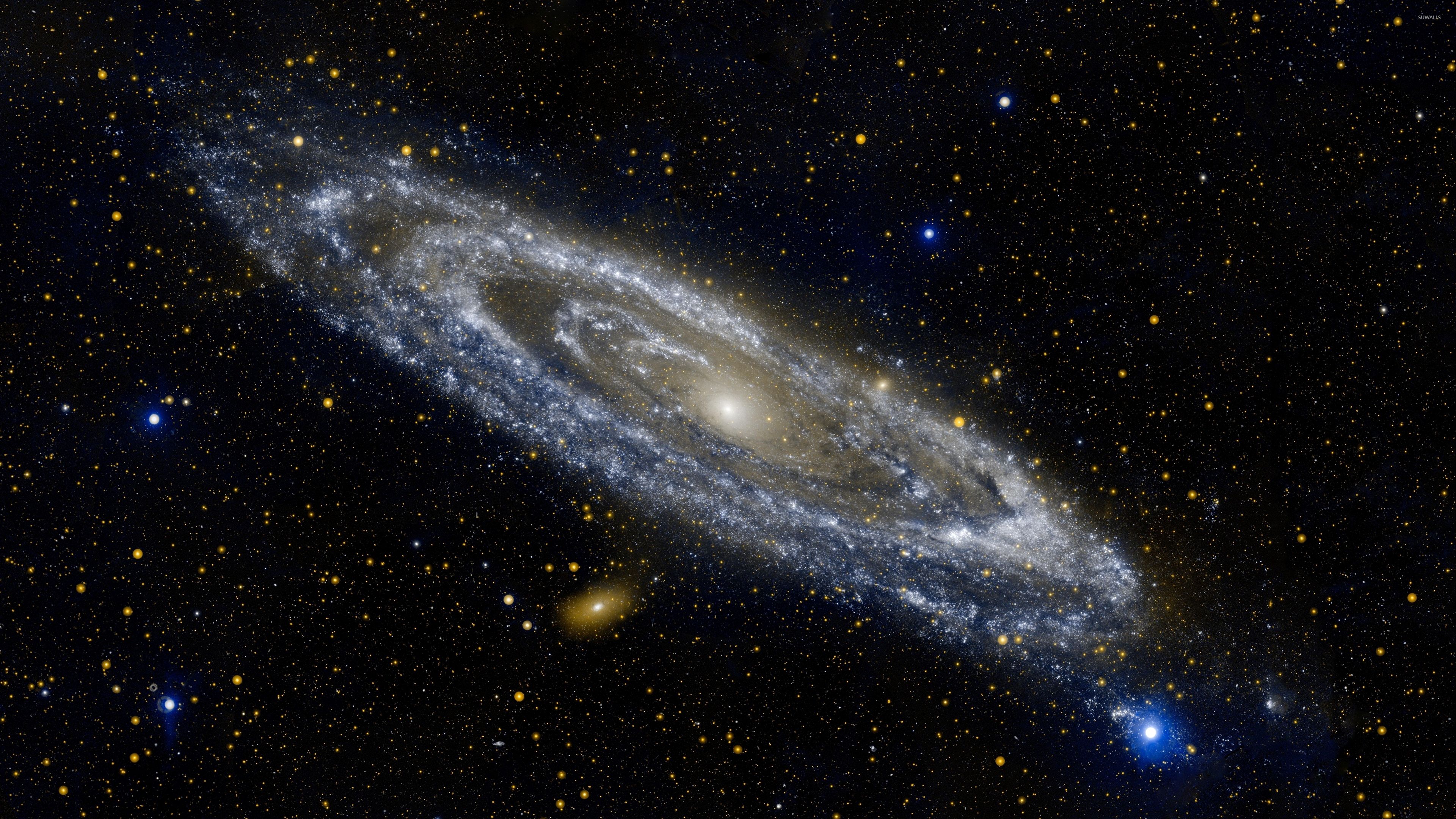
Step outside on a clear November night, far from the glow of any city, and look northeast. There, between the constellation Cassiopeia and the Great Square of Pegasus, you will notice something that shouldn't be there — a soft smear of light, faintly elongated, ghostly and still. It is not a cloud. It is not a comet. It is the Andromeda Galaxy, and it is the most distant object your naked eye will ever see.
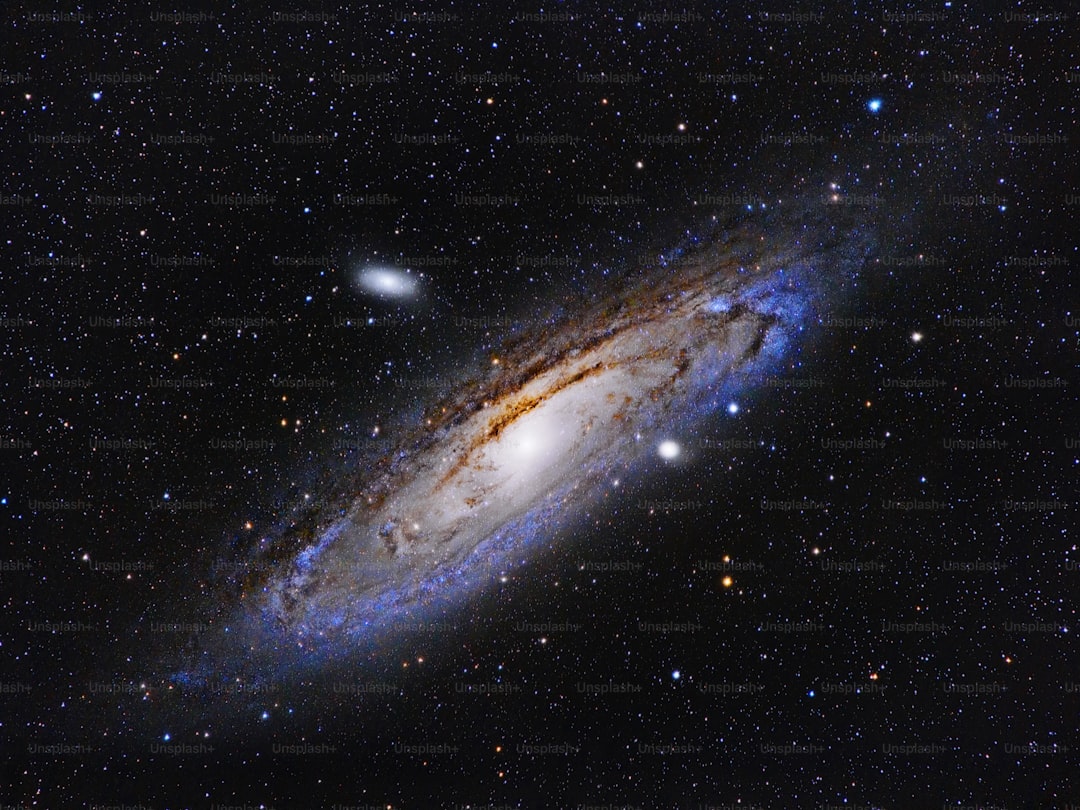
At 2.537 million light-years from Earth, Andromeda — designated M31 by astronomers — sprawls across the deep sky at a width six times the diameter of the full moon. In long-exposure photographs, it reveals itself in breathtaking layers: a blazing white core like a compressed sun, surrounded by concentric rings of blue-white star-forming regions, girded by a faint outer halo of ancient red stars that stretches almost imperceptibly into the surrounding blackness. Two smaller satellite galaxies, M32 and M110, hover beside it like attendants — one a tight, bright elliptical orb, the other a diffuse, elongated companion.
What makes the image of Andromeda genuinely staggering is what it represents in time. The light now entering your eyes left Andromeda when our ancestors were first dispersing out of Africa. The galaxy is not a distant static portrait; it is a message from our ancient past, still traveling toward us. And it continues to travel in the other direction too — Andromeda is hurtling toward the Milky Way at 110 kilometers per second. In roughly four billion years, these two spiral giants will collide and merge, remaking the cosmos above whatever worlds still exist.
The Whirlpool Galaxy: Locked in a Slow, Spiral Embrace
In the photograph, it is unmistakable — two galaxies caught in each other's gravitational arms, turning together in a silent, slow collision that has lasted hundreds of millions of years. The Whirlpool Galaxy, M51, hangs 31 million light-years away in the constellation Canes Venatici, and in any image captured by the Hubble Space Telescope, it is one of the most purely beautiful objects in the known universe.
M51 is a grand-design spiral galaxy — meaning its arms are not ragged or fragmented but sweeping, continuous, almost architectural. They curl outward from a brilliant yellow-white nucleus, threaded with dark dust lanes that trace their curves like brushstrokes. These arms glow blue at the edges where hot, young stars are being born in the compressed gas that the galaxy's gravitational dance has stirred into motion. The companion galaxy NGC 5194 clings to one arm like a hand resting on a shoulder — a smaller, irregular galaxy distorted by the encounter, its own stars trailing outward in a luminous bridge connecting the two.
The Hubble image of M51 has become one of the canonical images of modern astronomy because it captures something almost impossible to comprehend: motion on a galactic scale, frozen. The spiral does not feel static. Those arms appear to be moving, sweeping, turning — even though the rotation period of a galaxy like this is hundreds of millions of years. We are looking at geology, at deep time made visible. The colors in the image — the blue star clusters, the amber core, the red nebulae spotted along the arms like embers — are not decorative. They are data, telling us exactly where stars are being born and where the oldest suns have settled into a quiet, ancient glow.
The Sombrero Galaxy: A Hat Brim of Dust at the Edge of the Universe
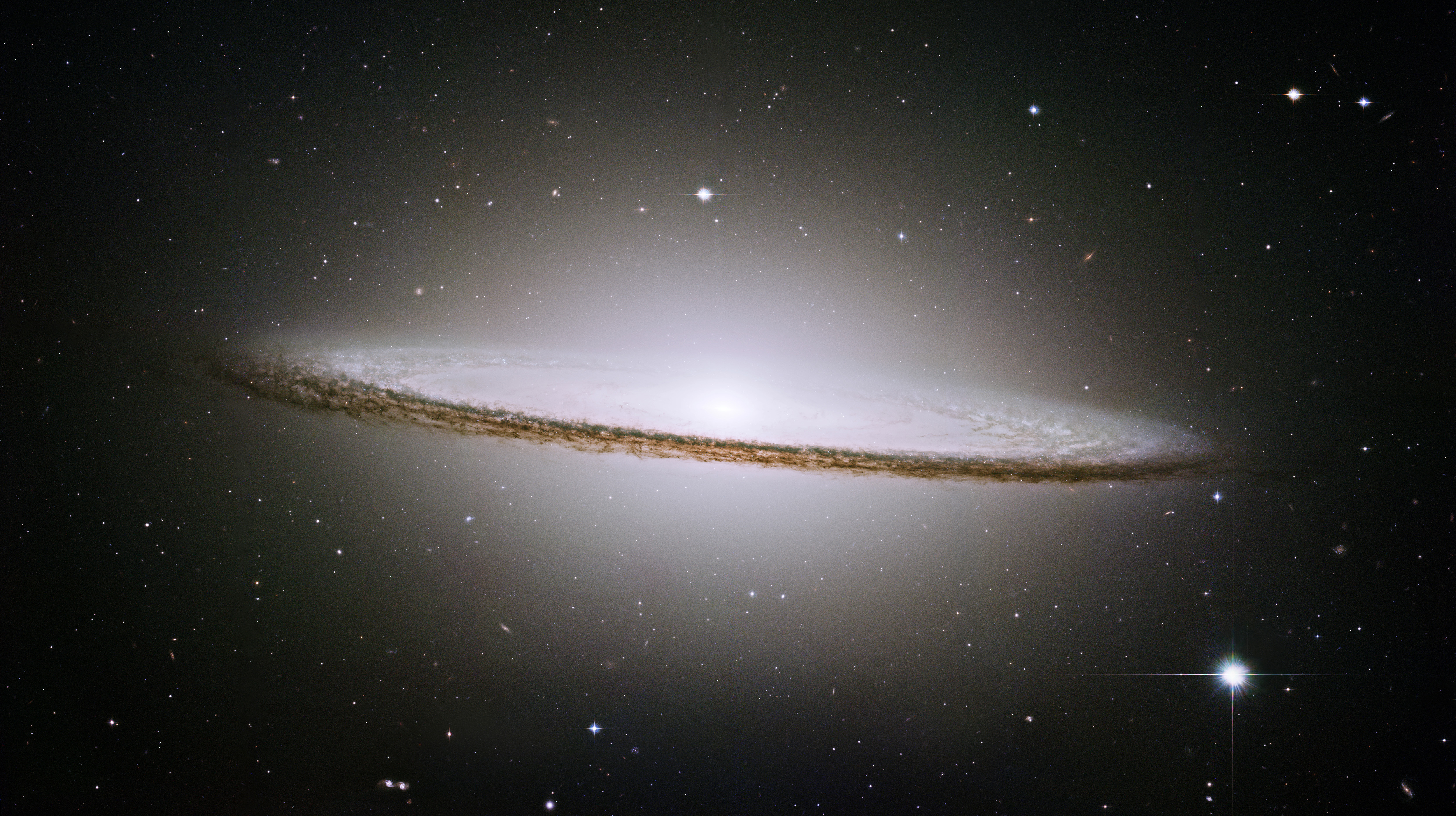
There is a photograph of the Sombrero Galaxy that looks less like an astronomical image and more like a painting — something that belongs on the wall of a museum rather than in a science journal. Seen nearly edge-on from 28 million light-years away, M104 presents itself as a luminous white dome rising above a perfectly flat, dark band of dust, like a broad-brimmed hat suspended in the void. That dust lane is so precisely defined it appears drawn with a straight edge.
The Sombrero sits in the constellation Virgo, and it belongs to an unusual structural category: it is technically both a spiral and an elliptical galaxy, possessing the flattened disk of a spiral but the massive, extended halo and bulging core of an elliptical. That halo — barely visible as a faint luminosity surrounding the entire structure — contains thousands of globular clusters, each one a gravitationally bound sphere of hundreds of thousands of ancient stars. The Sombrero has an unusually large number of these clusters, perhaps as many as 2,000, compared to the Milky Way's 150.
At the center of that bright core lurks one of the most massive black holes yet identified in a nearby galaxy — a supermassive void estimated at one billion solar masses. This black hole is sleeping now, not actively consuming material in any dramatic way, but its presence has been inferred by the velocities of stars orbiting in its vicinity, moving at speeds only explicable by something of immense and invisible gravity. The Hubble image of the Sombrero remains one of the space telescope's most iconic: a precise, symmetrical structure hanging alone against the total black of intergalactic space, beautiful in its geometry, terrifying in its scale.
The Cartwheel Galaxy: The Shockwave That Reshaped a World
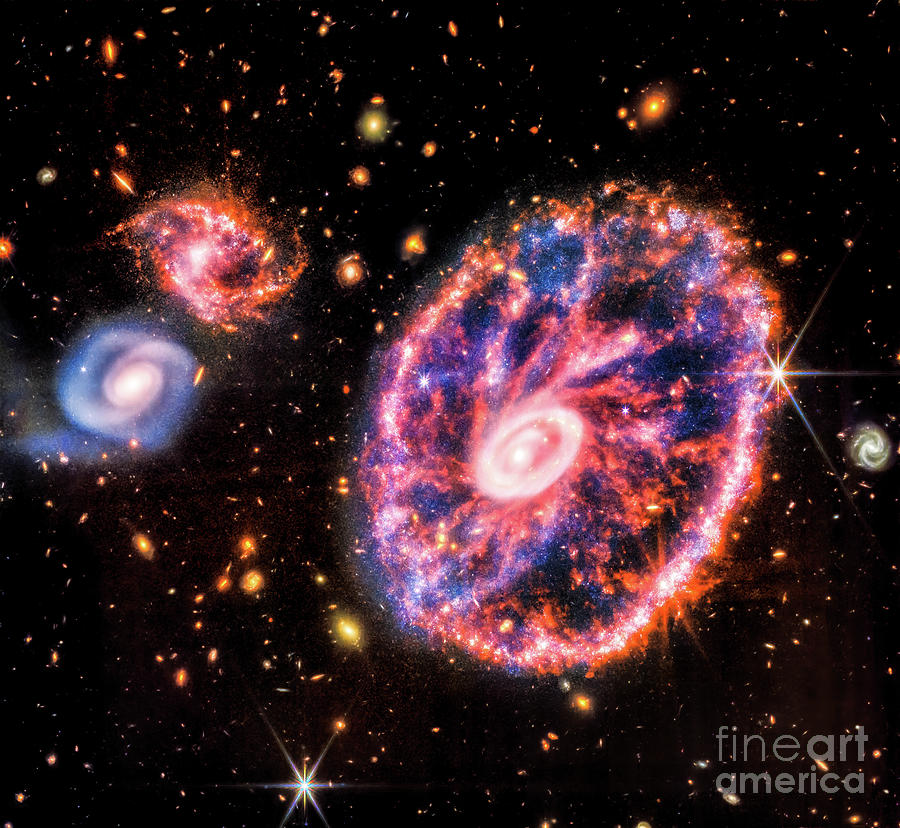
Look at the Cartwheel Galaxy and what you are seeing is the aftermath of a cosmic collision — not a slow, gradual merger like Andromeda and the Milky Way will one day be, but a high-velocity bullseye. Approximately 500 million years ago, a smaller galaxy punched almost directly through the center of what was once a normal spiral galaxy, and the shockwave from that impact rippled outward like a stone dropped into a still pond. What remains, 500 million light-years away in the constellation Sculptor, is one of the most structurally peculiar objects in the nearby universe.
The James Webb Space Telescope captured the Cartwheel in 2022 in a detail and color that no previous image had achieved. The outer ring blazes with points of blue-white: young, hot star clusters born from the gas compressed by the collision's expanding wave. Between this outer ring and the bright, distorted core, a ghostly inner wheel shimmers, connected by faint spoke-like filaments that radiate outward like the ribs of the cartwheel that gives the galaxy its name. These spokes are rivers of gas and dust, tracing the gravitational dynamics still playing out hundreds of millions of years after the original impact.
In the Webb image, color serves as a timeline. The outer ring glows blue, meaning new stars. The core burns white and gold — old stars surviving from before the collision. Red indicates warm dust heated by star formation. The whole structure is still expanding outward at tens of thousands of kilometers per hour. What you are looking at is not a finished object but a process, still unfolding, a cosmic ripple that will not stop until the outer ring disperses entirely into the intergalactic medium.
The Black Eye Galaxy: A Bruise the Size of Eternity
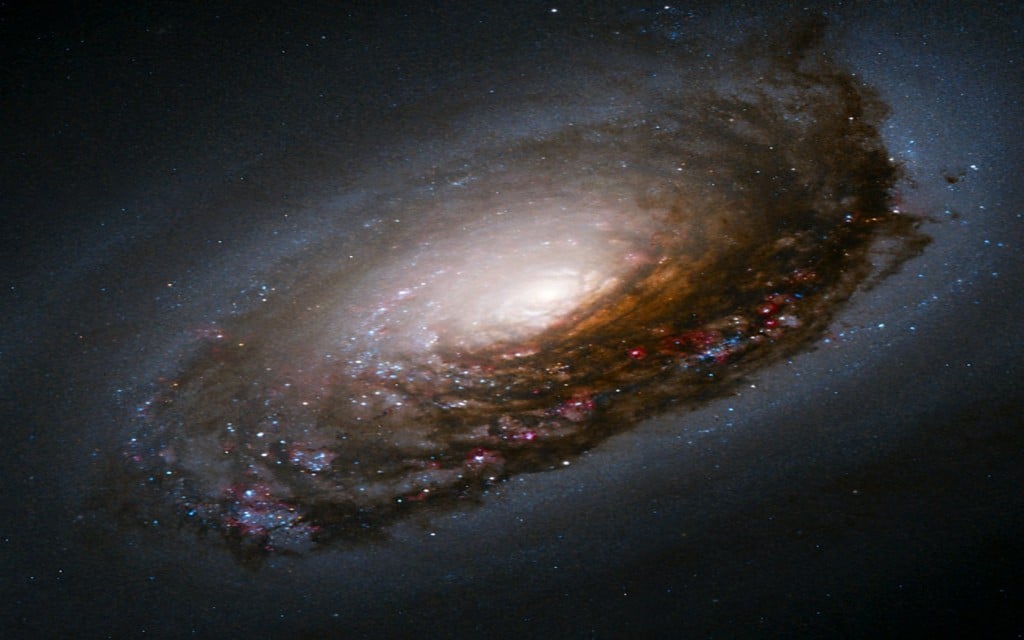
Its name is immediately descriptive and slightly unnerving. M64, the Black Eye Galaxy, contains a dark band of absorbing dust so pronounced that it appears, in photographs, as a massive bruise pressed against the galaxy's bright nucleus — a deep shadow curling across a luminous face. Located 17 million light-years away in the constellation Coma Berenices, it is one of the most striking visual anomalies in the messier catalog.
What the photographs reveal but don't immediately explain is the reason for that dark arc. The Black Eye Galaxy has two counter-rotating systems within it: an inner disk of stars rotating in one direction, and an outer disk rotating in the opposite direction. This is the signature of a merger that happened in the geological past — a smaller galaxy was absorbed, and its angular momentum left a permanent scar on the host galaxy's structure. The boundary between these two counter-rotating zones is exactly where the dark dust lane lies, compressed by the friction between two systems turning against each other for billions of years.
The core of M64 glows an amber-white at the center of the frame, surrounded immediately by that curved shadow, and then by outer spiral arms threaded with faint blue star clusters. In deep photographs, the outer arms appear disturbed, asymmetric, not yet settled into the clean geometry a stable galaxy would show. The merger that created this black eye is old — hundreds of millions of years in the past — but the galaxy is still not done digesting it. This is time made legible, history written not in text but in the shape of light and shadow seen from seventeen million light-years away.
The Large Magellanic Cloud: A Smudge of Light Spanning a Kingdom
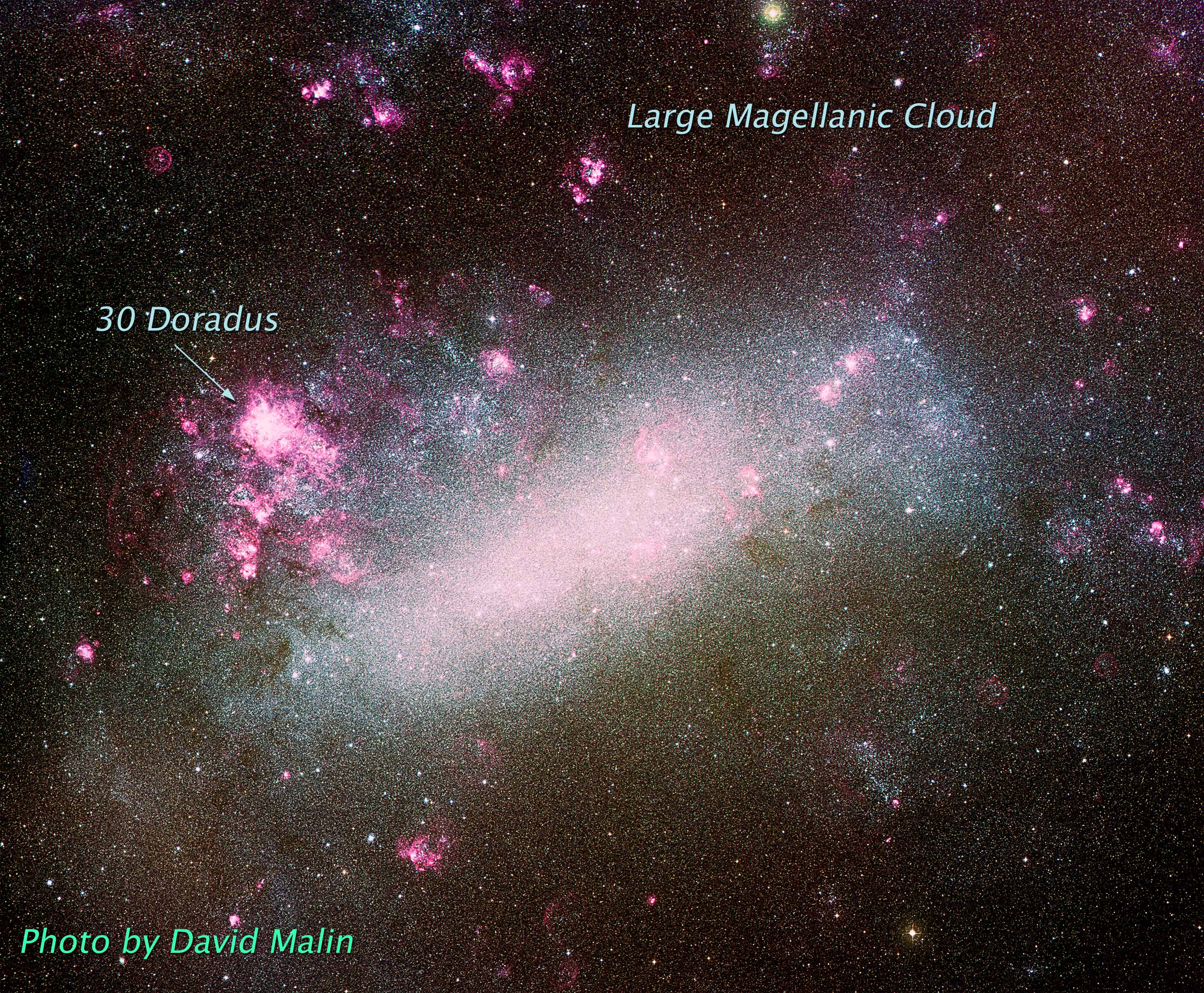
From the Southern Hemisphere, on any clear night, you can see it without a telescope: a large, irregular patch of light hanging low in the sky, like a piece of the Milky Way that has broken loose and drifted slightly apart. This is the Large Magellanic Cloud, a satellite galaxy of our own Milky Way, orbiting us at a distance of roughly 160,000 light-years. To southern cultures across millennia, it has simply been part of the sky — a fixture as familiar as the Southern Cross.
In detailed photographs, the LMC resolves into a chaotic tapestry of color and activity. It is not a neat spiral or an orderly elliptical. It is an irregular galaxy — disrupted, distorted, asymmetric — shaped by its gravitational interaction with the Milky Way and its sibling, the Small Magellanic Cloud. Within its borders, the Tarantula Nebula blazes as one of the most active star-forming regions in the entire Local Group of galaxies, a spidery filament of hydrogen gas glowing electric red and pink, threaded with blue-white star clusters so dense they make our Orion Nebula look modest by comparison.
At the heart of the Tarantula Nebula sits R136, a cluster of some of the most massive stars ever discovered — individual suns estimated at 150 to 300 times the mass of our own. In infrared photographs taken by the James Webb Space Telescope, these stars emerge from their surrounding nebula like lanterns through fog, each one destined to end in a supernova or hypernova within the next few million years. The LMC is not a dead gallery piece. It is the most immediately active stellar nursery visible from Earth, and it is our neighbor.
The Cigar Galaxy: Smoke and Fire at the Heart of a Starburst
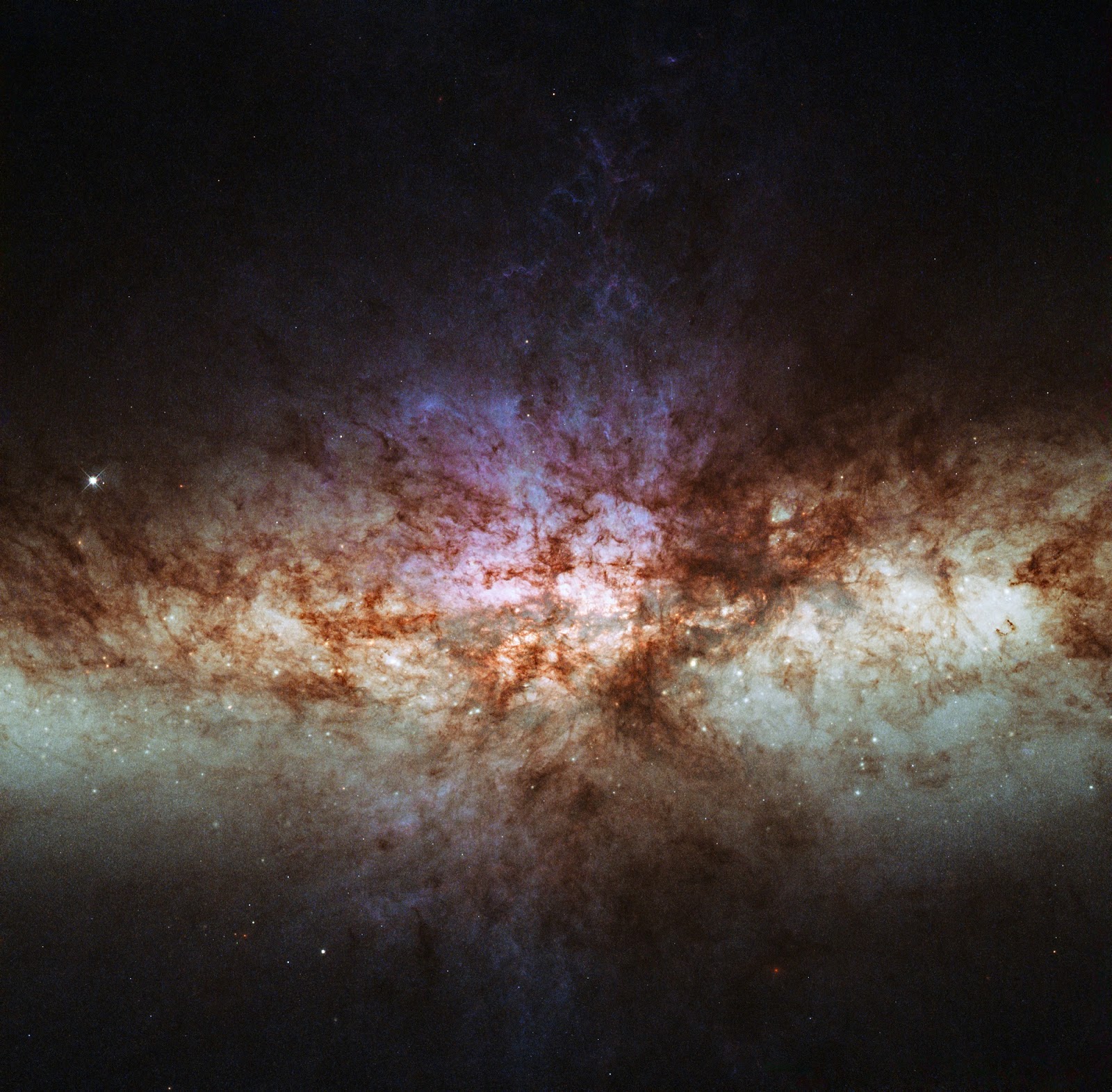
Twelve million light-years from us, in the constellation Ursa Major, a galaxy is burning itself alive. M82, the Cigar Galaxy, is not particularly large by galactic standards — it is an irregular galaxy, roughly one-fifth the size of the Milky Way — but it is forming stars at a rate ten times faster than our own galaxy. The reason is gravitational: its massive neighbor, M81, is pulling on it, compressing its gas, triggering wave after wave of star birth in its dense central region.
In the iconic images of M82, the galaxy appears edge-on: a dark, elongated cigar shape bisected horizontally by a chaotic tangle of dust lanes. But jutting perpendicularly outward from the center — straight up and straight down from the disk — are vast red filaments of ionized hydrogen, glowing in an eerie magenta-crimson against the darkness. These are galactic superwinds: outflows of gas driven by the collective energy of thousands of simultaneous supernovae, the dying explosions of all those massive stars that formed in a compressed burst millions of years ago. The galaxy is venting itself, exhaling its own material into the halo above and below its disk.
Color here is everything. The disk of the Cigar is amber and brown — old stars and dark dust. The polar outflows burn red, the signature wavelength of excited hydrogen. Scattered throughout the central region are pale blue knots: individual star clusters, each one as luminous as a small galaxy, packed into a region smaller than our galactic core. This is what starburst looks like. This is a galaxy not in equilibrium but in crisis, accelerated by gravity into a furious, unsustainable burst of creation.
Hoag's Object: The Perfect Ring That Defies Explanation
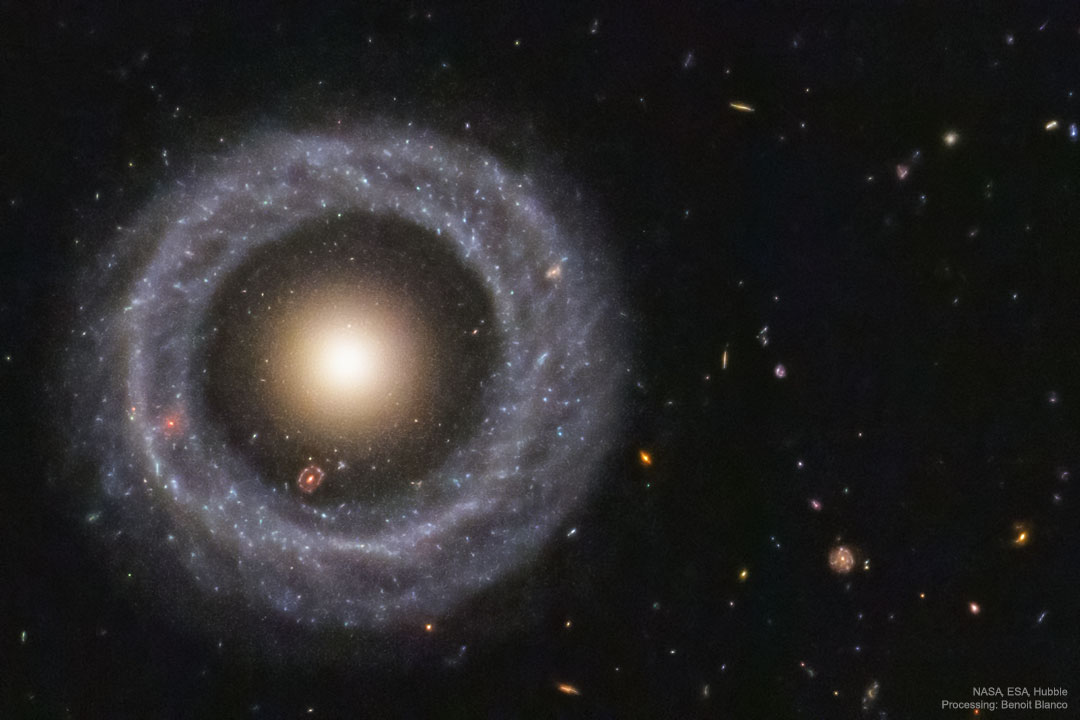
In 1950, astronomer Arthur Hoag was examining photographic plates when he noticed something he could not classify. It appeared as a nearly perfect ring of blue-white stars surrounding a compact, isolated core of yellow-red old stars — with empty, dark space between the ring and the core. It did not look like a merger. It did not look like a polar ring galaxy. It was something else entirely, something with no clean category in the existing taxonomy. It is now known as Hoag's Object, and it remains, nearly eight decades later, one of the most structurally enigmatic galaxies ever discovered.
Located 600 million light-years away in the constellation Serpens, Hoag's Object appears, in the Hubble image that brought it to wide public attention, as an almost artificial construction: a thin ring of blazing blue-white star clusters, evenly distributed, forming a near-perfect circle around a small, glowing elliptical core of ancient stars. Between them: nothing. Pure black intergalactic space. The precision of the ring, the cleanness of the gap, the isolation of the core — all of it suggests design, though of course none exists.
What makes the Hubble image even stranger is what appears in the gap between the ring and core: a second, smaller Hoag-like object, a more distant galaxy of similar ring structure, visible through the very center of Hoag's Object itself. The leading theories for how Hoag's Object formed involve either a very specific, high-velocity head-on collision with another galaxy — the same mechanism that created the Cartwheel — or a process of internal bar instability that caused stars to migrate outward. Neither explanation has been definitively confirmed. The galaxy sits in its perfection, offering no easy answers, just that immaculate, baffling ring.
NGC 1300: The Architecture of a Cosmic Barred Cathedral
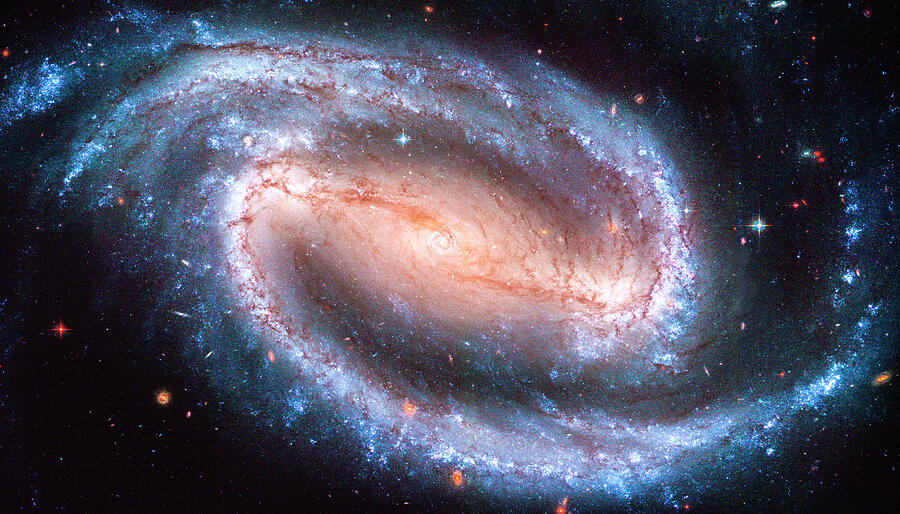
Some galaxies are beautiful in the way that storms are beautiful — chaotic, overwhelming, too large to fully take in. NGC 1300 is beautiful in the way a cathedral is beautiful: with deliberate structure, with symmetry, with a geometry so purposeful it seems almost designed. A barred spiral galaxy located 61 million light-years away in the constellation Eridanus, NGC 1300 is considered one of the finest examples of its type in the local universe.
In the extraordinary Hubble mosaic captured in 2005, NGC 1300 fills the frame with a commanding presence. From its nucleus, a straight bar of stars extends symmetrically in both directions, glowing amber and yellow — old stars packed into a rigid, elongated structure that cuts across the center of the galaxy like a golden bridge. At each end of the bar, the spiral arms begin — sweeping, dramatic, curving outward with blue star-forming regions scattered along their length like lights strung on a curve. The arms are not tight. They are grand and open, trailing outward into the surrounding void.
Most striking in the image is the detail of the bar itself. Peer into its central region with the Hubble's resolution and a miniature spiral emerges — a grand design spiral within the nucleus, a galaxy-within-a-galaxy swirling at the very core of the bar structure. This inner spiral is thought to be driven by gravitational resonance between the bar and the surrounding disk, a self-reinforcing pattern that has persisted for hundreds of millions of years. The bar funnels gas inward; the inner spiral forms from that gas; stars are born; and the whole structure maintains its extraordinary geometry across timescales that dwarf the entire history of complex life on Earth.
Our Milky Way: The River of Light We Have Always Called Home
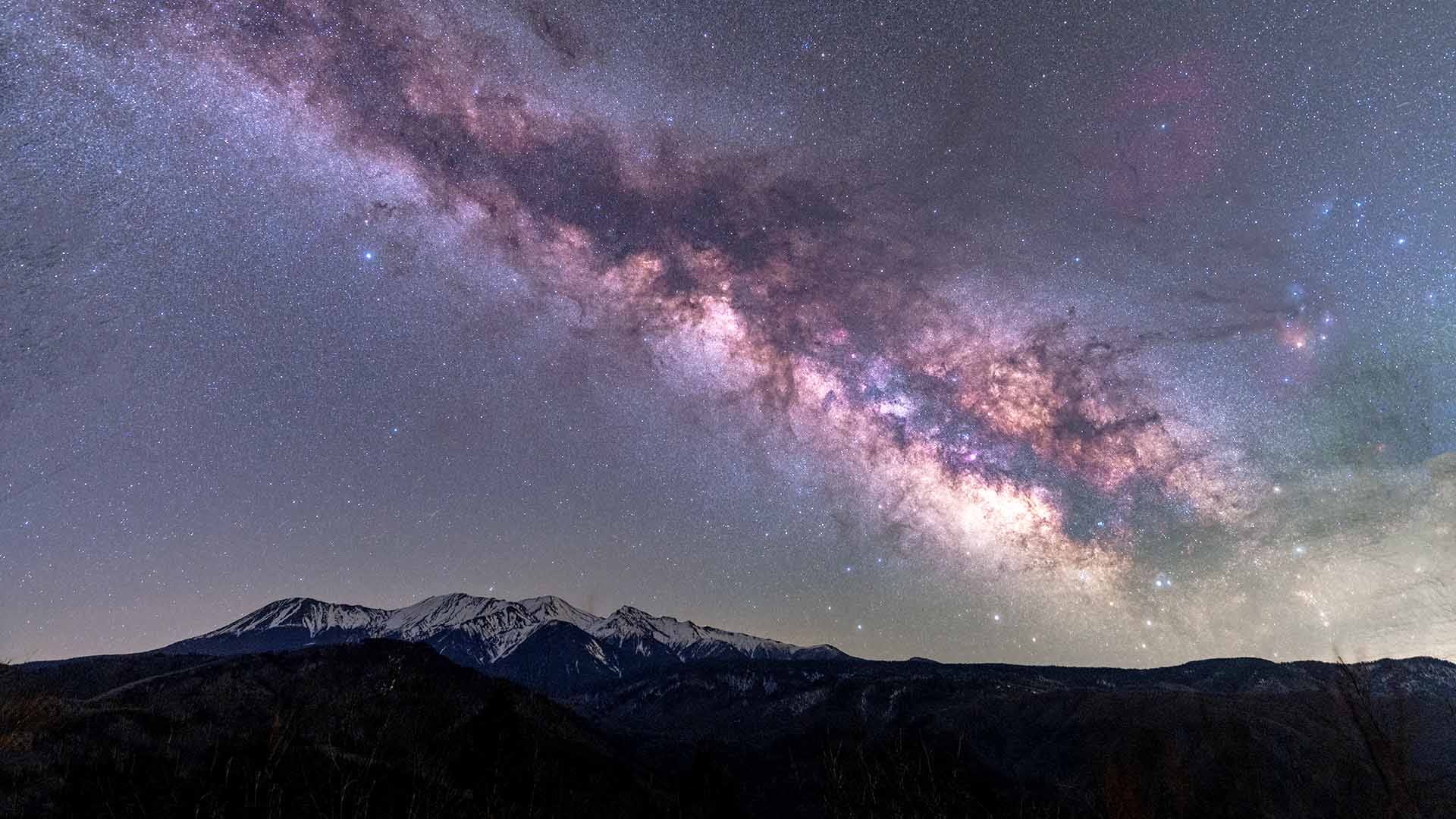
There is one galaxy that no photograph can fully capture, because every camera that tries to image it is already inside it. Our own Milky Way — a barred spiral galaxy approximately 100,000 light-years in diameter, containing between 100 and 400 billion stars — cannot be seen from outside. We know its shape the way a fish might know the shape of the ocean: imperfectly, inferentially, through the collective evidence of what surrounds us.
The photographs we do have are panoramas — wide-field images of the Milky Way's galactic plane stretching across a dark sky, captured from mountaintops in Chile, from the Atacama Desert, from the American Southwest on moonless summer nights. In these images, the galaxy appears as a dense river of light, mottled with dust clouds, speckled with blue star clusters, punctuated by the warm reddish glow of hydrogen nebulae. The center of the galaxy — the galactic core — rises above the southern horizon in summer from the Northern Hemisphere like a great glowing bulge, the densest concentration of stars in our local universe, surrounding a supermassive black hole called Sagittarius A* that contains four million solar masses.
Our position within the Milky Way is both intimate and humbling. We orbit within the Orion Arm, a minor spiral arm between two major arms, roughly 26,000 light-years from the galactic center. Every image of the Milky Way is a self-portrait taken from the inside, and every star visible in the night sky is a neighbor — close, in galactic terms. The universe contains an estimated two trillion galaxies. Each of them is a Milky Way, an island of light adrift in the dark. To stand under the Milky Way on a clear night and feel small is correct. But to stand there and feel alone is a misreading of the evidence. Wherever there is a galaxy, there is the possibility of suns. And wherever there are suns, history suggests, there may be nights exactly like this one.