The Fender Stratocaster: A Brief History
Steel Wire Pulled Taut Across a Solid Body
A man in a three-piece suit holds something that barely resembles a guitar — a lap steel with a horseshoe-shaped magnet clamped over the strings, wired to a small amplifier the size of a bread box. The year is 1931. The room is dim, lit by a single industrial bulb. Les Paul in a garage, or George Beauchamp in a workshop, or any one of a dozen inventors who were all chasing the same impossible idea at the same time: that music, invisible and fleeting, could be captured and transformed into electricity.
The problem with acoustic guitars was simple and maddening. They were not loud enough. In dance halls and clubs, the brass section drowned them out entirely. Guitarists were invisible men at the back of the stage. So engineers and hobbyists began attaching magnetic pickups to hollow-bodied instruments — devices that translated the vibration of a metal string into an electrical signal, which could then be amplified to any volume. The results were startling and imperfect. The hollow body would resonate sympathetically with the amplifier's speaker, producing a low, cycling moan. Feedback. It was the sound of physics working against ambition.
In photographs from those early years, the instruments look improvised, almost apologetic — bits of radio technology bolted onto woodworking projects. But in those messy, hybrid forms, you can see the shape of something coming. A new kind of instrument that did not yet know what it wanted to be.
Leo Fender's Radio Repair Shop on Harbor Boulevard
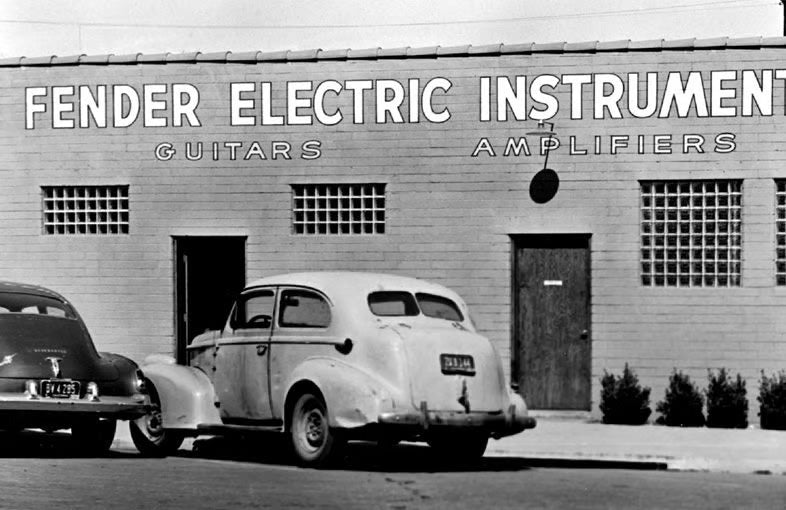
The town of Fullerton, California, in the late 1940s is flat and sun-bleached in every photograph you'll find — citrus groves stretching to the horizon, white stucco buildings casting short noon shadows. Inside a cinder-block building at 107 South Harbor Boulevard, a slightly built man with thick glasses peers into the guts of a broken radio. His name is Clarence Leonidas Fender, and he has never taken a formal music lesson in his life. He cannot play guitar. What he can do — what he does with a kind of obsessive, methodical joy — is understand how electronic things work.
Fender opened his radio repair shop in 1938, and musicians kept walking through the door with broken amplifiers. He fixed them. Then he started building them. Then, almost inevitably, he started thinking about the instruments themselves. His eye was practical, engineering-minded. He looked at the hollow-body guitars of the era and saw a problem: they were difficult to manufacture consistently, expensive to produce, and acoustically volatile. What if you built a guitar the way you'd build a radio? From components. With interchangeable parts. With a body so solid it would never feed back.
The images from his shop are intimate and specific: a workbench crowded with soldering irons and resistors, sawdust on the concrete floor, prototype necks hanging from the wall like artifacts in a strange museum. Leo Fender is rarely the subject of grand portraits. He appears at the edges of photographs, usually looking at something rather than the camera — at a circuit diagram, at a guitar neck being tested for straightness. A man absorbed entirely in the problem in front of him.
The Broadcaster, Stripped Down to Raw Ash
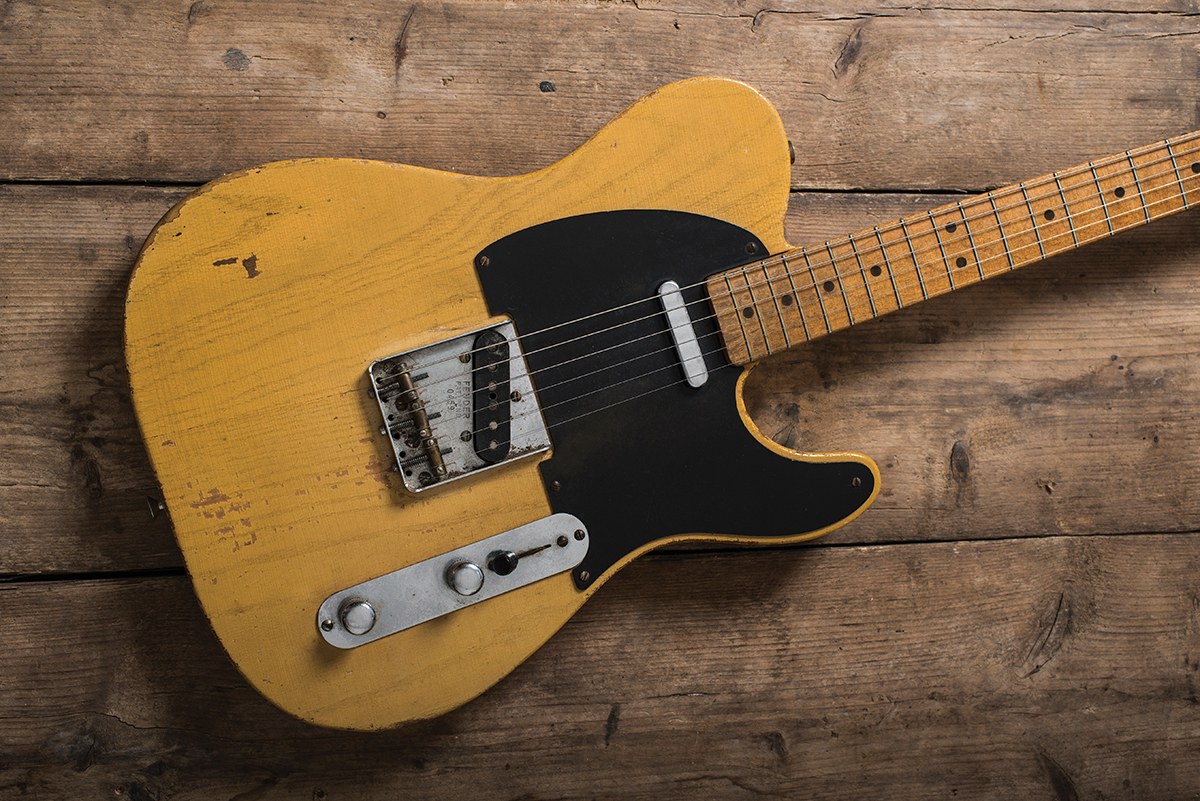
By 1950, Fender had built something genuinely radical. Lay it flat on a table and study it. The body is a slab of ash — no curves, no carved top, no ornamentation beyond a thin coat of butterscotch blonde lacquer. The neck is maple, bolted on rather than glued, which meant it could be replaced like a car part. Two single-coil pickups sit beneath the strings. There is nothing excessive about it, nothing romantic. It looks like it was designed by someone who considered beauty an afterthought and function a religion.
He called it the Broadcaster. Gretsch already owned that name, so it briefly became the Nocaster — nameless guitars with the model name literally clipped from the headstock decals — before settling into its permanent identity as the Telecaster. But the design philosophy it established was absolute and unwavering. Fender guitars would be built for manufacturing precision, for repairability, for the working musician who needed an instrument that could take punishment and keep playing.
Professional musicians who picked up early Telecasters in photographs always seem slightly surprised by them. You can see it in their posture — the guitar is lighter than expected, thinner, more utilitarian than the archtop jazz guitars they'd come from. But plug it in, and the tone is bright and cutting and completely unlike anything that came before it. Steel and ash and electricity, distilled into something new.
Three Pickups and a Tremolo Arm: The Day the Stratocaster Appeared
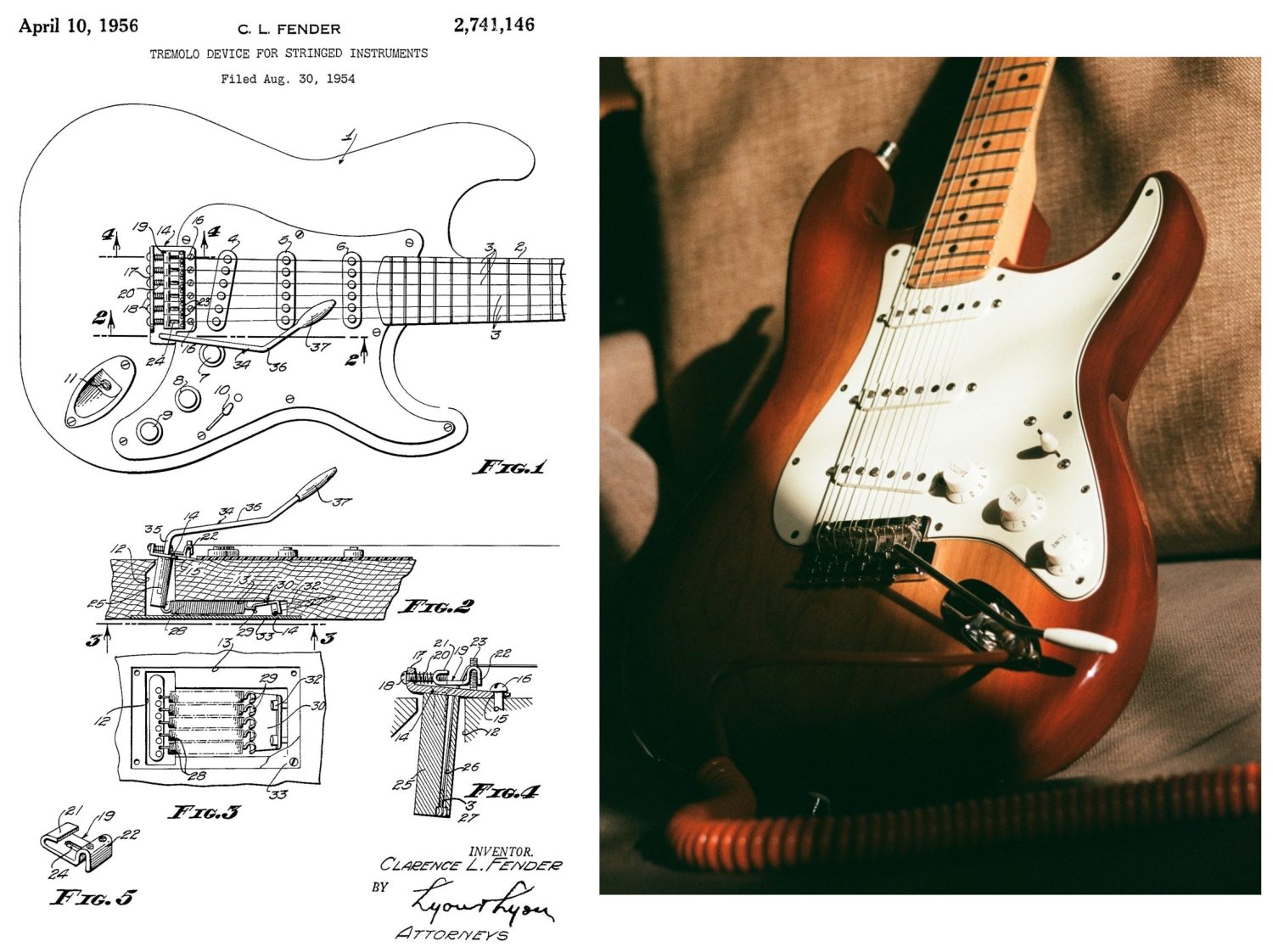
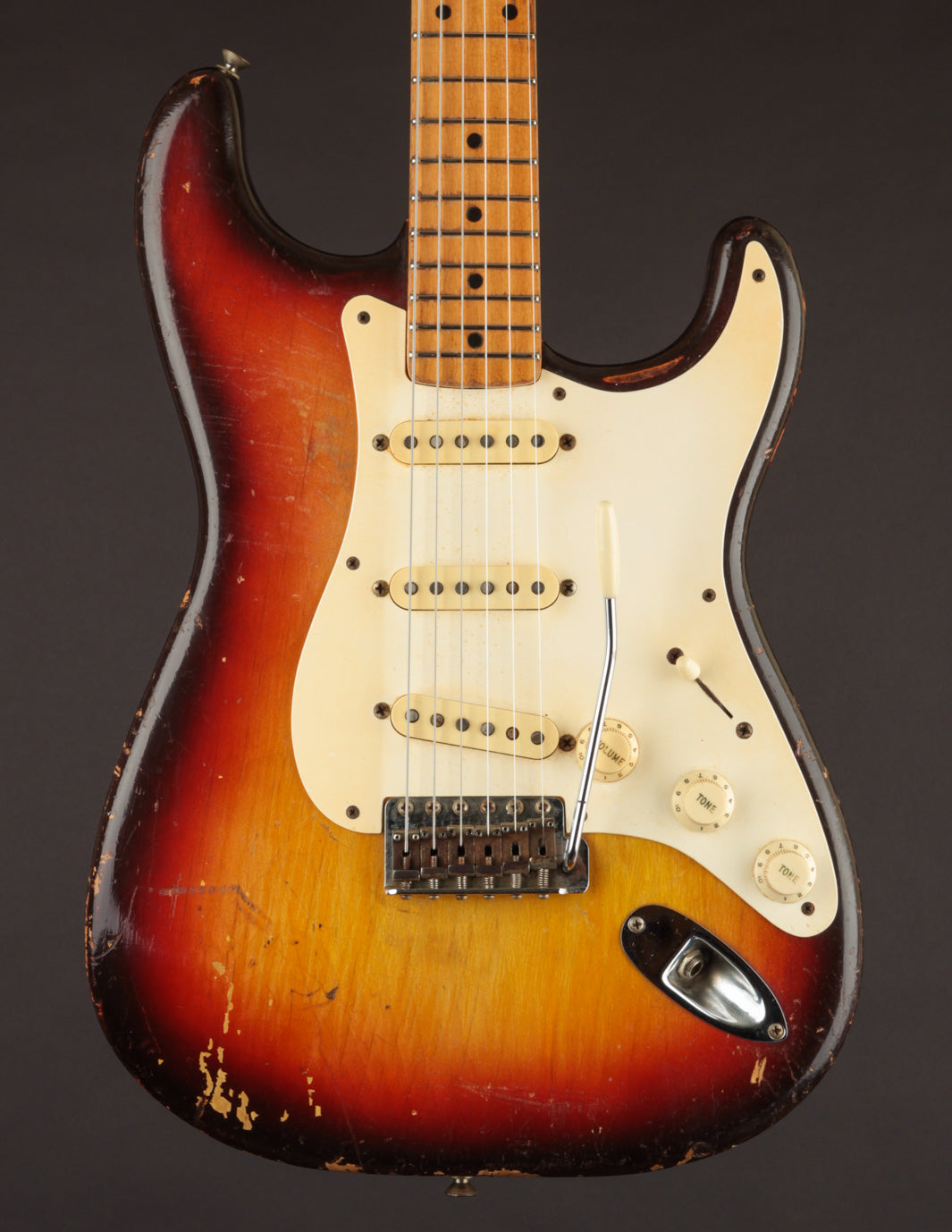
The photograph shows a 1954 guitar against a white background. It is the most important photograph in the history of electric guitars, even if almost no one was paying attention when it was taken.
The Stratocaster arrived in 1954 and was immediately, unmistakably different from anything Fender had built before. The body had been reshaped — no longer a simple slab, but a double-cutaway form with contoured edges, beveled at the back where it rested against the player's chest, carved at the front where the picking arm draped over it. These contours were born from direct musician feedback. Players had complained that the Telecaster's sharp edges dug into their ribs. Fender listened. The Strat's body was ergonomic before ergonomics was a word anyone used in guitar manufacturing.
Three pickups instead of two. A revolutionary tremolo bridge that allowed the player to push a metal arm and bend all six strings simultaneously, creating that liquid, wavering vibrato that would become one of the defining sounds of the twentieth century. Five-way pickup switching — originally three-way, but players quickly discovered they could wedge the switch between positions to access hybrid tones that Fender hadn't planned for, and eventually the company made those positions official. The Stratocaster was an instrument that players kept improving by accident, and Fender kept ratifying those accidents. The early colors were simple: sunburst, two-tone, the occasional custom color for an upcharge. But even in black and white photographs, the guitar projects a particular kind of elegance — streamlined, almost aerodynamic, as if it were designed to move through air.
Sunburst Finish Under a Marquee Light: The Golden Years
Photograph: a concert stage in 1957, somewhere in the American South. The guitar player stands at the microphone, a sunburst Stratocaster catching the single overhead light. The finish — red at the edges bleeding through orange to a pale gold center — glows like something internal, like the guitar is lit from within rather than illuminated from above. This is Buddy Holly, or possibly Hank Marvin, or one of a hundred players who took the Stratocaster and made it the instrument of a generation.
The late 1950s and early 1960s were the years in which the Stratocaster became iconic, though it did not happen all at once. Fender sold guitars to working musicians, to session players, to country pickers who appreciated the clean, articulate tones. Rock and roll arrived and the Stratocaster arrived with it, or rather, rock and roll grew up around the Stratocaster, each shaping the other. The guitar's treble bite was perfect for the crisp attack that early rock demanded. The tremolo arm introduced a new expressive vocabulary — a shimmer, a dive, a slow oceanic swell.
In photographs from this era, the guitars are uniformly gorgeous. The nitrocellulose lacquer that Fender used was thin and responsive, aging over decades into a network of fine cracks that collectors now call "checking" and treasure as evidence of authenticity. The wood beneath breathes through old finishes. The necks, maple on early models and later rosewood on maple, develop a patina of use — darkened at the first position where players' hands spent most of their time, worn pale at the frets. Every aging Stratocaster from this period is a document of someone's musical life, written in wear and light.
Hendrix's Guitar, Burning at Monterey Pop
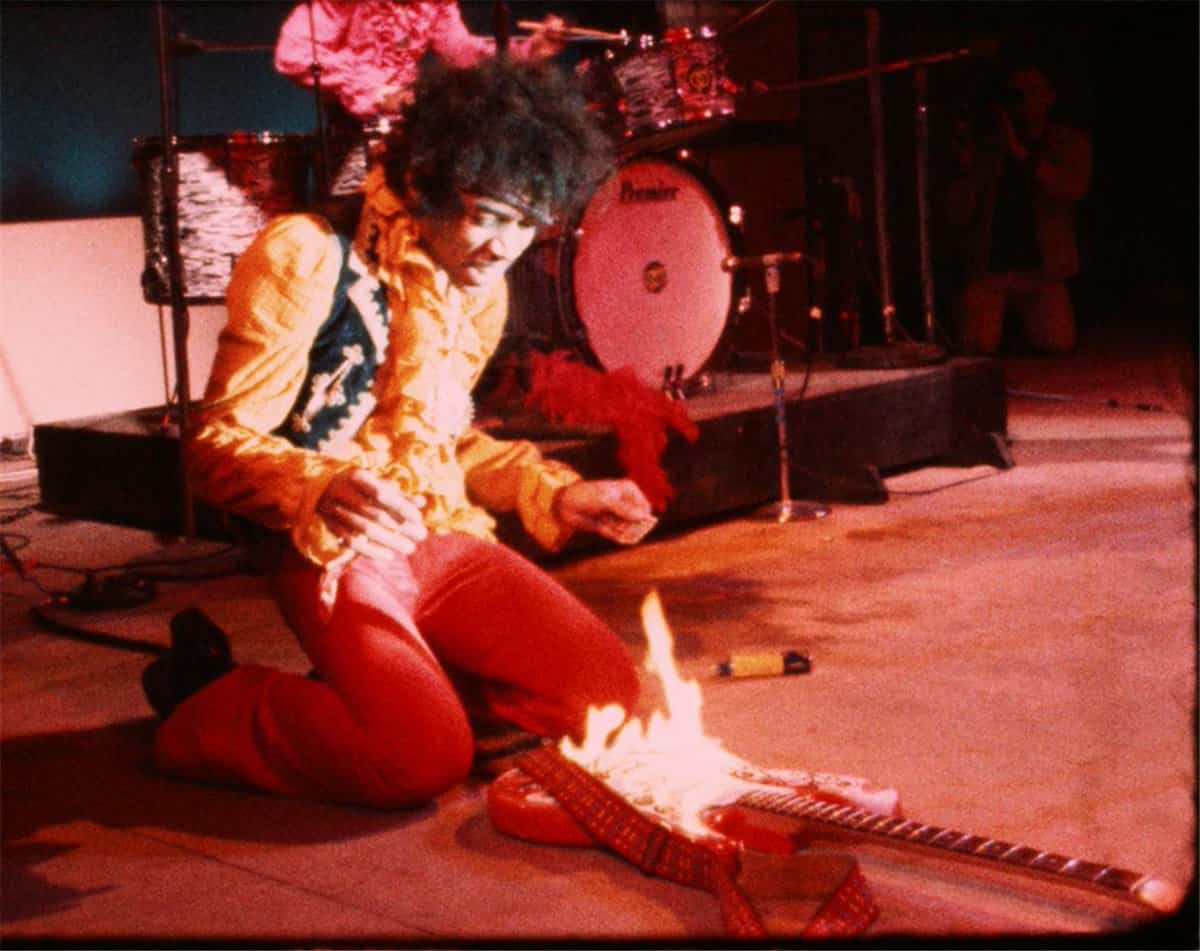
June 18, 1967. The photograph that almost everyone knows: Jimi Hendrix kneeling over a white Stratocaster on the stage of the Monterey International Pop Festival, a small can in his hand. He has just played "Wild Thing." Now he is pouring lighter fluid on his guitar. When he lights it, the white body blazes against the dark stage, and what burns is not just a guitar but the entire received notion of what a guitar could be or do or mean.
Hendrix had reverse-strung a right-handed Stratocaster to play left-handed, which altered the angle of the slanted neck pickup in ways that changed his tone in subtle but audible ways. He ran the tremolo arm with a violence and tenderness that the designers hadn't anticipated, pulling sounds from the instrument that no one had heard before — feedback sculpted into melody, strings bent to microtonal intervals that the frets didn't account for. He played the guitar with his teeth. He played it behind his back. And then he set it on fire.
The Stratocaster survived Hendrix's most famous performance as a melted artifact that now lives in a museum case, but its reputation did not merely survive — it was transfigured. The guitar that Leo Fender had designed in a cinder-block shop in Fullerton had become the instrument of the counterculture, the sound of liberation, the thing you could worship by destroying. After Monterey, after Woodstock, after all the photographs that followed of Stratocasters strapped to the bodies of Eric Clapton, Stevie Ray Vaughan, David Gilmour, Mark Knopfler, the guitar's cultural position was absolute and permanent.
The Gray Factory Floor: Fender Under CBS
Study a photograph of a Fender guitar made in 1970. Then find one made in 1965. Hold both images side by side.
In 1965, CBS — the Columbia Broadcasting System, a corporation that understood television and radio and very little about guitars — purchased Fender for thirteen million dollars. Leo Fender, in poor health and believing he might be dying, sold the company he had built from radio repairs and prototype necks. He would live another twenty-seven years, but the company that bore his name was now a subsidiary of a media conglomerate that measured success in quarterly returns and production efficiency.
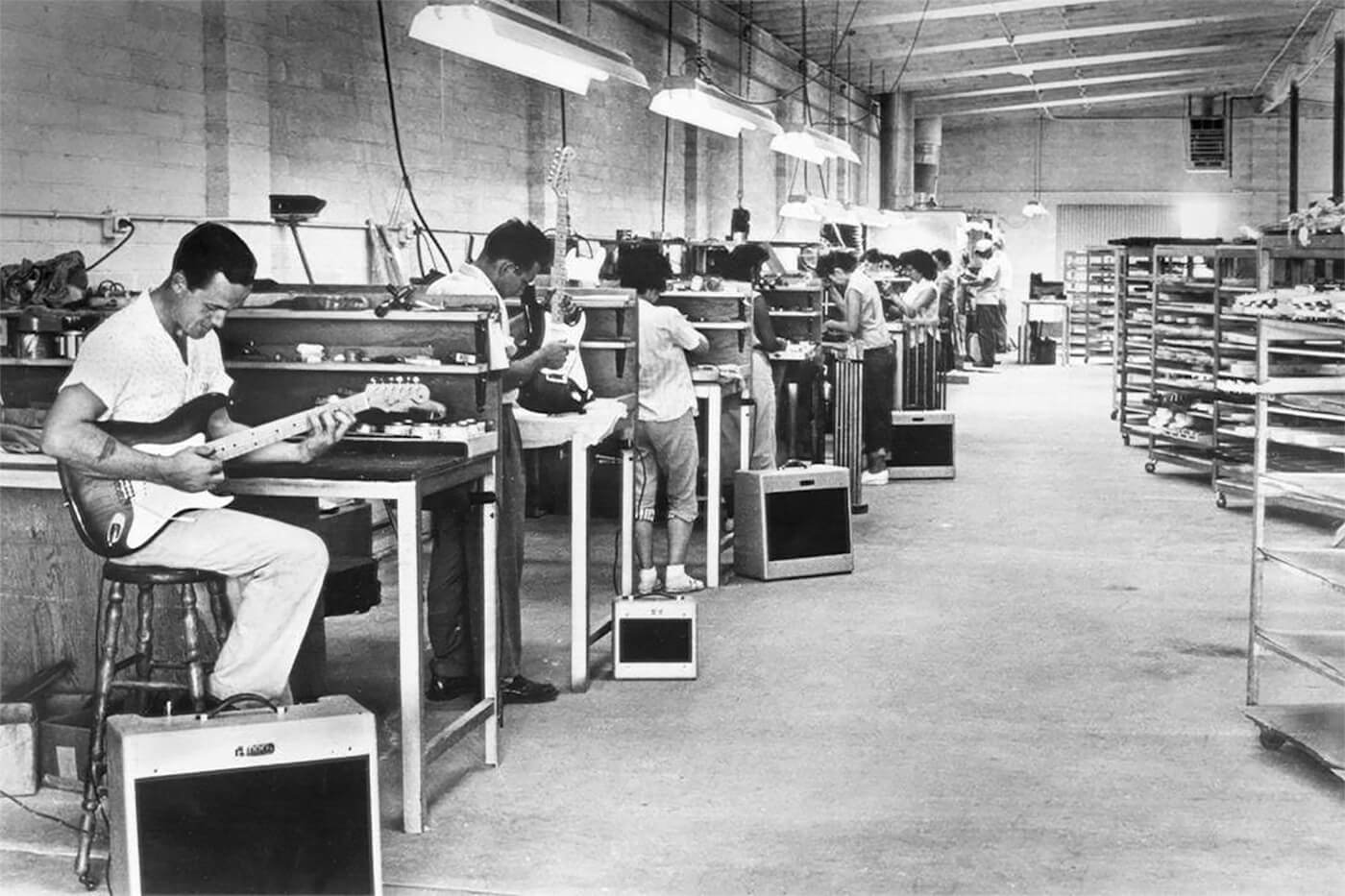
The photographs tell the story without commentary. Post-CBS Stratocasters are heavier — the light ash and alder bodies of the 1950s and '60s replaced by denser, heavier pieces of wood. The headstock grew larger, the logo bolder. Quality control became inconsistent. Necks varied. Finishes thickened into a plasticky polyester that sealed the wood hermetically, preventing it from breathing, aging, resonating the way vintage players had come to expect. Inside the plant, the assembly line moved faster. The individual care that characterized early Fender production — workers who knew the instruments, who played them, who understood what a neck should feel like — was systematically diluted.
Players noticed. The vintage market for pre-CBS Fenders began to form in the late 1960s and accelerated through the 1970s. Guitarists began paying premiums for instruments made before the sale, treating the year 1965 as a dividing line between sacred and profane. To this day, the phrase "pre-CBS" carries enormous weight among collectors, shorthand for a philosophy of craft that a corporate acquisition interrupted.
Sawdust and Relics: The Vintage Revival Begins
Walk through the Fender Custom Shop in Corona, California, and the smell hits you first — wood shavings, solvent, the faint sweet reek of lacquer. The light is bright and industrial, but the work happening beneath it is quiet and exacting. A craftsperson holds a guitar neck against a light source, sighting down the length of it, checking for the slightest deviation from straightness. Another is applying a sunburst finish with an airbrush, building the color up in transparent coats, watching the gradients bloom.
In 1985, a group of Fender employees — led by William Schultz — purchased the company back from CBS for twelve and a half million dollars. The corporation had been slowly strangling the brand, and the rescue came at the last moment. The new independent Fender moved production to Corona, established a Japanese manufacturing operation that produced excellent affordable instruments, and — crucially — opened the Custom Shop in 1987. This was a deliberate act of historical reclamation. The Custom Shop's mandate was to build guitars the way they had been built before: slowly, with attention, by individual craftspeople who took pride in each instrument.
The Custom Shop's most influential innovation was the Relic program. Master builder John Cruz began artificially aging guitars — replicating decades of wear with strategic sanding, careful application of chemical aging agents, simulated buckle rash on the backs, worn finishes on the necks. The results were controversial and revelatory. Critics called it dishonest. Players called it perfect — instruments that looked and felt broken-in, that had the resonance of aged wood and old lacquer, that did not require thirty years of touring to feel alive in your hands. In every photograph of a Relic Stratocaster, it looks like a survivor. Which is exactly the point.
The Custom Shop Master Builder at His Bench
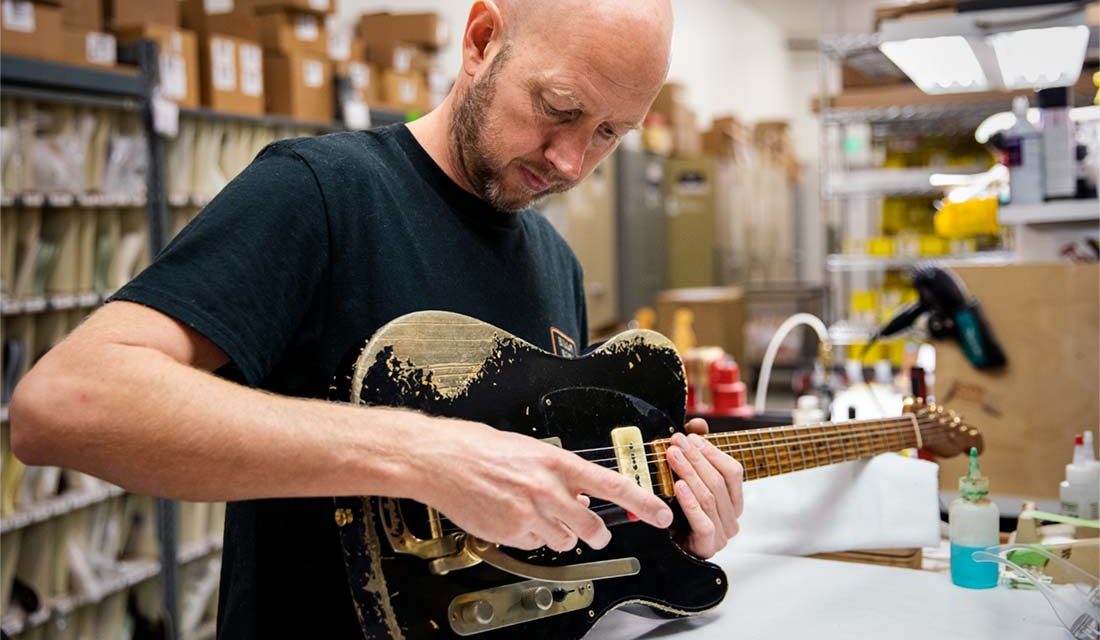
The hands in the photograph are the photograph. A craftsperson's hands — roughened, precise — fitting a neck pocket to a body, testing the join for gaps, for play, for the seamless mechanical intimacy that will determine whether this instrument feels like a tool or an extension of a human body. Behind them, guitars in various states of completion hang from racks, bodies without necks, necks without tuners, frames awaiting their electronics. The workshop is ordered in the way that genuine expertise orders things — everything in reach, nothing wasted, the arrangement of tools a language unto itself.
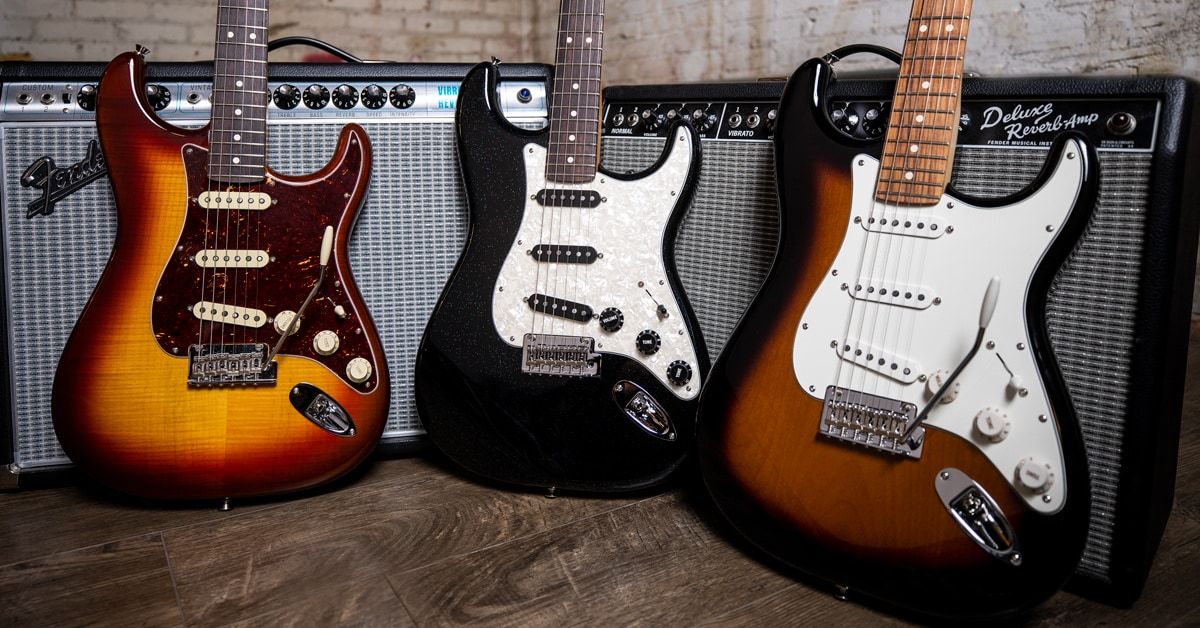
Modern Fender produces instruments across an extraordinary range of price and precision — from entry-level Squiers aimed at beginners to American Professional and Ultra series guitars sold in music stores worldwide, all the way to Custom Shop masterpieces that command prices in the tens of thousands of dollars. The lineage of each is traceable back to those original 1954 specifications. Three pickups. Tremolo bridge. Contoured body. Bolt-on maple neck. In seventy years of iteration, the fundamental architecture has changed remarkably little.
Master builders at the Custom Shop — names like John Cruz, Dale Wilson, Vincent Van Trigt — work with a depth of material knowledge that is almost antiquarian. They understand how specific cuts of alder affect resonance differently from ash. They know that the angle at which a neck is set changes the feel of the strings under the fingers. They select wood by tapping on it, listening to the acoustic response before amplification ever enters the picture. What Leo Fender began as an engineering solution to a manufacturing problem has become, in their hands, something closer to a tradition of craft.
Still Trembling: The Stratocaster at Seventy
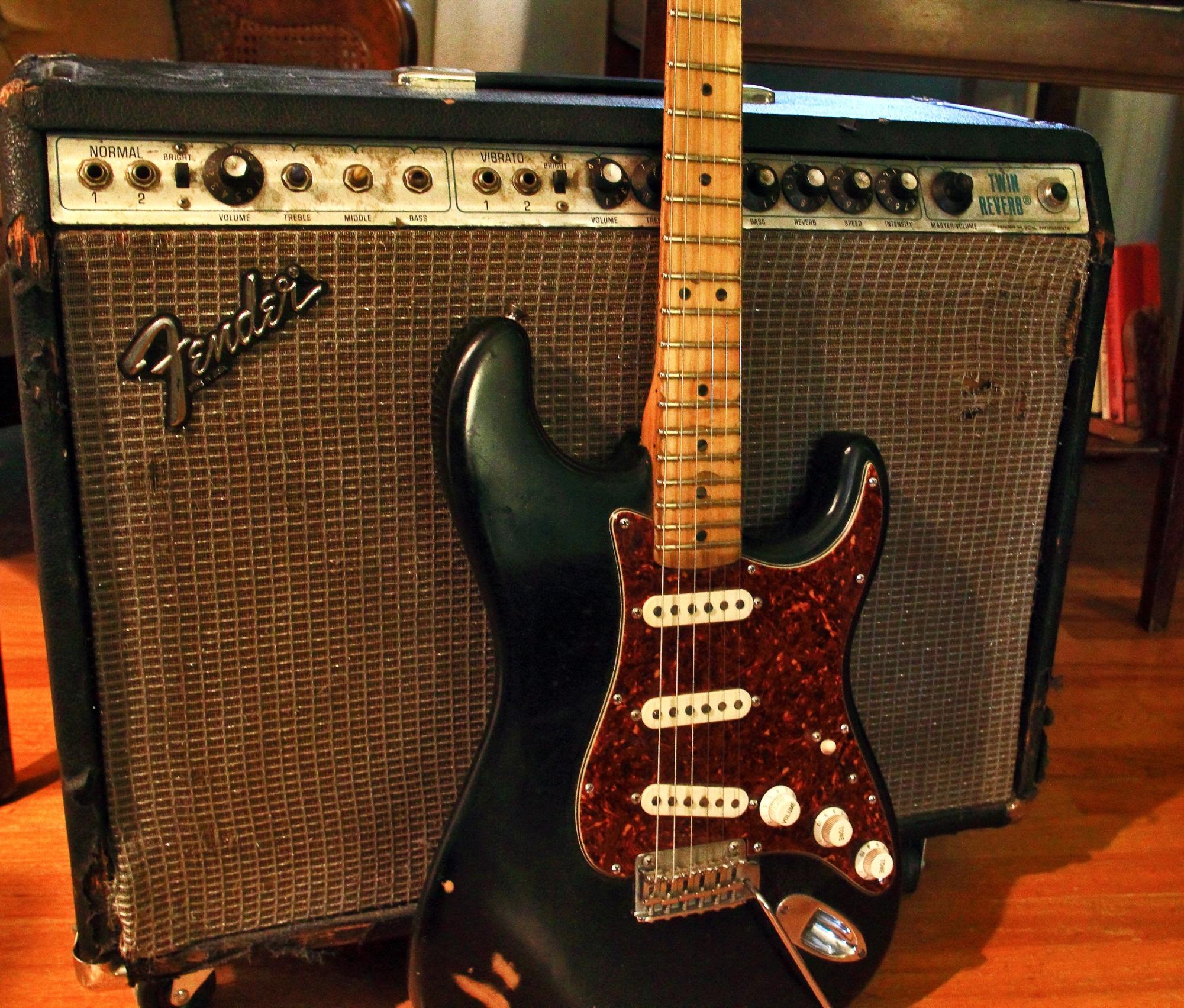
The final photograph in the gallery is taken under stage lights, 2024. The guitar is a Stratocaster. The player's hand moves to the tremolo arm, and the strings shimmer, and the sound that comes out of the amplifier is the same sound — not identical, but continuous with — every sound this instrument has made since 1954. There is something almost moving about this continuity. Electric guitars, unlike acoustic instruments, do not have a centuries-long pedigree. They are modern objects. And yet the Stratocaster has endured long enough to develop something like tradition.
Fender remains the most recognizable guitar brand in the world, and the Stratocaster remains its most iconic instrument. The company's headquarters are in Scottsdale, Arizona. Manufacturing happens in Corona, California, and Ensenada, Mexico. The Squier line — Fender's budget brand — puts Stratocasters in the hands of players who might spend a hundred and fifty dollars. The American Vintage II series reconstructs specific historical years with a fidelity that amounts to scholarship. The Custom Shop produces art objects. Everywhere across this range, the same three pickups, the same contoured body, the same tremolo arm that Jimi Hendrix bent toward the sky at Monterey Pop.
Leo Fender died in 1991, having lived to see his guitar become indispensable to popular music. He spent his final decades running another company — G&L Guitars, founded with his former colleagues — building instruments that, by many accounts, surpassed the Stratocaster in technical refinement. He never stopped improving on the idea. But the idea itself, the 1954 Stratocaster with its three pickups and its sculptured body and its floating bridge, had already escaped him. It belonged to the people who played it. It belonged to the photographs of all the stages and studios and bedrooms where someone picked it up and made it speak.
Stand before any Stratocaster and you are standing before one of the most successful industrial designs of the twentieth century — an object that solved a practical problem so elegantly that it became beautiful, that became expressive, that became the sound of something larger than any single inventor could have intended. The wood vibrates. The pickups listen. The amplifier speaks. And somewhere in that chain of transduction, something happens that cannot be entirely explained by physics.