Mercury Through BepiColombo Cameras
A Gray World Rising from the Black
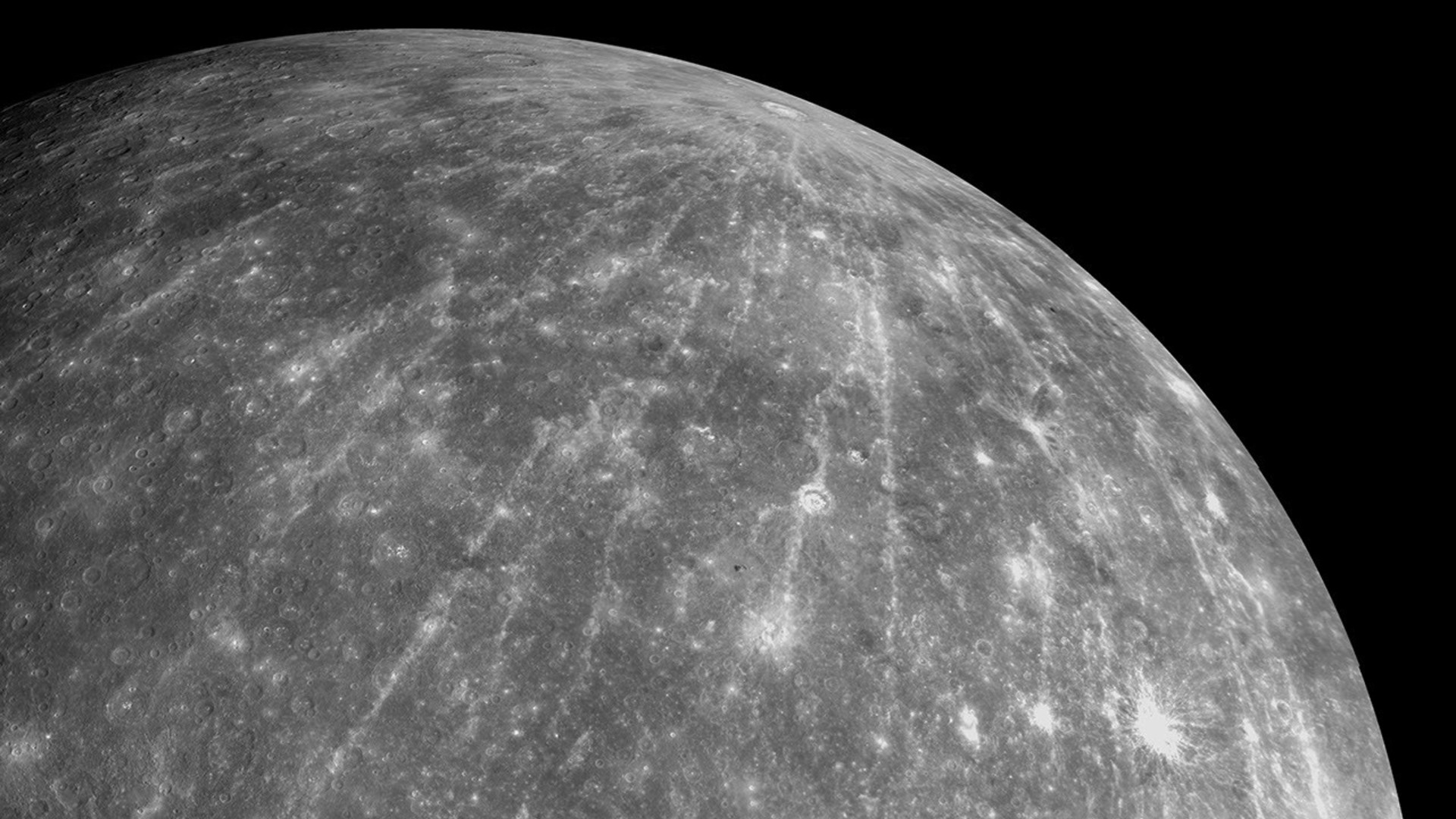
The first thing you notice is the silence of it. Not the silence of the image — there is no sound in any photograph — but a particular quality of stillness that emanates from the planet itself, as though Mercury has always existed in a state of perfect, ancient suspension. In the frames returned by the BepiColombo spacecraft during its successive flybys between 2021 and 2025, Mercury appears not as a world you are approaching but as a world that is waiting. It hangs against the absolute black of deep space like a worn coin dropped on velvet — gray, battered, older than comprehension.
The monitoring cameras aboard BepiColombo — small, unpretentious instruments called M-CAMs, mounted to catch engineering data and the occasional extraordinary view — were never designed to be the mission's primary visual storytellers. That role belongs to the suite of science instruments locked away and hibernating until orbital insertion. And yet the M-CAMs produced something the mission scientists did not fully anticipate: a series of images so raw, so unprocessed in their immediacy, that they feel less like data and more like dispatches. The planet fills the frame gradually, visit by visit, close pass by close pass, the way a face in a dark room slowly resolves into features as your eyes adjust.
Stand in front of these images long enough and you feel the geometry of the encounter. The spacecraft is moving at tens of kilometers per second. The planet is enormous. Space is not empty — it is a medium through which things hurtle, curve, and fall in precise gravitational choreography. The photograph freezes that choreography into a single breath.
The Limb Against the Dark
In the earliest frames from the first flyby — October 1, 2021 — Mercury presents its limb to the camera like a crescent moon but smoother, without atmosphere, without the pearlescent haze that Earth's air lends to distant horizons. Here the edge of the planet is a clean mathematical arc, a line drawn by nothing more than the physics of a sphere caught in sunlight. One half of that arc blazes in sharp white light. The other curves away into shadow so absolute it becomes indistinguishable from the vacuum around it.
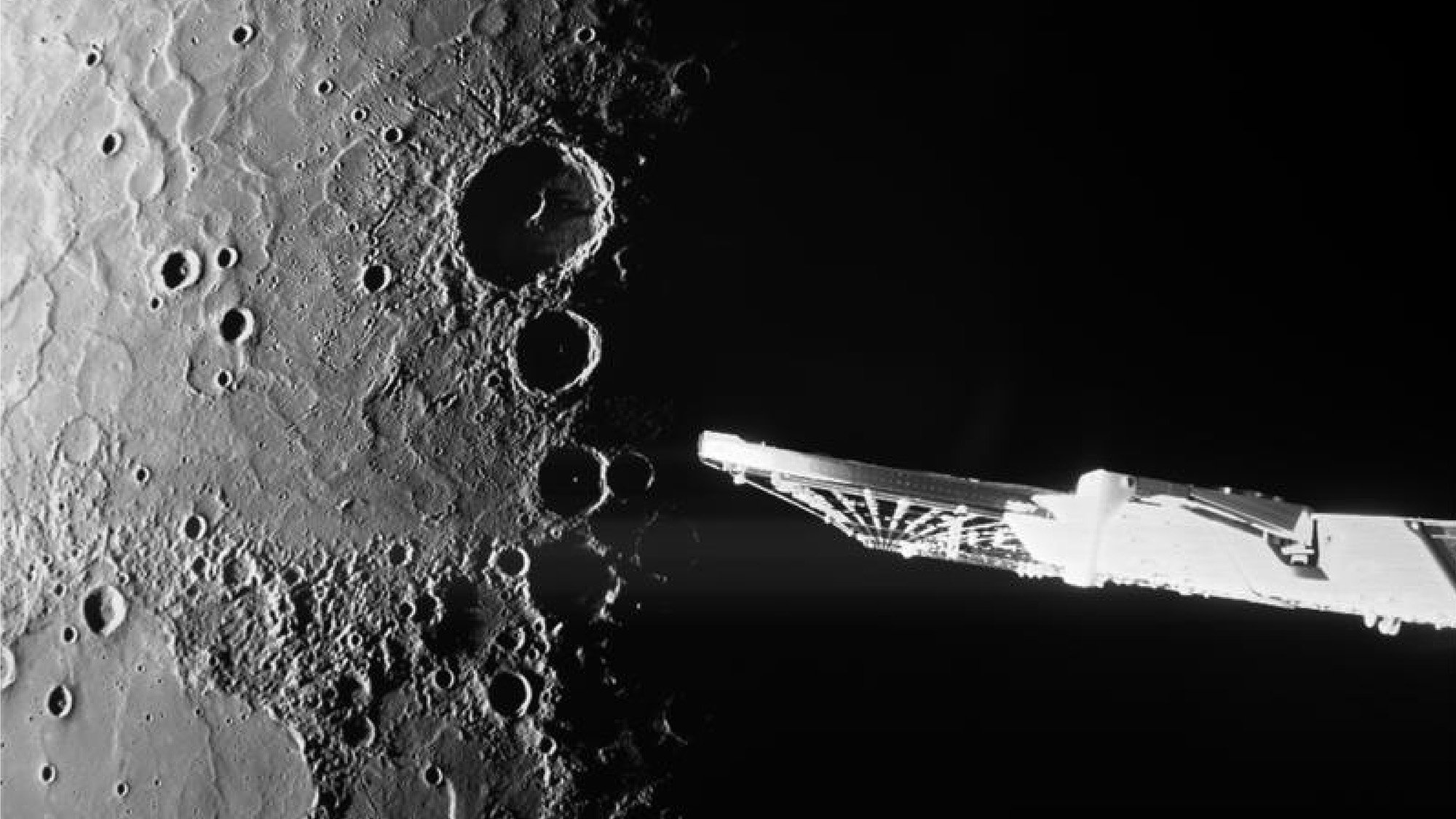
This is the thing that commands attention first: the terminator, that boundary between day and night on Mercury's surface, is not a soft gradient. There is no dusk here, no long twilight bleeding from orange to purple to blue. On a world with almost no atmosphere to scatter light, the terminator is a hard edge, a cliff in illumination, a place where boiling heat steps directly into cryogenic cold. In the BepiColombo images, you can trace this line across the surface and see the craters nearest to it stretched into long ellipses of shadow, the sunlight arriving at such a shallow angle that every small topographic feature casts a dramatic dark stripe across the gray plains.
The M-CAM captures this in black and white, and the absence of color is not a limitation — it is the truth of the place. Mercury has almost no color to speak of. What color exists is a story of chemistry and bombardment, and it requires spectral instruments to read. To the monitoring cameras, to the eye, to the first impression, Mercury is gray. Every shade of gray. Gray as graphite, gray as old concrete, gray as the ash of a fire that burned out a billion years ago.
The Solar Panels in the Foreground, Mercury Behind
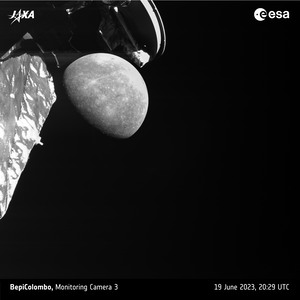
Some of the most unexpectedly moving images in the BepiColombo archive are not the clean planetary portraits. They are the shots where the spacecraft itself intrudes. BepiColombo is a layered, composite vehicle — the Mercury Transfer Module wrapped around the Mercury Planetary Orbiter and the Mercury Magnetospheric Orbiter — and its solar panels, vast latticed wings extending to gather sunlight at distances where sunlight is fierce and plentiful, occasionally sweep into the corners of the monitoring camera frames.
In these images, the spacecraft's golden-brown insulation and the geometric scaffolding of its solar arrays occupy the near foreground while Mercury fills the background, and the effect is startling. You are suddenly inside the encounter. The planet is no longer an object observed from a safe remove — you are aboard something mechanical, something human-built, and that thing is close enough to Mercury that the planet's limb spans more of the frame than the spacecraft does. The solar panels look fragile next to it. The solar panels look like something assembled on a Tuesday afternoon in a clean room in Europe, which they were, and Mercury looks like something assembled by collisions so catastrophic that the mind refuses to process them in human terms.
This juxtaposition — engineering against geology, the recent against the ancient, the intentional against the accidental — gives these incidental frames a weight that the cleaner images do not have. They remind you that the camera is not a disembodied eye. There is a machine here. There are people who built that machine. And the machine has traveled for years through interplanetary space to come to this exact point, this exact angle, to take this picture of a planet that does not know it is being photographed.
The Caloris Basin: A Wound That Never Healed
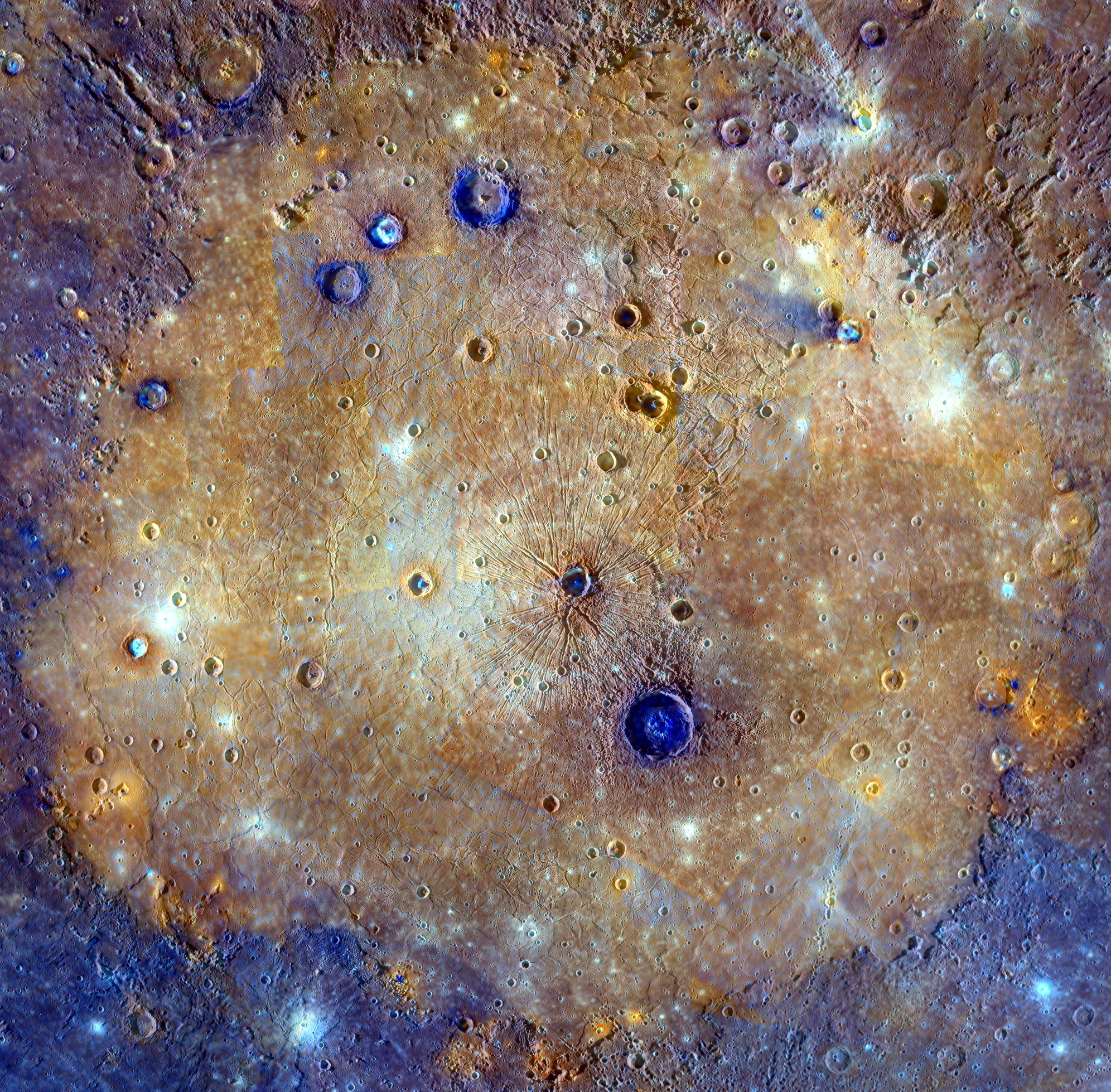
By the time BepiColombo made its later flybys, approaching closer and at different geometries, the cameras caught something that had previously existed mainly in the memory of NASA's Messenger spacecraft: the Caloris Basin, the largest impact structure on Mercury, a scar so vast it dwarfs most things on Earth that we would call large. The basin spans roughly 1,550 kilometers in diameter. It was carved approximately 3.9 billion years ago by an object that struck with enough energy to send shockwaves radiating through and around the entire planet, rippling the surface on the antipodal point — the exact opposite side of Mercury — into chaotic, jumbled terrain called, with scientific exactness, the "chaotic terrain."
In the BepiColombo images, Caloris does not announce itself the way Earth's Grand Canyon announces itself, with color and drama and visible depth. The basin is so wide, so flat relative to its diameter, that from orbit it reads more as a change in texture than a hole. The interior is floored with volcanic plains that were resurfaced by lava flows after the impact — flows that filled the original depression the way water fills a bowl, obliterating the deepest features, leaving behind a relatively smooth surface compared to the heavily cratered highlands that surround it. But the rim tells the story. The rim is a chaos of mountain ranges, rising several kilometers above the basin floor, sculpted by the rebound of rock that briefly became liquid, and then became solid again in shapes that still suggest motion, still suggest the shock of an event that no living thing witnessed because no living thing had yet evolved.
Look at the basin's interior closely, in the sharpened images processed by ESA's science teams. The surface is not smooth — it is fractured. Enormous polygonal cracks divide the plains into tiles, the result of the volcanic material cooling and contracting over millions of years. Mercury's surface is, in these regions, a mosaic. Enormous tiles separated by trenches. A planet-scale piece of broken pottery.
Crater Fields: The Arithmetic of Destruction
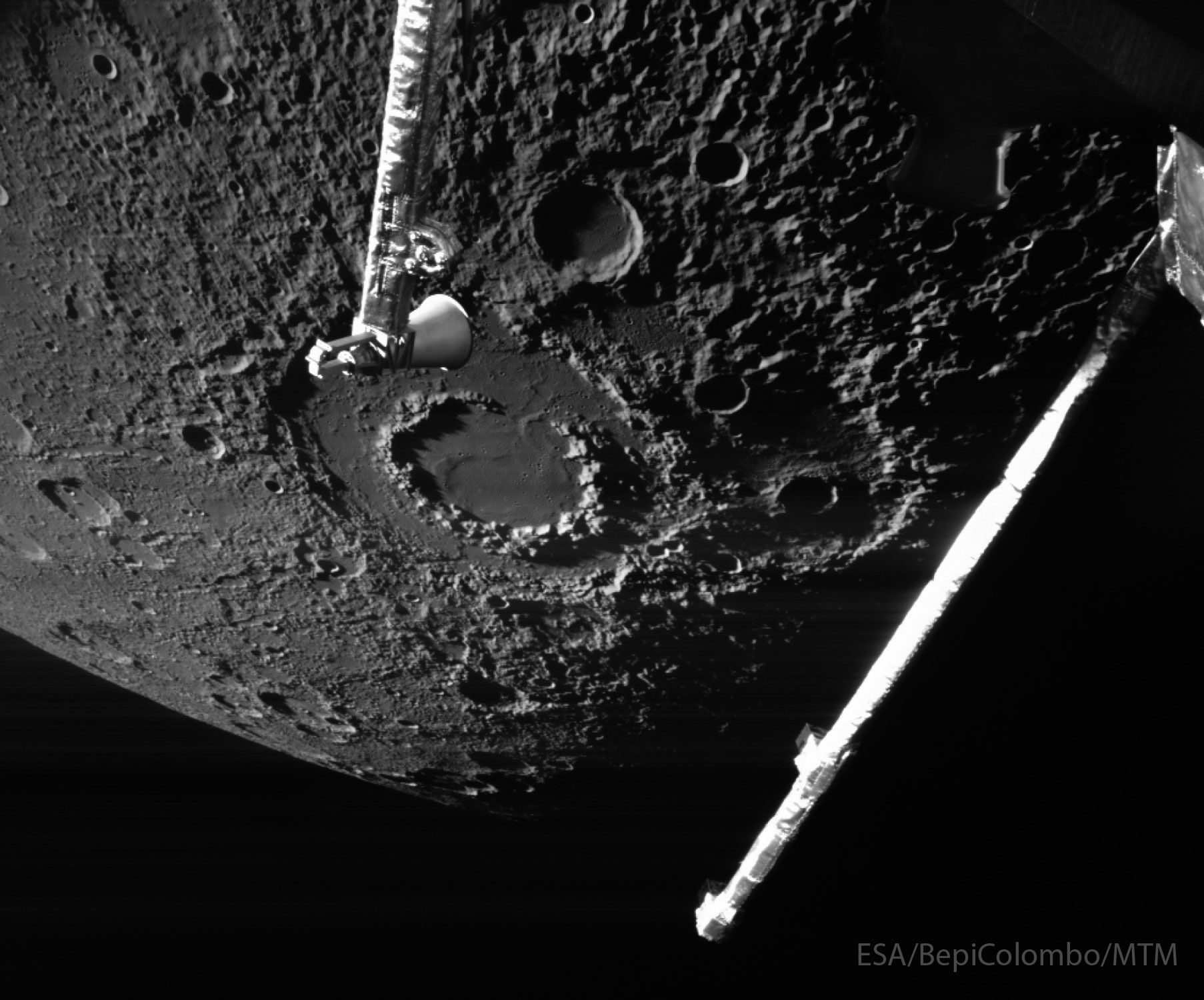
Pull back from Caloris and look at the broader surface, and you encounter a landscape whose primary language is the crater. Mercury has been bombarded for four billion years with relatively little geological activity to erase the evidence. No plate tectonics shuffles and subducts the ancient crust. No erosion by wind or water smooths the old rims into hills. What falls on Mercury stays on Mercury, recorded in stone, preserved in the cold silence of a world that has not significantly renewed itself since the Late Heavy Bombardment ended.
The BepiColombo images show crater fields of extraordinary density in the ancient highland regions. Craters sit inside craters. Smaller impacts have punched clean holes into the walls and floors of larger, older ones, producing a palimpsest of destruction — a record of every significant strike laid one atop another, the older events partially legible beneath the newer ones. To read this landscape is to read time backwards, the most recent events clearest, the oldest events preserved only in the ghost outlines of what they once were, softened and partially obliterated by everything that came after.
There is a particular type of crater that appears in these images with startling beauty: the rayed crater, whose impact ejected bright material in long, pale streaks across the darker surrounding surface. On Earth, such rays would be eroded within thousands of years. On Mercury, in the right regions, they persist for billions of years, glowing in the images like burst stars or like cracks in a dark floor filled with light. The most prominent of Mercury's rayed craters — Hokusai, named for the Japanese woodblock artist — produces rays that extend across a substantial fraction of the planet's surface, pale lines visible from space, a spray pattern frozen at the moment of impact and unchanged since.
The Terminator at Dusk: Shadow Architecture
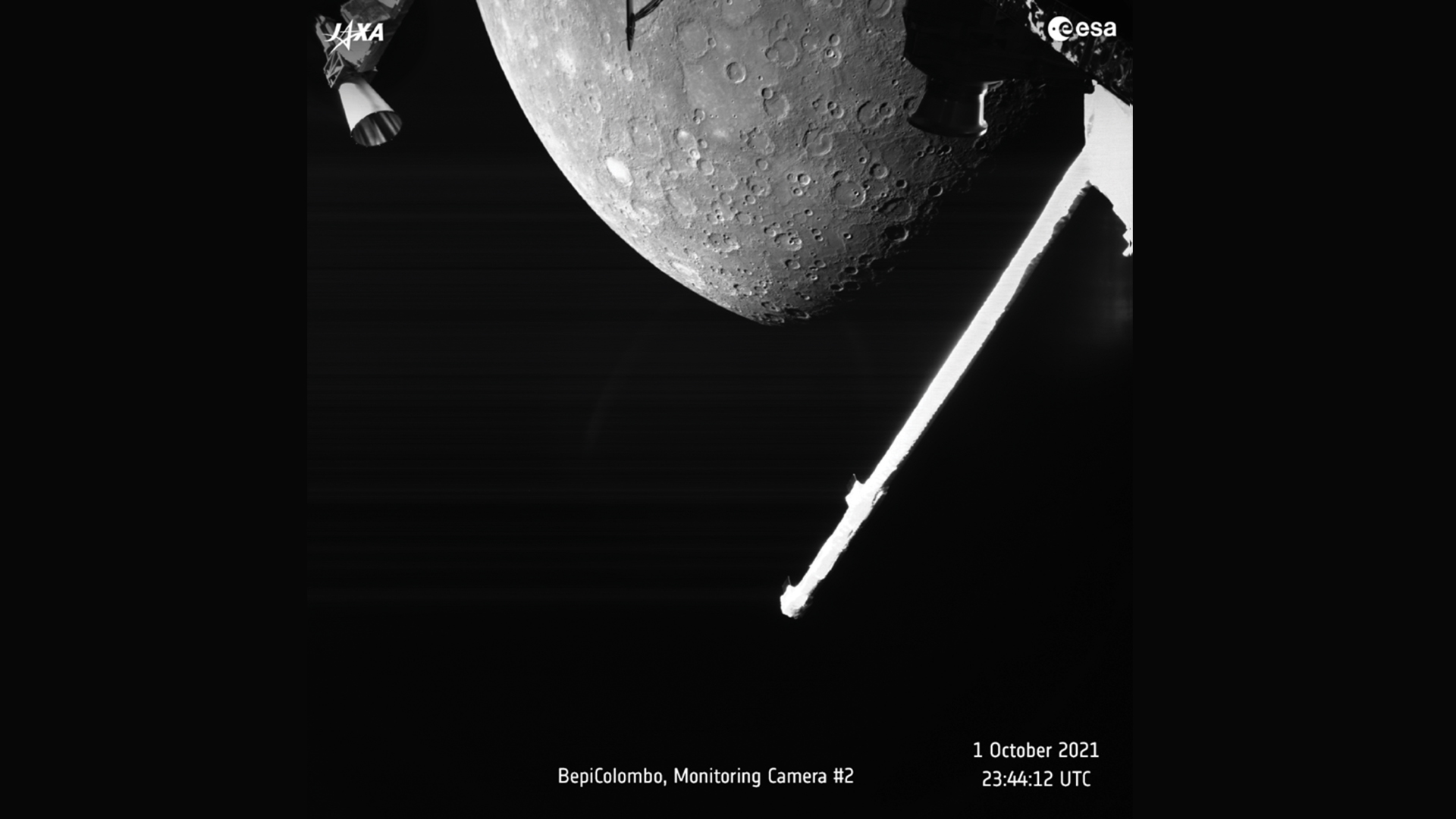
Return to the terminator and stay there. This is where the landscape reveals its most dramatic three-dimensional character, the low angle of the sun throwing every small feature into relief. In the BepiColombo images taken near the boundary between light and dark, the geology reads differently than it does in the fully illuminated regions. Here, craters that would be faint circles in high-noon lighting become ringed stadiums of shadow. Every wrinkle ridge — the long, sinuous compressional features that formed as Mercury cooled and shrank — becomes a dark line, a brushstroke across the plains.
Mercury has shrunk. This is one of the things scientists have confirmed, and the BepiColombo flybys contribute new data to the picture. As the planet's iron core cooled over billions of years, it contracted, and the surface above it buckled in compression, producing the wrinkle ridges and the lobate scarps — giant fault cliffs that can extend for hundreds of kilometers. The planet's radius has decreased by perhaps five to seven kilometers over its history. What looks from a distance like a simple gray sphere is, in the terminator lighting, revealed to be a deeply wrinkled, compressed, ancient skin stretched over a shrinking interior.
The shadows here are not merely dark — they are informative. Scientists use terminator-zone images specifically because the exaggerated shadow relief reveals topographic detail that would be invisible under direct illumination. To look at these BepiColombo frames from near the terminator is to look at a landscape that is, in a very real sense, visible only because of the angle. Move the sun twenty degrees and these features vanish back into the gray. The image is, in this way, a collaboration between the spacecraft, the camera, and the precise geometry of Mercury's position relative to the sun at the moment of capture.
The Night Side: Darkness as Subject
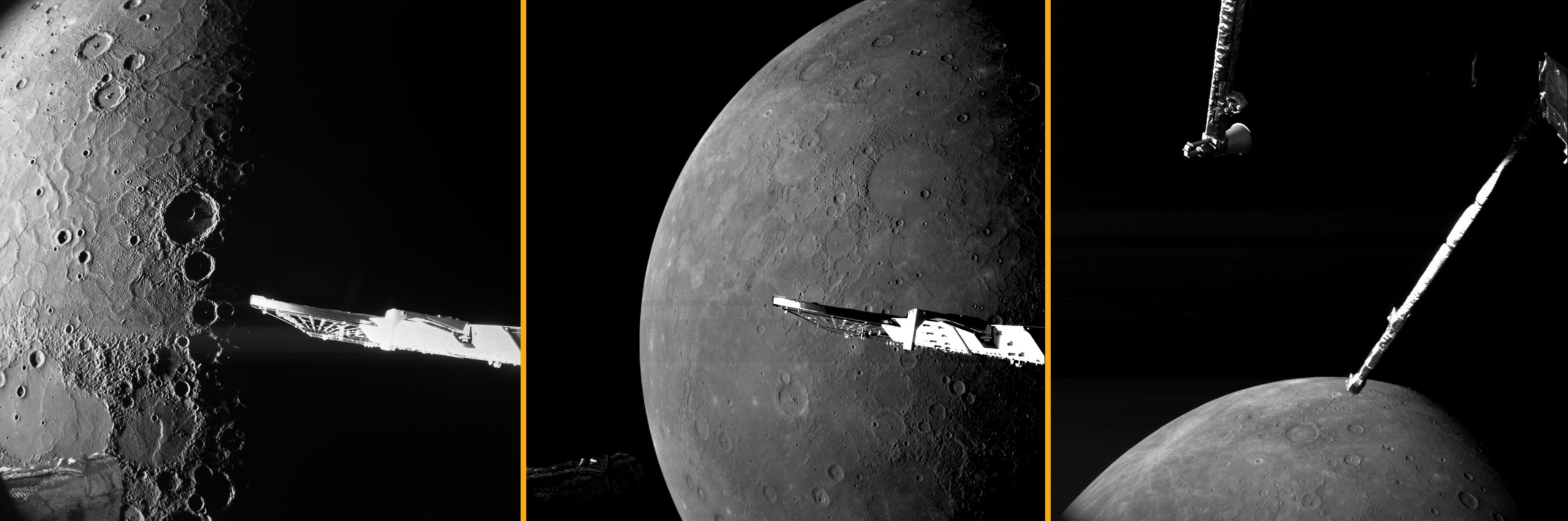
Not everything BepiColombo's cameras captured was illuminated. In several of the flyby sequences, as the spacecraft swung around the planet and the geometry shifted, portions of the night side came into view — not as landscape but as absence, as the thing that ends the lit surface and begins the void. The transition from the last visible crater rim to the unlit darkness is abrupt, and in the wider frames it produces an image that is more compositional than scientific: the planet as a crescent, the crescent as a gesture, the rest of the sphere implied but invisible.
This is Mercury's night side, where temperatures plunge to approximately -180 degrees Celsius. The same surface that bakes at over 400 degrees under direct sunlight drops to temperatures cold enough to freeze most gases, because there is essentially no atmosphere to retain the day's heat. The night side in BepiColombo's images is not a landscape — it is a fact about physics, rendered in pure black. It exists in the frame as a reminder that the illuminated surface, dramatic as it is, is only half the story.
There is something philosophically disquieting about these images of the dark hemisphere. The craters and basins and scarps are all there, in the darkness, exactly as they are on the lit side, equally ancient, equally preserved. But the camera cannot see them. They exist without being visible. Mercury keeps its own secrets, and the secrets are not hidden — they are simply unlit, waiting on the other side of the terminator for the sun to swing back around.
The Planet's Edge: Where Gravity Curves Space
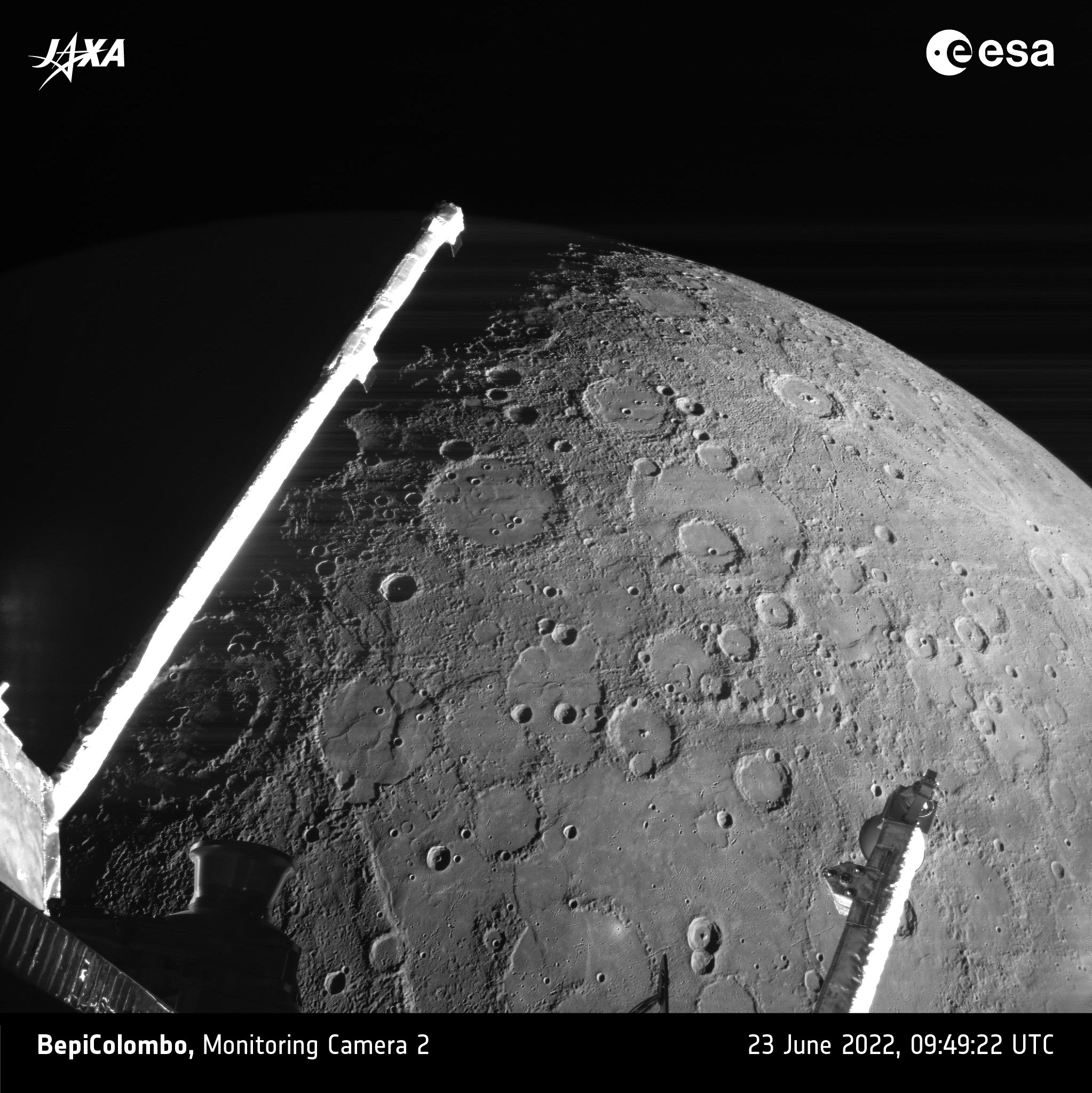
Look at Mercury's limb in the cleanest of the M-CAM images — really look at it, trace its edge against the black — and notice what is not there. No thin blue line, no atmospheric glow, no corona of diffuse light. Earth seen from space wears its atmosphere like a luminous halo visible even at a glance. Mercury's limb is simply the planet, then nothing. There is an exosphere — a sparse collection of atoms sputtered off the surface by solar wind and micrometeorite impacts — but it is far too thin to scatter visible light in any quantity the camera can detect.
This bareness, this nakedness of surface against space, gives Mercury's limb a particular kind of precision. The curvature of the planet is a clean fact, a geometric statement. In one of the most striking of the close-approach frames from the 2024 flyby, the limb curves across the upper portion of the image while craters and plains extend almost to the camera before the surface curves away. The foreshortening of the terrain near the limb — craters becoming ellipses, ridges becoming lines — creates a perspective that the mind reads as three-dimensional, as physical, as real, in a way that a more distant portrait of the whole planet does not.
Here, the planet has scale. It is not a disk. It is a sphere, and you are very close to it, and it is very large, and the spacecraft is very fast, and none of this will last. The encounter lasts minutes. The flyby is a geometry problem solved at 40,000 kilometers per hour, and the cameras fire as fast as their design allows, and then Mercury falls away behind the spacecraft as the gravity assist does its work, the planet's mass adding a fractional curve to the trajectory, sending BepiColombo onward, toward the final orbital insertion, toward the science that will begin when the hibernating instruments wake for good.
The Last Frame Before Departure
In the sequence of images from each flyby, there is always a last frame. The planet fills less of the field of view than it did a few minutes earlier. The craters that were individual features, nameable and mappable, have contracted back into texture. The terminator that revealed the topography so dramatically is now a thin arc. The Caloris Basin, if it was visible, has shrunk back into the planet's gray face, indistinguishable again from the surrounding terrain unless you know exactly where to look.
This is what departure looks like: not dramatic, not sudden, but gradual. The planet gets smaller. The black around it gets relatively larger. Mercury, which for a few minutes was the most immediate and overwhelming fact of the spacecraft's existence — a world at close quarters, a surface with features, a sphere with dimension — becomes again an object in a frame, a disk, and then a point of reflected light moving against the stars.
But the images remain. They accumulate in archives and are processed by scientists and shared with the public, and in those images Mercury is always close, always large, always in the moment of encounter. The photographs are a permanent flyby, an eternal approach. Every time you open the file and look at the gray surface and the sharp terminator and the rayed craters and the ancient basins, you are arriving. The spacecraft is always forty-seven minutes from closest approach, or thirty, or twelve, or one. The camera is always about to fire.
And Mercury is always rising from the black, gray and battered and patient, a world that has been waiting since before the sun had planets, waiting with exactly the kind of stillness that the photographs always manage, against all the odds of physics and distance and motion, to preserve.