Introduction
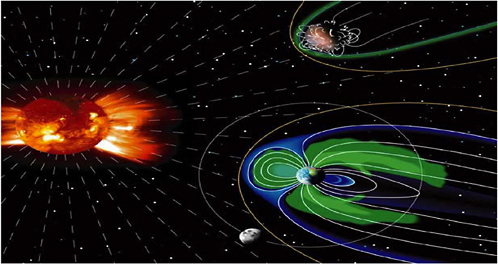
The application of physics to deep space travel is a field rife with challenges, paradoxes, and open questions that have puzzled scientists for decades. As humanity continues its quest to explore beyond our solar system, the limitations imposed by known physical laws become increasingly apparent. This article explores some of the most pressing paradoxes in physics as they relate to deep space exploration, highlighting recent breakthroughs, ongoing controversies, and key figures shaping this critical area of research.
The relevance of understanding these paradoxes cannot be overstated. Space physics is a dynamic field where theoretical frameworks are constantly being tested against real-world observations, particularly in the context of deep space travel. The ability to navigate through interstellar medium, understand gravitational effects at extreme distances, and harness energy efficiently for propulsion systems all hinge on resolving these paradoxes.
Foundational Concepts
At its core, the study of physics as it applies to deep space travel involves several fundamental concepts that are crucial for comprehending the challenges ahead. These include:
- Relativistic Effects: The closer spacecraft get to the speed of light, the more pronounced relativistic effects become. Time dilation and length contraction pose significant challenges for navigation and communication [2].
- Gravitational Mechanics: Understanding gravitational forces across vast distances is critical for trajectory planning and long-duration missions. Concepts such as black holes, wormholes, and dark matter complicate these calculations.
- Quantum Physics: At microscopic scales, quantum effects may influence spacecraft components or even the behavior of cosmic particles encountered in space [1].
Historical Context
Historically, deep space exploration has been marked by significant milestones and theoretical advancements that have shaped our understanding of physics paradoxes:
- Sputnik Era (Late 1950s - Early 1960s): The first satellites introduced the need to understand low Earth orbit dynamics, which laid foundational principles for later deep space missions.
- Apollo Missions (Late 1960s - Early 1970s): These missions provided valuable data on lunar gravity and solar radiation, highlighting the importance of shielding and trajectory calculations [2].
- Voyager Program (1970s - Present): Voyager spacecraft have traversed interstellar space, offering insights into particle dynamics in the heliosphere and beyond.
Key Figures & Contributions
Several key figures and institutions are at the forefront of addressing paradoxes in physics for deep space travel:
- Joseph E. Borovsky (Space Science Institute): Borovsky's work has been pivotal in exploring the unsolved problems in space physics, emphasizing the need to integrate new observational data with theoretical frameworks [2].
- NASA's Jet Propulsion Laboratory (JPL): JPL continues to develop advanced propulsion systems and navigation techniques that push the boundaries of current physical understanding.
Current State & Recent Developments
Recent years have seen significant progress in addressing some of these paradoxes, though many remain unresolved:
- Breakthroughs in Relativistic Navigation: Advances in GPS technology and improved models for relativistic effects are enhancing our ability to navigate spacecraft accurately [2].
- Quantum Computing Applications: Quantum computing offers new ways to simulate complex physical systems and could provide solutions to previously unsolvable problems in deep space travel.
Mechanisms & How It Works
Understanding the mechanisms involved is crucial:
- Relativistic Navigation Systems:
- Gravitational Assist Maneuvers:
- Quantum Shielding Hypotheses:
Real-World Applications & Case Studies
Case studies illustrate the practical implications of these paradoxes:
- Voyager 2: Encountered unexpected particle dynamics in interstellar space, prompting revisions to theories about solar wind interactions with outer planets.
- Mars Rover Missions: Relied on precise gravitational calculations and navigation systems to land safely on Martian terrain, showcasing the importance of accurate physical models [2].
Controversies & Open Questions
Ongoing debates within the scientific community include:
- Dark Matter and Dark Energy:
- Faster-Than-Light Propulsion:
Future Trajectory
Looking ahead, the future of deep space travel hinges on resolving these paradoxes and developing new technologies:
- Advanced Shielding Materials: Continued research into materials that can protect against cosmic radiation.
- Quantum Navigation Systems: The potential for quantum computing to revolutionize navigation algorithms.
Key Takeaways
- Relativistic effects pose significant challenges in deep space travel.
- Gravitational mechanics are crucial for accurate trajectory planning.
- Quantum physics may offer new solutions to shielding and propulsion issues.
- Recent breakthroughs in relativistic navigation have improved spacecraft accuracy.
- Continued research is essential for resolving paradoxes in deep space exploration.
By addressing these paradoxes, humanity can take significant strides towards realizing the dream of interstellar travel.